clean this page up its turned into a dumping ground.
this is ready to be pinpointed:
Former Australian Felix Hotel 168-174 Bourke Street,, MELBOURNE VIC 3000
-add it to the a to z
and here’s a story:
‘ An extraordinary prodigy, under the title of ‘ the Fat Girl,’ has been exhibited during the past week, a few doors above the Australia Felix Hotel, in Bourke street east . She weighs twelve stone eleven pounds, is about three feet high, and measures rather more than three feet round the waist. Her name is Mary Jane Youngman, and she is fourteen years of age.’ She was born and reared on the Lachlan, in New South Wales. Her case seems to be, in some measure, one of arrested development. It would appear that whilst very young she received an injury on the right side of her spine, and that since that time she has not materially increased in longitudinal dimensions ; she has not shed her first teeth, nor has her mind or brain developed the usual extent of a girl — in these climates almost a young woman — of fourteen years of age. In all these points she is still an infant. But the inferior develop-ment of physical life, the deposition of substance in the cellular tissue of her body, has gone on the same as if she had attained the full longitudinal proportions, and the higher cerebral and nervous development. Hence her unusual weight. She has been visited by a considerable number of per-sons, who have examined her extraordinary pro-portions with astonishment.
SOURCE: THE NEWS OF THE DAY. (1862, June 16). The Age (Melbourne, Vic. : 1854 – 1954), p. 5. Retrieved December 9, 2024, from http://nla.gov.au/nla.news-article155008096
great image from 1900s / John Hood Chemists Eliz st
https://abcrauctions.com.au/past-auctions/2281/abcr-auction-21/890/hood-melbourne-chemist-medicine-glass-dose-cup/
and 30s
https://abcrauctions.com/past-auctions/3784/abcr-auction-58/332/5-amber-glass-bottles-with-chemist-labels-3-x-hood-co-elizabeth-st-melbourne-and-2-x-j-w-mowat-bay-st-port-melbourne-victoria/
and
https://collections.mdhs.unimelb.edu.au/objects/33254/glass-bottle
https://collections.mdhs.unimelb.edu.au/persons/3841/hood-and-co-chemists-melbourne
1858
address: Glasgow Boarding House, No. 135 Little Collins street.
amazing little account of girl who was never paid wages who stole at boarding house and given hard labour.
LARCENY BY A SERVANT.
see: MELBOURNE CRIMINAL SESSIONS. (1858, May 19). The Age (Melbourne, Vic. : 1854 – 1954), p. 5. Retrieved November 29, 2024, from http://nla.gov.au/nla.news-article154856734
1858 from ads in age
171 Gt. Bourke-street, facing the market. (Eves Baths)
MR. BURTON, Solicitor No. 54 Elizabeth street, corner of Great Collins street
245 Elizabeth street, (next the church, corner of Latrobe and Elizabeth streets). BRISCOE and CO.
Victoria Boot Manufactory, 53 Bourke St in the immediate locality of the horse bazaars.
see: Advertising (1858, May 21). The Age (Melbourne, Vic. : 1854 – 1954), p. 1. Retrieved November 26, 2024, from http://nla.gov.au/nla.news-article154857570
1858
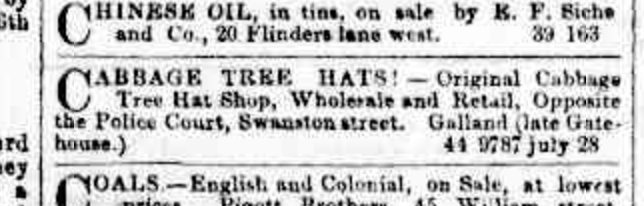
cabbage tree hat shop! opposite the police court on swanston st!
source (1858, May 19). The Age (Melbourne, Vic. : 1854 – 1954), p. 8. Retrieved November 29, 2024, from http://nla.gov.au/nla.news-page18217039
James Dobson, 111 Bourke street, Melbourne, is now executing orders for Ladies’ Riding Habits, ….ad for replicas after Victoria Princess Royal.
see: Advertising (1858, May 21). The Age (Melbourne, Vic. : 1854 – 1954), p. 2. Retrieved November 26, 2024, from http://nla.gov.au/nla.news-article154857569
last column
CORNER OF LONSDALE AND ELIZABETH STREETS> 1858
anecdote of prisoner escaping from prison van from Police Court to Western Gaol. smug reference to Captain McMahon’s roofing.
see here: THE NEWS OF THE DAY. (1858, May 22). The Age (Melbourne, Vic. : 1854 – 1954), p. 4. –last column. (Yesterday, while a lunatic was being conveyed…) http://nla.gov.au/nla.news-article154857762
SOURCE Melbourne’s Bluestone Story 2021-07-18 by Fiona Anderson https://www.weekendnotes.com
/melbourne-bluestone-story/#:~:text=As%20it
%20is%20an%20
igneous,other%20more%20bland%2C%20greyish%20basalts
https://en.wikipedia.org/wiki/Coffee_palace
SOURCE: EARLY MELBOURNE. BY OLD CHUM Truth (Perth, WA : 1903 – 1931), Saturday 20 September 1913, page 2 ‘ No. 203. [ALL BIGHTS RESERVED] https://trove.nla.gov.au/newspaper/article/207421743#
The shop of Mr. Edward Arnold was at 56 Elizabeth-street, one door from the nor-east corner of Collins-street. The house was built about the year 1845, and was demolished in December, 1910. I made a special trip to Melbourne to have “a look at the old’ premises, hearing they were about to be demolished, but arrived in time to see the last old brick carted off the ground. At the first land sale, conducted by Robert Hoddle, June 1, 1837, one James Ross purchased the half-acre for £32—not 5s. a foot on the Collins-street frontage. It would take, probably, £1,000 a foot to buy it to-day. Mr. Ross was a carpenter from Van Diemen’s Land, and understood to be in the employ of John Batman; at a rate, he followed the fortunes of John Batman, and not those of John Pascoe Fawkner. In 1888 the value of the half-acre was estimated at a few pounds short of half a million sterling! In a very short time Mr. Ross, at the solicitation of persons who wished to build places of business, cut up and sold in allotments the half-acre, the price averaging about £2 per foot. In this connection a Melbourne newspaper of three years ago may be quoted ;— “It is 75 years ago since John Batman landed on the banks of the Yarra, and, viewing the site on which Melbourne stands, entered in his diary the historic prediction. ‘This will be the place for a village.’ In Batman’s party was a carpenter named Ross, who was accompanied by his wife and child, a boy about two years of age. Ross died some years ago, but his son, James, still lives, and as far as the latter knows, he is the only surviving link between the present generation and Batman’s little pioneering party. He has found refuse in his old age in the Convent of the Little Sisters of the Poor at Northcote. Fragile and somewhat below the average height, his 77 years seem to weigh more heavily on him than on most men of that age. He is however, intellectually alert, and still | retains recollections of his childhood. He ( can distinctly , recall to “mind the impression of Batman, who, unable to walk, was being driven about the little settlement in a conveyance. At that time Mr. Ross’s father owned the land at the corner of Elizabeth-street and Collins-street, the point where the Block now terminates; but the property, which is now worth many thousands cf pounds, passed out of the hands of the Ross family before they could derive much benefit from it. While his father, who also owned a small vessel, was trading to and from Westernport Bay, trouble with the natives occurred, and Mr. Ross, who was then about seven years of age, has a lively recollection of the hanging, in Melbourne of two of the blacks for murder. There was only one school in Melbourne then, and the master was one day overpowered by the boys, because he refused to allow them to go to the races. At a very tender age Mr. Ross was obliged to work, but it was not until the famous gold rush took place, when he was 18 years of age, that he found employment very remunerative. Prior to 1853 a load of wood brought 3s. 6d. bat after the gold rush much as £6 a load was realised.
While meetings were being held on August 20 by the Early Pioneers’ Association in commemoration of the departure of Burke and Wills on the fatal expedition across the continent, James Ross, above mentioned, passed away. He was born in Van Dieman’s Land in 1833 and with his parents arrived in 1836. His mother was the first woman buried in the little cemetery on Flagstaff Hill. The remains of Mr. Ross were interred in the Spring Yale Cemetery on August 22. Some of the earliest pioneers were present at the graveside. I entered the employment of Mr. Arnold towards the end of 1858. He was an artist by profession, a good draftsman, but as “professional” men went at a discount in the first fifties he became a bookseller and stationer. His, wife was a daughter of Mr. William Perry, the nursery man at Heidelberg, her brother being a partner in the firm of Symons and Perry, auctioneers. In the early years of his trade, Arnold did well and built himself a country house. “Cloverdale,” Toorak. Thus, when the gold fever had died out, he sold to Mr. John William Bogg, of J. H. Clough and Co., wool brokers. Mr. Arnold’s immediate neighbors in 1854 were Michael Cashmore, on the corner where, Alston now is. He was a draper, but in after years, became a butcher, and controlled the supply of meat to the Jewish community, of which he was a prominent and most esteemed member. Cashmore was. succeeded by Mr. George Horne.
South of Arnold were Watt and Co., furniture warehousemen, and next them Gibbs, Rowley, and Company, auctioneers, and then Thomas Gregory, in boots and shoes.
Round the comer in Collins-street. Edward J. Poulton, also in boots and shoes; and next him George Lewis, chemist and druggist. On the southeast comer of Collins and Elizabeth streets was the Clarence Hotel, kept by Waldron Johnston, but in after years by Mr. Phair, a gentleman with a wooden leg and a very pretty wife. John Whiteman the harmonious blacksmith’s, who published a volume c verse, “Sparks from the Anvil,” and was historic as the husband of Madame Midas, nee Cornwell, kept the hotel at one time. Whiteman added Legislative duties to his other occupations, and represented Emerald Hill in the Assembly for some time.
On the south-west comer of the intersection were Sayce and Cheetham, Staffordshire warehousemen. Towards the end of the decade, the corner was occupied by the Colonial Insurance Company, W. Grem being managing director.
Let me here introduce Mr. Michael O’Grady. He was a Rcecommon man, born in 1821. He went to London as a boy to push his fortunes. When Gavan Duffy had determined upon emigrating, the Irish in London invited him to a dinner. The committee was one representing all the Irish districts in London. “This friendly demonstration,” says Sir Charles in “My Life in Two Hemispheres,’” “introduced me to a man destined to become a lifelong friend, Michael O’Grady, the manager of an insurance office, and a man of great practicable ability. He accompanied me at a later period to Australia, when he became my constant ally in difficulties and my colleague in office, and his sympathy and services only ended with his life.” In 1855 Mr. O’Grady was sent to Sydney to establish a branch of the “People’s Provident Society.” The next year he removed to Melbourne, and established himself in the insurance business. He was the Australia general manager of the European Assurance Society, and not very prosperous one at any time. In 1861 he entered the Legislative Assembly as member for Villiers and Heyesbury. I believe his directors at home objected to his entrance into public life, as being likely to interfere with their business, and O’Grady severed his connection with the European. Then John O’Shanassy and others of the party to which Mr. O’Grady belonged, founded the Australian Alliance Assurance Company, with Michael O’Grady as managing director, his office being on the south-west corner of Collins and Elizabeth streets, where had been the Colonial Insurance Company. Mr. O’Grady held portfolios (Works, – etc.) in the Siadcu and Duft’y Governments, and died in 1875.
In 1854 the north-west corner was occupied by Henry Hart, a clothier, who was succeeded towards the end of the decade by Zanders and Co. This corner, the half acre, was purchased at the first land sale-same day that James Koss made his purchase for £42, and in 1888 the valuators placed the same value on it that they did on Ross’s corner. I do not know who this Thomas Brown was: I have an idea that he was a man of color. because in the fifties and up to the time of his death the corner belonged to John Milton Dascombe, who had kept the Woolpack Inn, on the corner of Flinders Lane and Queen-street, and Mr. Dascombe married a widow named Browne, whose first husband was a man of color. I know Dascombe’s step-children, a boy and girl, had a good deal of colored blood in them. They went to England with Dascombe about 1853. In 1859 Mrs. Dascombe and her children left London for Melbourne. The mother died on the way out, and was buried at sea. The girl went back to England to her step-father; the boy was apprenticed to Fulton, the ironfounder, became an engineer, and was chief engineer of the s.s. Macedon when he died. Mr. Dascombe is not long dead. A few years before that event he revisited Melbourne in , connection with his property. That transacted, he returned home again. He made a fortune in the Woolpack, and used his money well.
At this time the number of booksellers in Melbourne was limited. The chief in the business was George Robertson, though he was not the oldest an the trade. He had his store near the Mechanics’ Institute, just opposite the ‘Argus’ office. His chief salesman was Mr. William Maddock, who, in the first sixties, was sent to Sydney to open a branch, which he subsequently took over on his own account. Some years ago he gave up business to take the management of the circulating library at Mr. William Dymock’s, and from which position he has but recently retired on the score of old age. Mr. Maddock claims to be the oldest bookseller, in Australia. The brothers Dymock were also, at one time, in George Robertson’s employment. About the year 1860, Mr Robertson left Collins-street to enter upon-new premises, which he had erected near the ‘”Age” office, in Elizabeth-street. This gentleman had good business instincts. He sent one of his assistants about every three years to London, where, knowing the wants of the Australian trade, he made his purchases’ judiciously. George Robertson’s shelves seldom had any dead stock. Mr. Samuel Mullen, who was the first, I think, to establish a “Mudie’s Library”‘ in Melbourne, was a shopmate of Mr. Robertson’s in London, and joined him on his arrival in Melbourne, soon leaving, however, to open business on his own account. How he succeeded, the present, business bears witness. On Saturday evening, September 5, 1853, Mr. Robertson entertained at dinner at the Criterion Hotel his friends and employees in commemoration of the fifteenth anniversary of the establishment of his business in Melbourne. About 120 guests, including the, Mayor of Melbourne (James Stewart Butters, only recently dead) and many prominent citizens sat down to an excellently served dinner, and the proceedings, which were kept up until nearly midnight, were of the most. pleasant description.
JAMES CAPLE had his shop in Collins-street, about midway between Elizabeth and Queen streets, on the northern side. He arrived in Melbourne in 1854. with his wife and family and other passengers, in a small vessel, of which and her cargo he was part-owner. The voyage was an adventurous one, but it was not marred by accident, although the limited size of the vessel made it one of great peril. I knew Mr. Caple well. He was a large man, of considerable flesh, with a bulbous nose, and addicted to snuff-taking. His wife, a dainty, little woman, wearing spectacles, attended to the shop as well as her lord and master. In England, Mr. Caple had been engaged in the book trade, travelling from place to place to hold periodical sales. On arriving in Melbourne, he at once started in the business. He afterwards took an active part in colonial and civic politics, and for a time was a member of the City Council. Mr. Caple was the means of having established by the postal authorities a “late fee” system. The mail steamers, in the late fifties, lay out in the Bay; the mails, therefore, closed in Melbourne some hours before the mail steamer sailed. The mercantile people grumbled, though they could post mail matter on board up to the hour of sailing. Caple established a late letter bag in his shop, where, up to an hour of the vessel sailing from the Bay, letters could be posted for a late letter fee of one shilling, reduced subsequently, if I remember aright, to 6d. Thousands of letters were so sent. The bag was sealed and sent on board, and delivered to the mail officer by a special messenger. After Caple had been working his late letter bag for some months, with considerable profit to himself, the Postmaster General stepped in and stopped the business. The G.P.O. established a late letter bag, and blocked the delivery of Mr. Gaple’s by giving instructions to the mail officer that it was not to be received. On one occasion Mr. Caple stood as a candidate for North Melbourne, but got badly beaten. He had a brother, somewhat of a derelict, who sold newspapers on the corner nearest his brother’s shop. He told me that James had invited him to a Sunday’s dinner at his house, Elsternwick. He would not, go, as he could get as good a dinner in town for the money he would be called upon to expend in going to Elsternwick, besides which he would avoid “a sermon.” In the middle sixties, ill health obliged Mr. Caple to retire from business, and betake himself to a country life; but early in 1868 he had apparently recovered his health, and re-established him self in his old business in Collins street. He had suffered from heart disease, bronchitis, and dropsy. On the Tuesday he was able to eat his dinner, but soon after told his wife that it would be his last meal. Two hours later he passed away in peace. He came from Bristol, or its neighborhood, and was in his 59th year at the time of his death in 1868.
I can only recall one gentleman in the secondhand book trade, but he held a stock capable of keeping half a dozen shops in full business. Henry Tolifian Dwight was the precursor of E. W. Cole, and had his store adjoining the Old White Hart, at the top Of Bourke-street. I mean the old “Old White Hart,” not the palatial structure of to-day. He started business in the mid-fifties, and as a secondhand bookseller supplied “a long-felt want.” One of his earliest advertisements is before me;— • ‘”Your books will give you knowledge,” and make you respectable.-“‘—Dr. Johnson to Miss Laugton. BOOKS (Old and New, Theological and Miscellaneous). A Largs Assortment Constantly on Sale at H. T. DWIGHT’S, ‘ Near the Parliament Houses N.B.—Books bought, sold, or exchanged: upon liberal terms. – Mr. Dwight was a linguist, who suffered from asthma. It was outside his shop I first saw baskets of books from one penny up to a shilling. There was a salesman outside—a a man of years, and wearing spectacles—who kept up the parrot cry of “Books, books, books.” Mr. Dwight died in 1872. His stock’ consisted of over 35,000 volumes, and took Edward Cohen and Co. 14 day to sell by auction. Catalogues were prepared, and sold at 6d. each. I think Mr. Dwight was a bachelor, and that his wealth enriched some of the Melbourne charities. (To be continued) SOURCE: EARLY MELBOURNE. BY OLD CHUM Truth (Perth, WA : 1903 – 1931), Saturday 20 September 1913, page 2 ‘ No. 203. [ALL BIGHTS RESERVED] https://trove.nla.gov.au/newspaper/article/207421743#
——–
*Collins Street had two sets of numbers, east and west of Elizabeth Street. SOURCE The sale of the Collins street premises of the old London Bank From herald sun retro on instagram:
https://www.instagram.com/heraldsunphoto_retro/p/B7h-i5-gdLe/
| SOURCE Melbourne inns that have gone BY MICK ROBERTS on https://timegents.com /2018/08/09/melbourne-inns-that-have-gone/ |
Though the Criterion had passed before my day, I remember as a boy seeing its rival, the Clarence, at the south-east corner of Elizabeth and Collins sts. It was then leased by Wolstenholme, but the man who made its name was his predecessor. John Whiteman, a versatile individual, who in turn had tried prospecting, mining, veterinary surgery, and blacksmithing before taking the Clarence. In his leisure he indulged in the somewhat incongruous pursuits of politics and poetry. The time devoted to the former – he was for some years member for Emerald Hill, now South Melbourne – evidently led to his neglecting the hotel, and in 1888 he was back at his original trade, blacksmithing.
The older generation may recall the sensational stories of his wife’s daring and successful operations on ‘Change in the ’80’s. From these profitable speculations, and from the Midas mine, discovered by her near Smeaton, she became known as Madame Midas.
SOURCE Melbourne inns that have gone BY MICK ROBERTS on https://timegents.com
/2018/08/09/melbourne-inns-that-have-gone/
—–
ALSO CHECK OUT https://trove.nla.gov.au/newspaper/article/4748932 needs looking at.
——
One of Melbourne’s most popular hosts was John Cleeland, of the Albion, in Bourke st, on the north side a little east of Buckley and Nunn’s. It was the coaching house, and many of the squatters made it their headquarters. Cleeland, like most Ulstermen, was enterprising, and had taken part in the early rush to California. He made money there, and, having bought a schooner, traded for some years in the South Pacific, a hazardous calling today, but infinitely more so at that period. His luck followed him to the Albion, and he purchased a property on Phillip Island, where he bred cattle and kept a few racehorses, and with one, Woolamai, he won the Cup in 1875.
SOURCE Melbourne inns that have gone BY MICK ROBERTS on https://timegents.com/2018/08/09/melbourne-inns-that-have-gone/
It is not generally known that three Melbourne publicans became notable figures in England. Messrs Spiers and Pond, who kept the Theatre Royal Hotel, and the somewhat notorious Cafe de Paris in the ’60’s and ’70’s, on their return to London ran the Criterion, in Piccadilly Circus. Universally known as the Cri, under their management, it became, as did the Rajah of Bong, “renowned alike in story and song,” and during the ’80’s and ’90’s was the favourite resort of London’s gilded youth.
JOE THOMPSON, the well-known bookmaker, owner of Don Juan, which had won the Cup in 1873, who once kept the Royal Charter in Bourke st, which he renamed Tattersalls, also went to England, where he became a leading, if not the leading, bookmaker. Another celebrity, who kept Tattersall’s, again renamed, the VRC Hotel, was Jem Mace, ex-champion of England.
But it was during the boom years that the licensed victualling trade reached its zenith. In 1888 in Swanston st alone, between Flinders st and Lonsdale st, there were no fewer than 21 hotels, and excellent some of them were.
And what characters some of the landlords of that era were, and what stories one could tell of them did space permit, of Abe Hicken, the ex-pugilist; of Pollock, a rotund little Jew, who kept Her Majesty’s, and who always wore a white waistcoat; and of Paddy Reynolds, host of the Royal Mail, who initiated the custom of presenting a gold-mounted whip to the jockey winning the Cup; of Madame Lacaton, a masculine-looking French-woman, who kept the Maison Dore, in Lonsdale st; and of Halasey, an Hungarian, who opened the Cafe Anglais in Collins st, and demonstrated to Melbournites the distinction between a gourmand and a gourmet.
But they’re all past like those festive times when six o’clock closing was unknown, and the quality of the liquor enabled one to understand old Omars’ curiosity concerning what the vintners bought.
SOURCE Melbourne inns that have gone BY MICK ROBERTS on https://timegents.com/2018/08/09/melbourne-inns-that-have-gone/
—————————————–
the Hilton in East Melbourne, which replaced Sir William Clarke’s lavish town house, Cliveden Mansions. The building boom of the 1960s and 1970s threatened the large older style hotels in the central city. Heritage legislation has been only partly effective in saving Melbourne’s older style pubs. Menzies in Bourke Street, the Federal, the Oriental, the Occidental and Scott’s in Collins Street, and the Cathedral in Swanston Street were demolished before the legislation came into effect, but as late as 1990 the City Court Hotel dating back to 1849, on the south-eastern corner of La Trobe and Russell streets, was demolished overnight without a protest. SOURCE ‘HOTELS’ DAVID DUNSTAN https://www.emelbourne.net.au/biogs/EM00727b.htm
However, some old hotels live on in the city and the inner suburbs as delicensed shells, refurbished as housing or offices, coffee lounges, restaurants and cafés. The Ship Inn, a former hotel from Melbourne’s earliest years, still stands at 383 Flinders Lane. Among the licensed survivors, brewery, health, licensing law and fashion-inspired renovations have provoked considerable changes, particularly to the interiors.
SOURCE ‘HOTELS’ DAVID DUNSTAN https://www.emelbourne.net.au/biogs/EM00727b.htm
PASSMORES HOTEL BLOCK??
“Elizabeth Street saw the adventurers go and saw them return – broken or prosperous. All ways to the diggings led from Elizabeth Street. The first coach for the diggings left Passmore’s Hotel, at the corner of Elizabeth and Lonsdale streets, laden with passengers on October 6 1851. This hotel was a landmark from the early settlement days. It was a refuge for ‘man and beast’ after rough overland journeys.” (Anon, Elizabeth Street has a Colourful Part in the Eventful Story of Melbourne, 1937) -SOURCE p9 Elizabeth Street
Historical Character Study, Green Heritage Compliance and Research pdf
…
with the GPO on one side and Beehive
Corner on the other, home of the Beehive Clothing Company and the later London Stores. The other
iconic intersection was with Collins Street, which housed Alston’s Corner – the site of an early
tobacconist shop and reputedly Melbourne’s first brick building, and; Equitable Corner – home of the
Equitable Life Assurance Company, constructed by Nellie Melba’s father David Mitchell. -SOURCE p9 Elizabeth Street
Historical Character Study, Green Heritage Compliance and Research pdf
“THE BLOCK” what actual block!
As a result of people being naturally drawn to the centre of the city, the absence of a central square
within the Hoddle Grid was often lamented throughout the 19th century. A recurring preferred location
for such an amenity was the block bounded by Collins, Swanston, Bourke and Elizabeth streets.
Irrespective of the lack of a physical central square, Melbourne’s population independently created a
social equivalent known as the Block, a ritual promenade down Collins Street from Swanston to
Elizabeth Streets. Doing the Block was a core part of Melbourne culture throughout the nineteenth
century and into the twentieth. At the end of World War 1, an observer described the ritual –
“Rich or poor, gentle or simple, there they were, promenading, shopping, sightseeing or picnicking …
In Collins, Bourke, Swanston and Elizabeth Streets, on a fine afternoon may be seen … hosts of ladies
flitting about in the most airy and fascinating style – fluttering like so many butterflies in the sunshine
– some very pretty, but all interesting to look at …
From Swanston Street down to Elizabeth Street, and then back again to Swanston street, they drift in
an ever-increasing tide. A few of them appear to be there with a purpose … but the vast majority are
there simply because it is “the Block,” and “to do the Block” afternoon in and afternoon out is part of
the daily ritual of their lives.
It used to be the fashion to sneer at the Young Man on the Block. He was generally an anaemic little
fellow who loafed on the edge of the pavement and exercised a pretty taste in purple socks and cheap
cigarettes. But there is a new Young Man on the Block today – a young man with set to his shoulders,
and a jaunty tilt to his khaki cap [World War 1 returned servicemen]. He has earned the freedom of
his city, and he saunters up and down her streets like a schoolboy happy in his holiday. With him walks
the Block girl, smartly dressed and smartly shod, with a cheeky little look from under a cheeky little
hat, and a dapper pair of black silken ankles twinkling up the street. … Boys wearing the colours of
Elizabeth Street Historical Character Study
12
every public school in Melbourne stroll up and down in slavish imitation of their elder brothers or join
up similar groups of smiling ‘flappers’.
The Block has its own character as the Block has its own crowd. The pessimist may condemn it for its
aimlessness and its idleness. But to those who are daily drawn to it by the grey magnet of its pavement,
it is the centre of all things, it is Melbourne incarnate – in a word it is ‘the Block’.” (Anon, Doing the
Block, 1919) -SOURCE p12 Elizabeth Street
Historical Character Study, Green Heritage Compliance and Research pdf
BL:OCK???
In heavy rain the natural topography defied the urban straitjacket, Elizabeth Street’s ever present
drainage line came to the fore making it a highway of the city’s rubbish –
“[Edwin Carton Booth in 1868] Pieces of timber, wisps of straw, waste paper, and corks, as they are
borne past and beyond carpenters’ shops, stable yards, printing offices or hotels, sufficiently indicate
the character of the neighbourhoods from which they have been carried; corks come down into the
main stream from every side. From all the rights of way they pour in crowds. They rush out of the
lower slums of Little Burke Street, and from both ends of every street in town, until they collect in a
dense mass in the wide space between Collins Street and Flinders Lane, where they form a closely
packed army of bobbing Bedouins, testifying to the absorbent powers of the population, when bottled
beer is in question.” (Brown-May, 1998)
-SOURCE pp7,8 Elizabeth Street
Historical Character Study, Green Heritage Compliance and Research pdf
1860 Schuhkrafft & Howell Eliz St corner of Lonsdale St (late Harkers Stores) p44 ad in Sands Kenny and Co street directory awesome illustration
SOURCE: The Story of Elizabeth Street Once an “Unhealthy Hollow” By A. W. GREIG, Argus, Saturday 4 May 1935, page 5 https://trove.nla.gov.au/newspaper/article/12235443#
On the north-east corner of Elizabeth street and Flinders lane a solid two-storied structure was erected for the English, Scottish, and Australian Bank in 1855 or 1856. It stood there for over 30 years. In the late ‘eighties or early ‘nineties it was replaced by the Australian Buildings, a notable example of the architecture of the land boom period.
SOURCE: The Story of Elizabeth Street Once an “Unhealthy Hollow” By A. W. GREIG, Argus, Saturday 4 May 1935, page 5 https://trove.nla.gov.au/newspaper/article/12235443#
nb the ESAB bank turned into mega gothic cathedral elsewhere, puff piece on the architecture etc online in trove here SOURCE “ENGLISH, SCOTTISH, AND AUSTRALIAN CHARTERED BANK.” The Argus (Melbourne, Vic. : 1848 – 1957) 27 May 1887: 7 Article identifierhttp://nla.gov.au/nla.news-article7911144 Page identifier http://nla.gov.au/nla.news-page279921
The oldest building at the intersection of Collins and Elizabeth streets stands on Townend’s Corner. It was erected in 1858-9 by Edward Sayce, who had leased the ground from Thomas Budds Payne, an early financial magnate. Though now somewhat dingy in appearance and dwarfed by the modern structures around it, it is an interesting memento of the period when Melbourne was first assuming a settled form after the breathless days of the gold rush. At the north-west corner in the digging days stood an out-fitting business, which remained, with changing ownership, down to the ‘seventies, when the once well-known tobacconist, John Lipshut, took over the shop. The massive building which now stands there was erected by the Equitable Life Assurance Society, an American organisation, in 1893-4, at a time when Melbourne was in the throes of financial depression. The allotment at the north-east corner was purchased at the first land sale in 1837 by James Ross, a henchman of John Batman. Documents in the possession of Mr. B. H. Altson, the present owner and occupier of the corner building, show that Batman gave Ross financial assistance in the transaction. A shop erected on the corner in 1840 survived for more than 60 years. Although it had an undistinguished appearance amid its later surroundings, it was not without esteem from its contemporaries. “Under the designation of ‘Victoria House ‘ ” says the “Port Phillip Gazette” of January 27, 1841, “Mr Cashmore has lately opened those extensive premises at the comer of Collins and Elizabeth streets as a general silk and haberdashery emporium, and the fashionables of Melbourne if not attracted by the handsome exterior will find ample scope for their admiration in the display which the interior now affords.” Cashmore remained there until the fifties when another draper took his place. Later a tailor occupied the corner, and finally in 1885 a tobacconist Mr. Altson has carried on business there since 1886. In 1903 he pulled down the old building and erected the present Altson’s Corner.
SOURCE: The Story of Elizabeth Street Once an “Unhealthy Hollow” By A. W. GREIG, Argus, Saturday 4 May 1935, page 5 https://trove.nla.gov.au/newspaper/article/12235443#
An Old Inn
About midway on the west side of the section of Elizabeth street between Collins and Little Collins streets stood in the early ‘fifties the Union Inn. This gave place in 1855 to the office of the “Age ‘ which had been established in the preceding year. Next door, on the south side, the London Tavern was opened in 1859 and when the “Age” moved to Collins street 20 years later this hotel appeals to have absorbed the vacated premises George Robertson who had commenced his book-selling business in Russell street, and then had moved round the corner into Collins street, next to the Baptist Church established himself in Elizabeth street in 1860 in a tall, narrow building on the north side of the ‘Age ‘ office. In 1872 he moved westward up Little Collins street and was succeeded in Elizabeth street by McLean Brothers and Rigg a newly formed firm of ironmongers the partners in which were men of energy and enterprise. During their tenancy the building was enlarged to its present size; but after the collapse of the land boom the business dwindled, and it was ultimately absorbed by James McEwan and Co. In 1903 George Robert-son returned to his former position, and there his business is still carried on by Robertson and Mullens Ltd.
SOURCE: The Story of Elizabeth Street Once an “Unhealthy Hollow” By A. W. GREIG, Argus, Saturday 4 May 1935, page 5 https://trove.nla.gov.au/newspaper/article/12235443#
James McEwan had begun in the iron-mongery trade in this locality in the early ‘fifties. Almost next door to him was another ironmonger, Thomas Jackson. By 1868 the two businesses had been amalgamated, and a little later the present building was erected, being opened in August, 1870. McEwan died about this time, but his name has been perpetuated in the designation of the firm. John O’Shannassy, whose name was afterward so well known in Victorian politics, had a drapery business on this side of Elizabeth street, just north of Little Collins street, in the ‘fifties. This was not his first venture, for he had opened a good deal farther south in the same street in 1845. He was one of the principal promoters of the Colonial Bank, which in 1858 replaced the Grand Imperial Hotel at the north-east corner of Elizabeth and Little Collins streets. The bank was rebuilt in 1880 with an elaborate entrance adorned with symbolical figures carved in bluestone. An attempt was made to preserve this door-way, when the building was pulled down lotely, by incorporating it in the front of one of the older parts of the Medical School at the University; but the pon-derous figures could not all be used, and some of them lie forgotten in an obscure corner of the University grounds. (Mr. Greig will conclude his story next Saturday.)
SOURCE: The Story of Elizabeth Street Once an “Unhealthy Hollow” By A. W. GREIG, Argus, Saturday 4 May 1935, page 5 https://trove.nla.gov.au/newspaper/article/12235443#
…………………………….
The projected rebuilding of the south-eastern corner of Collins and Market streets, where the Union Club Hotel is being demolished, has aroused interest in the somewhat confused traditions of the
spot. The Shakespeare hotel, which once
stood on this corner, is referred to as one of the oldest licensed houses in Melbourne. Even 50 years ago it was but a memory.
Chance has placed in my way a relic of this old hotel, in the form of a bill tendered by its landlord to some early day visitor.
Nearly 90 years ago, at the second sale of Crown lands in Melbourne, on Novem-ber 1, 1837, John Pascoe Fawkner bought this corner for the trifling sum of £10. Two years earlier he had erected a hotel some-where at the back of the present Customs building, near the site of the offices of the Electricity Commission; but on the laying out of the town this ground was reserved for Government use, and he knew that sooner or later he would have to give up possession. He accordingly took steps to transfer his business to the site of which he had acquired the legal freehold, and about the end of June, 1838, he moved into a building which he had erected on the Market street frontage, somewhere about the spot now occupied by the Colonial Mutual Buildings. For this he obtained a licence under the name of “Fawkner’s Hotel,” and in a shed at the back he estab-
lished the printing plant with which the
“Port Phillip Patriot” was produced. On the Collins street corner he seems to have had a timber-yard, for we find him adver- tising in April, 1839, “Van Diemen’s Land sawn timber, shingles, and laths” for sale; but he was already contemplating retire-ment to rural life, and after having held his licence lor 12 months he relinquished it. About the same time he was building on the Collins street corner of his block what was to be the first permanent home of the Melbourne Club, formed in the closing months of 1838; and in June, 1839, tenders were called for “fitting up the bal-
cony on the east and south fronts of the Melbourne Club House.”
For the foregoing account of the earliest history of Fawkner’s corner I have been compelled to rely more on inference, coupled with oral tradition, than on exact records. Historical topography for this stage of Melbourne’s existence is a diffi- cult study. From the time when the Mel-
bourne Club entered into occupation of its building, however, we are on firmer ground. Early in 1845 the club was looking forward to a move farther along Collins street, and Fawkner was advertising its premises as being to let from the following Septem-ber. He found a prospective tenant in the person of one Joseph Gregg, a former employee of the Melbourne Steam Naviga-tion Company, who on October 18, 1845, made application to the bench of magis-trates for a publican’s licence, handing in “a recommendation both numer-
ously and respectably signed,” as a
testimonial of his character. “There is at the present time,” the “Patriot” asserted, “a great want of an hotel in the town as the headquarters of captains and mates of vessels, whose whereabouts by that means would be more clearly defined.”
But the magistrates declined to issue a new licence until the annual licensing day came round, and Gregg turned his attention else-where, procuring the transfer of the Queen’s Head Hotel in Queen street, early in December. For some months longer the old clubhouse remained unused, but on May 2, 1846, a licence for it was granted to M. J. Davies, a former pilot from New castle, “on the understanding that it was to be considered as a family hotel.” Thus did the Shakespeare Hotel come into exist-ence, though why a hard-bitten old sailor should have chosen such a name for a tavern which was expected to become the resort of seafaring men is difficult to under-
stand. Perhaps Fawkner, who had early tried to make his own hotel a centre of culture by providing a library for the use of his lodgers, was the sponsor.
Mr. Davies remained in occupation of the Shakespeare for less than 12 months, for on February 9, 1847, he transferred his
licence to Joseph Cowell Passmore, who
had first entered the hotel business in Octo-ber, 1845, when he took over the Devonshire Arms, Collingwood, from Francis Clark. In those days magistrates demanded reasons from the principals concerned when a hotel
changed hands. Passmore was by trade a house painter, “and labouring under ill
health . . . . wished to obtain some more healthy employment,” while Clark, if I remember correctly, desired to devote more time to conducting a butchering business in which he was interested. It was in Pass- more’s time that the account to which I have already referred was rendered to some
lodger at the Shaklespeare. It has an ornate heading, engraved by Thomas Ham, exhibiting a bust of the poet, with flow-ing curls and upward turned moustache. For four days’ accommodation the charge is £1/12/4, but this includes more than £1 for liquid refreshments, and only 12/ for meals and beds. What make the document
more interesting are the pencilled notes on the back, representing tallies of sheep, &c., indicating that the customer to whom the
bill was rendered was a squatter, or at least the manager of a sheep station. Mr. W. A. Bon, of Bonnie Doon, who has pre-served this relic of the past, ascribes its date to the early fifties “anterior to the gold rush,” and in this he is probably right, for in 1851 or early in 1852 Passmore sold out from the Shakespeare, and moved down to the busier haunts of Elizabeth street, then becoming the high road to the gold-fields. Indeed, the Shakespeare seems to have stood on a quiet corner, although it was hard by the market, opened first in 1841,
and not far from the police office and its adjoining stocks. The stocks, it is true were beginning to fall into disrepute when the hotel was opened, and in 1849 the police
office was moved down to Swanston street. By this time, however, the Shakespeare had become one of the stopping places of the ‘buses which plied to St. Kilda and Brighton, making one trip a day to Brigh- ton, and two to St. Kilda, and charging repectively 1/ and 2/ a passenger. But generally we hear little of the Shakespeare in the ‘forties, and we can only conclude that it was carried on as its first licensee had promised it should be, as a quiet, well-conducted family hotel.
The original building, of which, with its high-peaked roof we get distant, unsatis- factory glimpses in some of the old pictures of the period, seems to have been pulled down some time in 1862, for about the end of this year we find the Shakespeare ad-vertised as a “newly built hotel.” The building then erected was presumably the one now disappearing. In 1864 or 1865 it became the home of the Union Club, and the Shakespeare Hotel passed out of exist-ence. The club only lasted for four or five years, and the building again fell
vacant, but from 1870 onwards it was known as the Union Club Hotel.
SOURCE:
THE SHAKESPEARE HOTEL.
JOHN FAWKNER’S CORNER.
By A. W. GREIG.
Argus (Melbourne, Vic. : 1848 – 1957), Saturday 30 April 1927, page 10
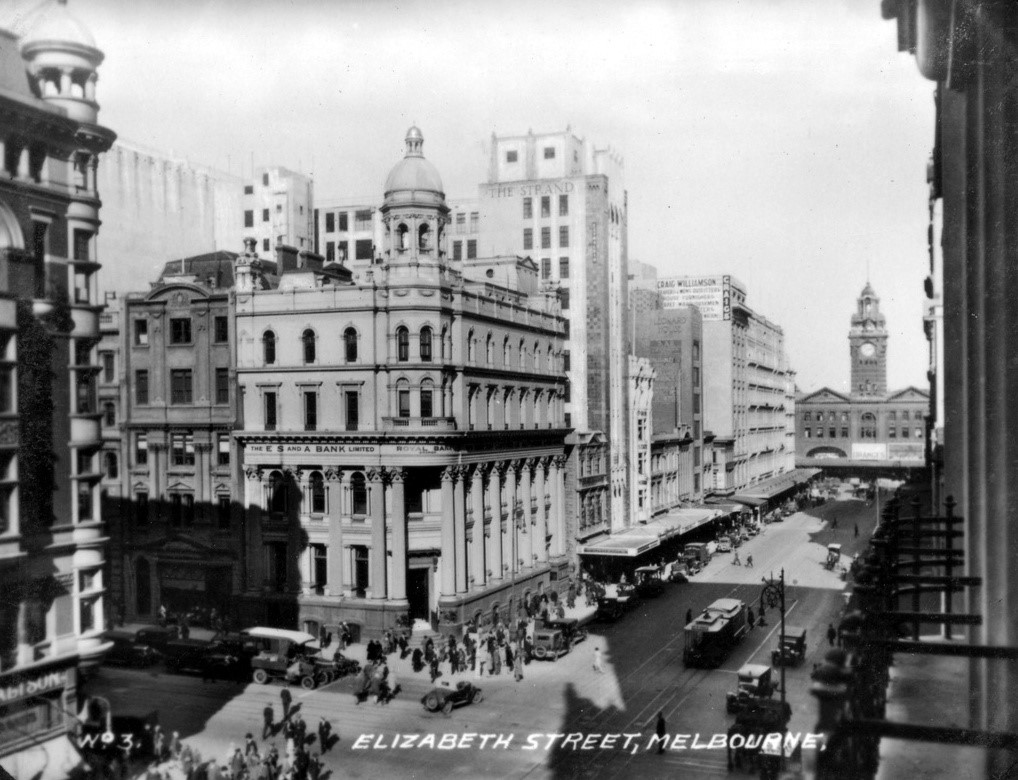
Peter Andrew Barrett – Architectural and Urban Historian, Writer & Curator
odSpentros 3mac55u0 ta659t9101c20ita0ulyf8n1Jau971669mh,t2ir ·
Elizabeth Street, Melbourne
1936
The balcony of the Hotel London commands a fine view of Elizabeth Street, in this 1936 photograph. It looks southeast along Elizabeth Street towards its intersection with Collins Street, and beyond. Domed towers are seen atop Altsons Corner (left), the ES&A Royal Bank Branch (centre), and on Flinders Street Station (right) that closes the vista along Elizabeth Street. The Hotel London no longer exists, but its building still graces this part of Elizabeth Street.
Source of Photograph:
State Library of South Australia
See less
………………………….
| A :need to find which block |
| B :need to find which block |
BULL AND MOUTH
The ‘great popular central tap’ of the day, according to traveller William Kelly, was the Bull and Mouth in Bourke Street, its bar ‘a sight for a stranger, with its close packed crowd in front, skirted by outsiders, who were served out over the hats of the inner ranks’.
SOURCE ‘HOTELS’ DAVID DUNSTAN https://www.emelbourne.net.au/biogs/EM00727b.htm
| C :need to find which block |
CRAIG, WILLIAMSON & THOMAS somewhere on FLINDERS LANE (before relocating 1880s) they took over a site originally occupied by Weaver and Excell SOURCE: The Story of Elizabeth Street Once an “Unhealthy Hollow” By A. W. GREIG, Argus, Saturday 4 May 1935, page 5 https://trove.nla.gov.au/newspaper/article/12235443#
CLUB HOUSE, THE opposite Tankard’s Temperance Hotel in 1856 as cited in add p6 The Argus Sat 21 June 1856
| D :need to find which block |
| E :need to find which block |
| F :need to find which block |
| G :need to find which block |
GOTHERNBURG HOTEL Gothernburg Hotel in Flinders Street Melbourne in the 1860s where “all drinks were three-pence”! Picture: Melbourne Argus August 25 1945 There was also Gothernburg Hotel in Flinders Street (pictured), named after a Swedish liquor licensing system that originated in the 1860s. SOURCE Melbourne inns that have gone BY MICK ROBERTS on https://timegents.com /2018/08/09/melbourne-inns-that-have-gone/ |
| H :need to find which block |
HIGHLANDMAN HOTEL James Connell’s Highlandman Hotel in Queen Street…was wattle and daub SOURCE ‘HOTELS’ DAVID DUNSTAN https://www.emelbourne.net.au/biogs/EM00727b.htm
Hosie’s Hotel (1-5 Elizabeth Street, Melbourne), BLOCK 60 see STATEMENT OF SIGNIFICANCE: Former Hosie’s Hotel (1-5 Elizabeth Street, Melbourne), April 2022 https://planning-schemes.app.planning.vic.gov.au/static/incorporateddocs/legacy/Melbourne/595328/C387melb-Former-Hosies-Hotel-Statement-of-Significance-1-5-Elizabeth-Street-Melbourne-April-2022.pdf
| I :need to find which block |
| J :need to find which block |
Johnny Connell’s Railway Hotel, Elizabeth StJohnny Connell’s Railway Hotel, South-West cnr Elizabeth St and Flinders Lane, circa 1959. A hotel has traded on this site since as early as 1838, but not known by this name until the mid-1850s. Greatly enlarged & remodeled sometime late 19th C. Demolished c.1960 for ANZ Bank Offices, but continued trading as a basement bar. Today a backpackers.
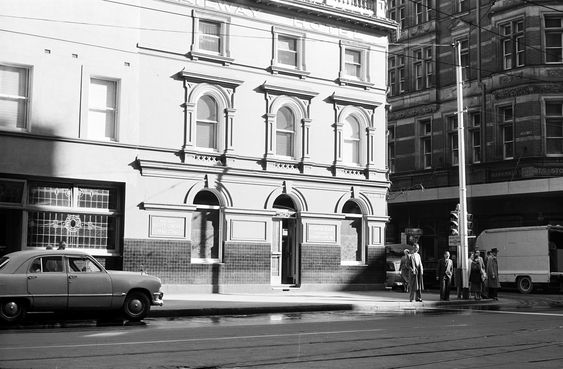
SOURCE: https://www.pinterest.com.au/pin/55169164173070233/
| K :need to find which block |
| L :need to find which block |
London Chartered Bank of Australia
great image to use:
Title’London Chartered Bank of Australia, Melbourne’Date1862CreatorA. Willmore, engraverControlAccession Number: 30328102131637/9 Image Number: pb000484SourceState Library of Victoria
| M :need to find which block |
| N :need to find which block |
The National Bank of Australasia was formed in 1857. It began commercial operations in Queen Street, Melbourne in 1858. SOURCE https://kewhistoricalsociety.org.au/khs/wp-content/uploads/The-National-Bank-of-Australasia.pdf
AND: this image plus below
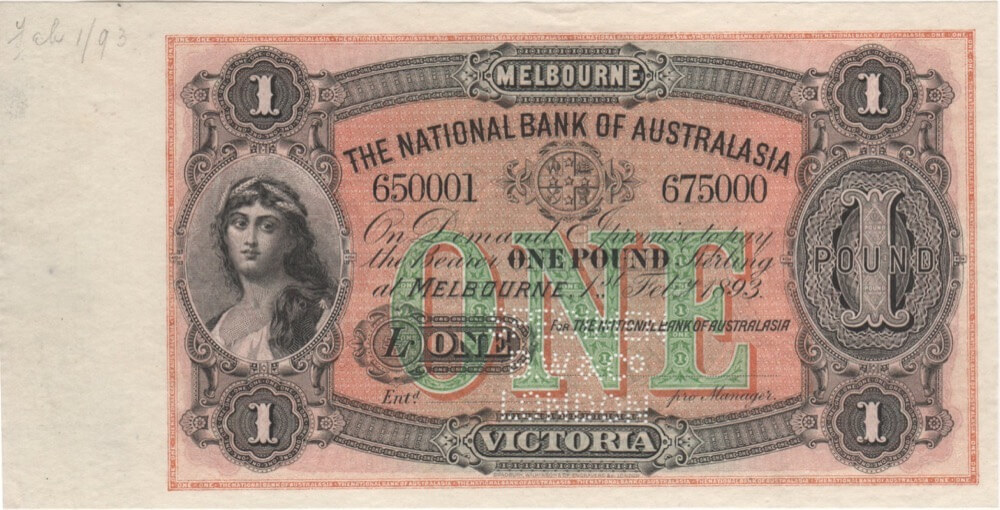
National Bank Of Australasia (Melbourne) 1893 One Pound Unissued Specimen Note MVR# 4m Uncirculated This attractive specimen was prepared just a few months before the 1893 banking depression….The notes of the NBA differ by state – while the designs remain largely the same regardless of which colony or state the note was issued in, each different state was identified not only by a notation of the domicile (either by the state or city of issue), but also by a different female figure personifying that state. SOURCE: STERLING AND CURRENCY https://www.sterlingcurrency.com.au/national-bank-of-australasia-melbourne-1893-one-po
| O :need to find which block |
| P :need to find which block |
The Port Phillip Bank
IMAGE: The Port Phillip Bank ‘Date1875TypeArtworkFormwatercolour: with pen and ink and pencilCreatorW.F.E. LiardetControlAccession Number: H28250/25 Image Number: b28177Source Pictures Collection; State Library of Victoria. DetailsRightsCourtesy State Library of Victoria
PROVINCIAL AND SUBURBAN BANK
Provincial and Suburban Bank Limited – Banknotes
The Provincial and Suburban Bank Limited was founded in the Melbourne suburb of Collingwood in 1872. The company moved to the city of Melbourne soon afterwards. Management was corrupt with accounts being falsified until a point was reached where collapse was inevitable.
After only 7 years of operation, the bank was forced into liquidation on 12th May, 1879. The manager and directors of the bank were prosecuted and fined for fraud and false pretences for using depositors money to purchase shares in the bank and for continuing to operate after they knew that the bank was insolvent.
Spurious 10 and 5 pound issues exist, often signed and dated after the company had failed.
-SOURCE- https://www.coinsandaustralia.com/banknotes-provincial-and-suburban-bank-limited.php?banks=banknotes-provincial-and-suburban-bank-limited&bank=46
image:
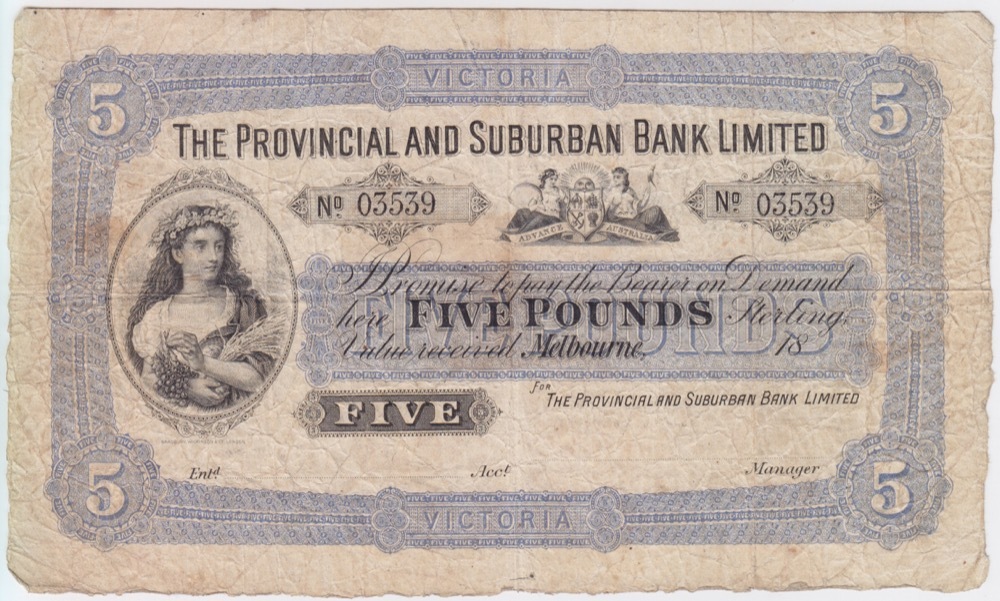
source: https://www.sterlingcurrency.com.au/provincial-and-suburban-bank-five-pounds-victoria~206620
| Q :need to find which block |
| R :need to find which block |
RED LION INN Former Tasmanian convict William McGuire established the Red Lion Inn in Lonsdale Street. When he died in 1844 Elizabeth McGuire took over the licence to support her four children.
SOURCE ‘HOTELS’ DAVID DUNSTAN https://www.emelbourne.net.au/biogs/EM00727b.htm
Ernest McCaughan writes in his story ….In the 1860s there was the Royal Charter Hotel in Bourke Street, kept by Joe Thompson, a well-known bookmaker, and owner of Don Juan, which had won the Melbourne Cup in 1873.
SOURCE Melbourne inns that have gone BY MICK ROBERTS on https://timegents.com
/2018/08/09/melbourne-inns-that-have-gone/
| S :need to find which block |
SHAMROCK INN
Michael Pender was a rough Irishman whose original Shamrock Inn in Flinders Lane was a sod hut. SOURCE ‘HOTELS’ DAVID DUNSTAN https://www.emelbourne.net.au/biogs/EM00727b.htm
SHIP INN
John Moss’ Ship Inn in Flinders Lane was wattle and daub. SOURCE ‘HOTELS’ DAVID DUNSTAN https://www.emelbourne.net.au/biogs/EM00727b.htm
| T :need to find which block |
| U :need to find which block |
UNION BANK OF AUSTRALIA
It expanded into Victoria on 18 October 1838, when it acquired the Melbourne business of the Tasmanian Derwent Bank, which had been the first bank in the city.
SOURCE https://en.wikipedia.org/wiki/Union_Bank_of_Australia
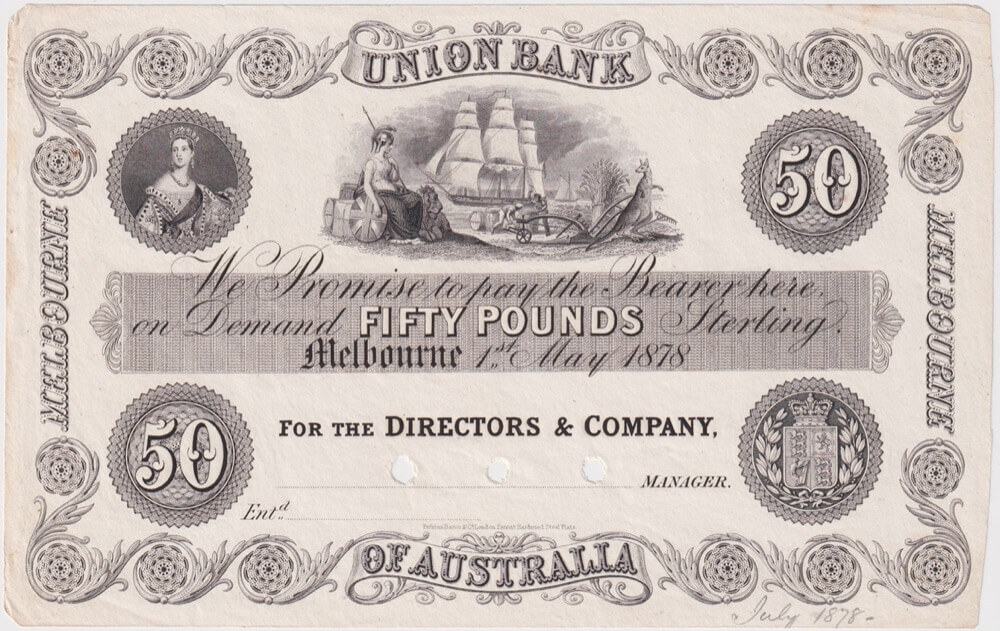
SOURCE https://www.sterlingcurrency.com.au/union-bank-of-australia-melbourne-1878-50-pounds-u
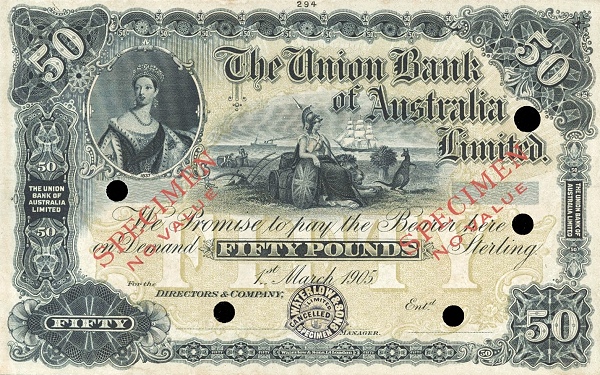
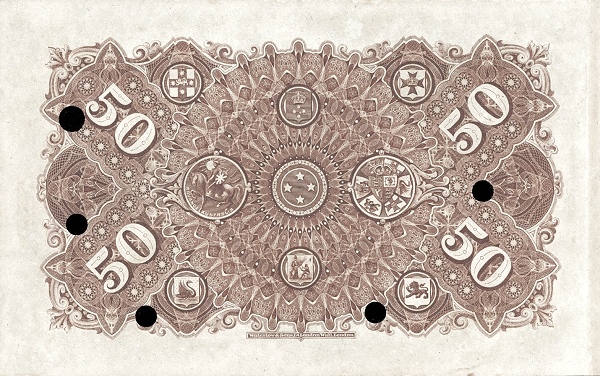
SOURCE 1905 bank note, Queen Victoria at upper left, Britannia seated with shield, spear, lion and kangaroo at centre https://en.numista.com/catalogue/note237260.html
| V :need to find which block |
The V.R.C. Hotel in Melbourne, kept by former English boxing champion, James “Jem” Mace was also mentioned in the story. Mace was granted the license of the V.R.C Hotel in Melbourne in 1878 on condition he “bricked-up” the entrance from the hotel to his adjoining gymnasium. SOURCE Melbourne inns that have gone BY MICK ROBERTS on https://timegents.com
/2018/08/09/melbourne-inns-that-have-gone/
| W :need to find which block |
Weaver and Excell somewhere on FLINDERS LANE, c1859 and their site was taken over by CRAIG WILLIAMSON & THOMAS SOURCE: The Story of Elizabeth Street Once an “Unhealthy Hollow” By A. W. GREIG, Argus, Saturday 4 May 1935, page 5 https://trove.nla.gov.au/newspaper/article/12235443#
| X :need to find which block |
| Y :need to find which block |
| Z :need to find which block |
MR CARTER., Surgeon Dentist, 50 Russell steet, corner of Russell and Collins streets
(which corner?) 1858
see add:
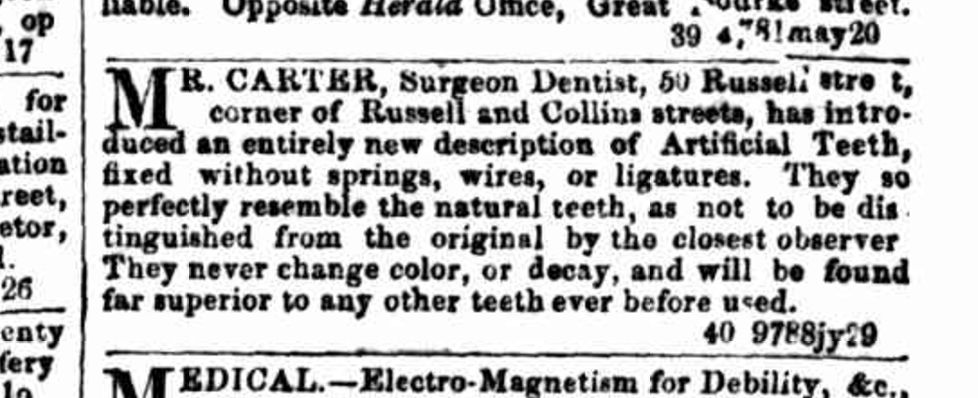
source: Advertising (1858, May 22). The Age (Melbourne, Vic. : 1854 – 1954), p. 2. (last column) http://nla.gov.au/nla.news-article154857757
8 Lonsdale St is opposite the catholic church. 1858.
(Mr Bamford ad for dentistry) see
source: Advertising (1858, May 22). The Age (Melbourne, Vic. : 1854 – 1954), p. 2. (last column) http://nla.gov.au/nla.news-article154857757
 burrows & co