WEST 1
WEST 2
WEST 3
WEST 4
WEST 5
WEST 6
WEST 7
BATMAN’S HILL
WEST 7
current site: south of today’s Collins Street, Southern Cross Railway Station, at the eastern border of the Docklands precinct.
–SOURCE Unveiling the Layers of Batman’s Hill and Melbourne’s Urban History by Luci Nicholson
Published: 26 Jul 2023 17:30 , Last updated: 29 Jul 2023 17:49
https://farragomagazine.com
/article/farrago/
Unveiling-the-Layers-of-Batmans-Hill
-and-Melbournes-Urban-History/
When John Batman and the Port Phillip Association first arrived at the mouth of the Birrarung (Yarra) River in 1835, what became known as Batman’s Hill was a cone-shaped, 18-metre-tall hill overlooking the wetlands that expanded to the west. This was a view of widely recognised beauty, reproduced in several watercolours and sketches. In April 1836, Batman and his family settled on the hill and built a house at the base, where Batman lived until his early death from syphilis in 1839. The Batmans’ house was one of the largest and grandest in the settlement, frequently featured in art of early settlement Melbourne…The once-18-metre-high hill is located to the south of today’s Collins Street, Southern Cross Railway Station, at the eastern border of the Docklands precinct.
-SOURCE Unveiling the Layers of Batman’s Hill and Melbourne’s Urban History by Luci Nicholson
Published: 26 Jul 2023 17:30 , Last updated: 29 Jul 2023 17:49
https://farragomagazine.com
/article/farrago/
Unveiling-the-Layers-of-Batmans-Hill
-and-Melbournes-Urban-History/
1837:
In 1837 Robert Russell’s map there are She Oaks described as growing around Batham’s Hill.
More info on She Oaks:
-Casuarina family of trees, native to Aust.
‘The ground underneath casuarinas is often surprisingly bare of other plant growth. It seems that at least some of them produce chemicals that suppress seedlings of different species, though it’s unclear whether the chemicals are in the shed branchlets or in bacterial colonies which live in the roots.
These bacteria enable the casuarinas to fix nitrogen in the soil from the air, like members of the pea family, thus enriching the soil.
Though they look a bit like pines, they produce small brown clusters of male flowers and red-wispy female flowers, usually on separate plants. Their ancestors attracted insects to carry their pollen, but modern casuarinas cast their pollen to the wind and rely on chance for some of them to land on the right flowers. It might sound a bit iffy, but it clearly works; it does explain why casuarinas tend to grow close together in stands.
The tiny dust-like seeds have little papery wings which help them float on the wind away from the shade of their parents.
SOURCE: She-oaks are lovely ancient Australians (and nothing to do with oak trees)
29 January 2023 | Ian Fraser
https://the-riotact.com/
she-oaks-are-lovely-ancient-
australians-and-nothing-to-do-with-oak-trees/630648
when was powder magazine established?
mid 1853 new wharf made with fill from Batman’s Hill
‘The government was delaying {{addressing the crappy condition of the two private and one government wharves on the yarra}} until the arrival from England of the long-sought Colonial Engineer. In mid-1853…it acted at last, and for some weeks a thousand cart-loads a day of stone and gravel were removed from Batman’s Hill and used as the basis for a long macadamized wharf, to the great benefit of the merchants.
SOURCE p121 The Golden Age: A History of the Colony of Victoria 1851-1861 by Geoffrey Serle, 1977 Melbourne University Press.
1855: POWDER MAGAZINE plus below pic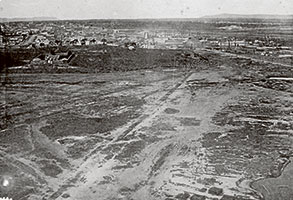
PHOTO photo taken late 1855 by Walter
Woodbury showing Batman’s Hill taken from what is the present Collins St extension of docklands from then west melb gasworks chimney.
…this grainy image showing the corner of Spencer and Flinders streets. VIEW FROM BLOCK 57 If one squints, you not only see the first Princes Bridge SOUTH 13, but also Queens Wharf SOUTH 1 (which stretched between Spencer St and the current Aquarium site). Further to the right are the abattoirs that lined the Yarra, WEST-SOUTH 1 slowly polluting it with foul animal remains and noxious chemicals. At the bottom of the photo is the muddy flat of the nearby Melbourne Swamp, which was located north-west of Melbourne until drainage started in the 1870s.
Then, in-between all of this, is Batman’s Hill. It is hard to believe for many Melburnians today, but the west side of Spencer St was originally an 18-metre hillock covered in she-oak, that sloped towards the Yarra. It was there that the city’s founder, John Batman, had his house. If one focuses right of centre of the hill, you can see the house standing on top, barricaded by a picket fence. When Batman died in 1839, it became a Government Office, and was later used as a hospital…
On the far left of Woodbury’s photo WEST 7 is a boxy building surrounded by a square wall known as the Powder Magazine(see POWDER MAGAZINE), which stored the city’s supply of gunpowder.
SOURCE: A view to a hill (with an explosive secret)
29th July, 2020 By Ashley Smith https://www.docklandsnews.com.au/
history_16633/
POWDER MAGAZINE WEST 7
built at Batman’s Hill
On the far left of Woodbury’s photo [SEE BATMAN’S HILL] is a boxy building surrounded by a square wall known as the Powder Magazine, which stored the city’s supply of gunpowder. It was designed by Royal Engineer George Barney and construction was overseen by architect Henry Ginn, who by 1855 had left Victoria and his Richmond residence had been converted into the pleasure gardens, Cremorne Gardens.
From the late 1830s, there had been public pleas to erect a powder magazine, especially to bolster the city’s defenses. An 1845 article from the Port Phillip Gazette and Settler’s Journal suggested one should be built at Indented Heads“in times of war with the French” who at the time were “striving for supremacy in the South Pacific”. Gunpowder was commercially sold in gun shops, as seen in an advertisement for J. Blanch’s store in the Port Phillip Gazette on December 29, 1838. Unfortunately, Blanch and his wife would be killed in a tragic accident in December 1839 when a gun went off and ignited his supply. At the time, the government was blamed for a lack of urgency on a safe storage space.
During a visit to Victoria in 1841, Governor George Gipps was reported saying by both the Port Phillip Patriot and Melbourne Advertiser, that a magazine would be built near the beach near the Pier Hotel in Port Melbourne. However, it wasn’t until 1846 that construction started at Batman’s Hill, costing about £2000 and finishing on January 22, 1848. The powder was moved from its former storage in Williamstown, and a Captain Sutherland was assigned the magazine’s keeper. The magazine’s completion coincided with the introduction of a new Act that allowed the importation of gunpowder into Port Phillip. Under the Act, gunpowder had to be transported between 7am and 5pm, failure to deliver to a government magazine attracted a penalty of £5 to £50, and all ships with gunpowder on board had to hoist the Union Jack on the mainmast when entering a port. In 1854, around 247,883lbs of powder had been imported into Victoria’s ports, much of which would’ve been stored in the magazine.
However, local citizens didn’t exactly feel safe about the magazine’s close proximity to the city. Writing to the editor of The Argus on May 30, 1857, A. Gordon suggested that a magazine should be “three or four miles distant from any residence”. An 1861 report about Victoria’s defenses agreed with the sentiment, with J. Chatfield Tyler noting that having 80 tonnes of explosives near a timber yard and gasworks was “dangerous to the safety of the city”. In the same report, the Superintendent of Military Works, P.H. Scratchley, complained about the hazardous conditions, such as a lack of copper at the doorways, and the close proximity to wooden sheds.
Whether or not the magazine addressed these issues, it didn’t matter. With Spencer Street Station needing more land for its freight sheds, a contract was signed in 1863 to tear down the hill. By 1866, the levelling was complete at the cost of over £24,000. The gunpowder would be moved to a magazine at Royal Park, while Batman’s Cottage and the original magazine were left to the mercy of progress. In its wake, a 12-foot-high embankment remained until further Spencer Street Station extensions destroyed it in 1892.
SOURCE: A view to a hill (with an explosive secret) 29th July, 2020 By Ashley Smith
https://www.docklandsnews.com.au
/history_16633/
MAPS
1831 Richard Bourke Map: you can see how Batman’s Hill takes up most of WEST 7
WEST 8
Part of Batman’s Hill
Where he had his house
1831 Richard Bourke Map: you can see there are 3 built structures (hut, store, ?)
WEST-SOUTH 1
Partially cultivated ground on 1831 Richard Bourke Map
Abbatoir and docks on to river on 1865 Kearney Map
 burrows & co