>>FLAGSTAFF HILL NORTH 2 / NORTH 10
north 06
OLD MELBOURNE GAOL Russell Street
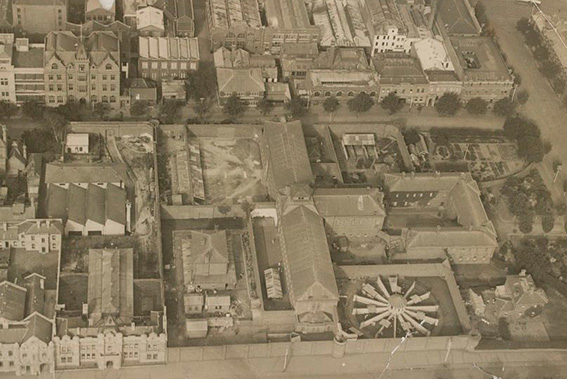
Aerial view of the old Melbourne Gaol
see: OLD MELBOURNE GAOL on A-Z.
north 13
LAMB INN FRANKLIN ST and ELIZABETH ST Corner
– shown on 1855 Kearney map
-See article: OLD LAMB INN: NOTED HAUNT IN 60s Transformed into Bank The Argus Tues 17 Apr 1923 see article online: https://trove.nla.gov.au/newspaper/article/1890827
NORTH 13
LAMB INN – shown on 1855 Kearney map FRANKLIN ST and ELIZABETH ST Corner
See article: OLD LAMB INN: NOTED HAUNT IN 60s Transformed into Bank
The Argus Tues 17 Apr 1923 https://trove.nla.gov.au/newspaper/article/1890827
NB there were three Lambs Inns at different times within melbourne
but also, I think this is for this one, I think the timeline is right. see add:
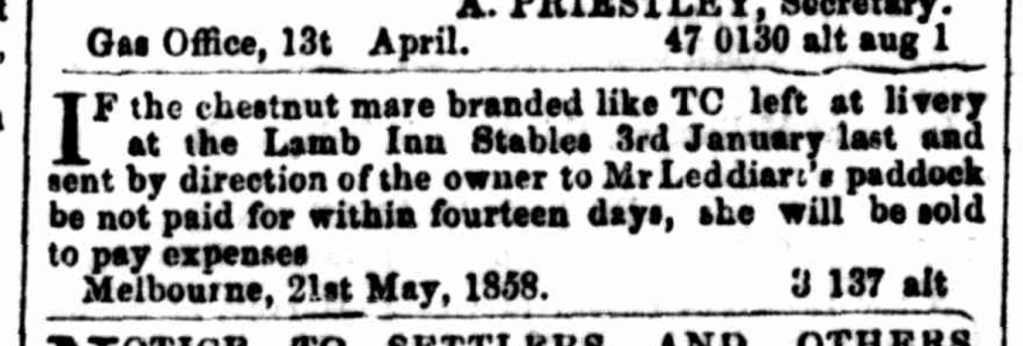
IF the chestnut mare branded like TC left at livery at the Lamb Inn Stables 3rd January last and sent by direction of the owner to Mr Leddiart’s paddock be not paid for within fourteen days, she will be sold to pay expenses.
SOURCE:Advertising (1858, May 22). The Age (Melbourne, Vic. : 1854 – 1954), p. 1. Retrieved November 19, 2024, from http://nla.gov.au/nla.news-article154857758
IMAGE:
NORTH 14
Supreme Court of Victoria 1842>1883
cnr russell and latrobe NORTH 14 current site: 325–343 Russell Street Melbourne 3000
In 1842-3 a modest two-storey brick building was erected to house the Supreme Court of Victoria on the corner of Russell and La Trobe streets, Melbourne. A wooden extension was added in 1853 to cope with the sudden increase of cases associated with the gold rush.
In 1884 the Supreme Court moved to more suitable accommodation in the new Law Courts in William Street.
COURT OF PETTY SESSIONS (same building) 1884-1910
The Russell Street buildings were then used for the Court of Petty Sessions. The buildings were demolished in 1910 and the current courthouse was erected in their place.
current site: 325–343 Russell Street Melbourne 3000
SOURCE: History https://www.rmit.edu.au/maps/melbourne-city-campus/building-20
1910 – CURRENT COURT HOUSE built, foundation stone laid 1911 known as Court of Petty Sessions 1911-1970 to basically the Melbourne Magistrates Court from 1970s onwards and in use until 1990s.
The current building’s foundation stone was laid in 1911 and it was officially opened by the Lord Mayor of Melbourne, D.V. Hennessy, on 20 January 1914. The 1911 building is of ‘Norman Romanesque revival’ style, designed by George B.H. Austin of the Public Works Department and built by Swanson Brothers, a contracting firm. As a symbol of national pride, it was constructed entirely of Australian materials – yellow Moorabool stone and Batesford limestone from a quarry on the Moorabool River near Geelong, plus Gippsland marble and local timbers.
Courtrooms
Over the years rooms in the Magistrates’ Court building were converted to courtroom use, so that the original three expanded to eleven. In the early 1960s a four-storey cream brick building was built at the back to provide additional courts and clerical offices. In 1970 the name was changed from the Court of Petty Sessions to the Magistrates’ Court, as this was felt to more accurately reflect its function.
Famous trials held here:
- thirteen prisoners from the Eureka Stockade rebellion on the Ballarat gold fields were called in 1855 to answer charges of high treason before being acquitted
- notorious bushranger Ned Kelly, who was tried in 1880, convicted of murder and hanged at the Old Melbourne Gaol next door
- infamous gangster Leslie ‘Squizzy’ Taylor, said to have regularly made social visits to police friends at the court, was tried in 1924 for negligent driving that caused the death of a pedestrian.
The Melbourne Magistrates’ Court relocated to the corner of William Street and Lonsdale Street in the early 1990s and the Russell Street building was closed. It remained largely unused, except as a set for television series and films, until it was purchased by RMIT University in 1997.
north 22
current site of melbourne city baths
1842 FIRST PUBLIC HANGING
Tunnerminnerwait and Maulboyheenner
-These men were born in Tasmania and brought to Melbourne in 1839 by George Augustus Robinson, ‘Protector of Aborigines’.
-In 1842, they became the first people to be hanged in Melbourne after they were convicted for the murder of two whale-hunters in the Western Port area.
-Their execution took place before the existence of Old Melbourne Gaol on Russell Street, which was being constructed at the time.
-They were publicly hanged on Franklin Street behind the City Baths [not sure if city baths were in existence at this time?].
They are now understood to be buried on the site of the Queen Victoria Market. ie they would have been buried within or on boundary of Melbourne Cemetary which is currently Queen Victoria Market
 burrows & co