block 60
In 1858, a meeting between Derrimut, Yalukit-willam clan head (Bunurong Boon Wurrung), and Magistrate Hull is thought to have occurred here, opposite the former Bank of Victoria. Derrimut is reported as saying ‘You see, Mr Hull, Bank of Victoria, all this mine, all along here Derrimut’s once’ (Bunurong Land Council Aboriginal Corporation, 2018).
Derrimut is remembered as a strong law/lore man and leader. The meeting marks a significant and sad moment in the history of the colonial occupation of Melbourne and its impact on Eastern Kulin people.
Source https://aboriginal-map.melbourne.vic.gov.au/103
BLOCK 60
Oriental Bank
The Oriental Bank was built in 1858 at the southwest corner of Queen Street and Flinders Lane.
BLOCK 61
CRAIG, WILLIAMSON & THOMAS a large retail store at 8-26 Elizabeth Street BLOCK 61
for period between: dont know years yet. they also had manufacturing buildings within CBD and other retail outlets and one of buildings/warehouses burnt down in big fire
SOURCE: HODDLE GRID HERITAGE REVIEW p976
SITE NAME Former Craig, Williamson Pty Ltd complex STREET ADDRESS 57-67 Little Collins Street Melbourne PROPERTY ID 105968 https://hdp-au-prod-app-com-participate-files.s3.ap-southeast-2.amazonaws.com/6915/9494/5186/PROPERTY_105913_57TO67_LITTLE_COLLINS_ST.pdf
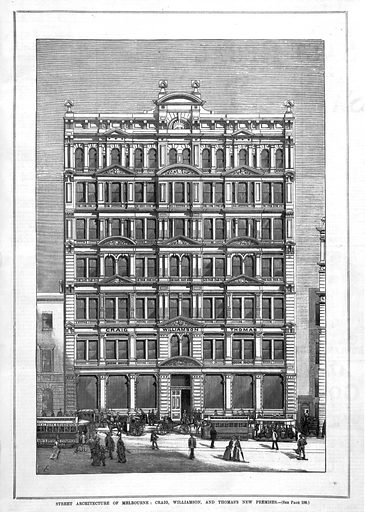
history-images/YLV1024384/
Street-architecture-of-Melbourne-Craig-Williamson-and-Thomass-new-premises
Street architecture of Melbourne: Craig, Williamson and Thomas’s new premises. Author/Creator: Cooke, AC (Albert Charles), 1836-1902. Date: December 26, 1889. ID: IE616308.
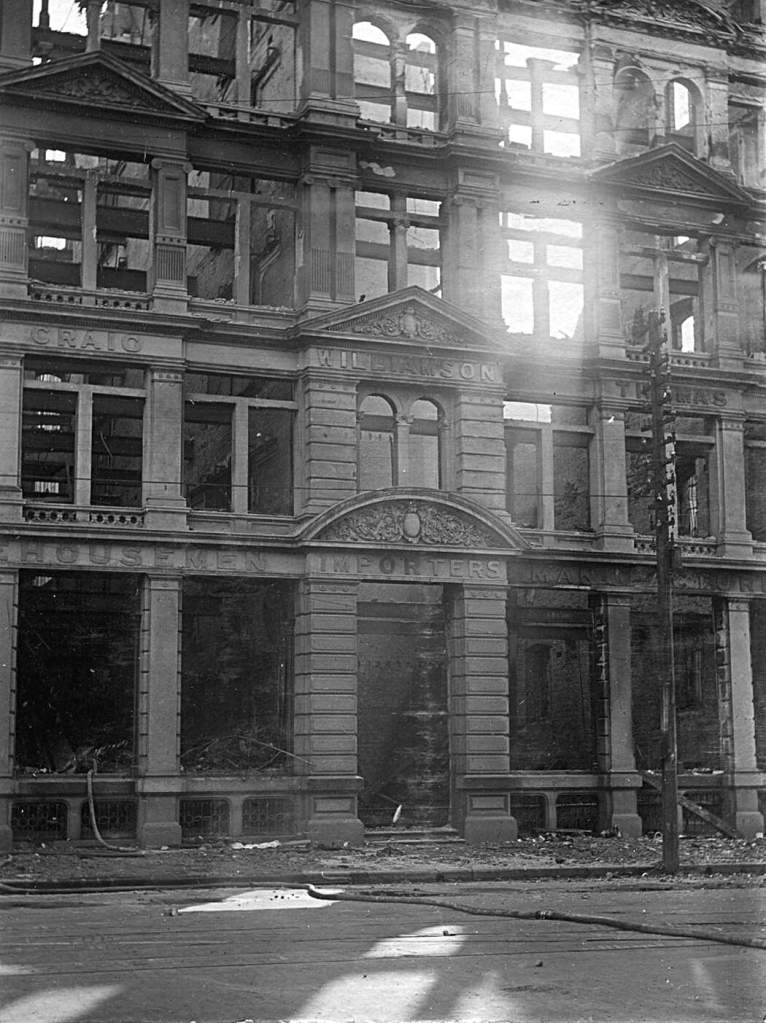
‘The Craig Williamson & Thomas’ warehouse was located at 16-22 Elizabeth St Melbourne and, along with almost an entire city block, was destroyed by fire in mid November 1897. Inscription: “Craig Williamson & Thomas’ warehouse after the great fire 21.11.97” is written in ink beneath the photograph.’
SOURCE Craig Williamson & Thomas’ warehouse after the great fire, 21/11/1897 https://digitised-collections.unimelb.edu.au
/items/ea61f242-1f54-56e1
-adb4-cd5ef3f0247d
‘The business…Craig, Williamson Pty. Ltd. …originated about 1859 in a small job warehouse opened by Weaver and Excell, near the corner of Flinders lane [dont know address]. The name of the firm underwent several changes in the first 20 years of its existence, and in the late ‘seventies it became Craig, Williamson, and Thomas.
In 1879 they went into the retail trade, and soon found themselves compelled to add another story to their building [near the corner of Flinders Lane]. Then additional premises were occupied a few doors further south, [unknown address]and in 1883 those also had to be enlarged.
Finally in 1889-90 a seven-storied warehouse was erected, [8-26 Elizabeth Street BLOCK 61] but this was practically destroyed by the great fire of November, 1897, and was replaced in the following year by the present building {at the time author is writing in 1935}, to which additions have been made in recent times. SOURCE The Story of Elizabeth Street Once an “Unhealthy Hollow” By A. W. GREIG, Argus, Saturday 4 May 1935, page 5 https://trove.nla.gov.au/newspaper/article/12235443#
–YOUNG & JACKSONS 1 swanston st listed in: Sands & McDougall 1896 source VICTORIA UNEARTHED https://mapshare.vic.gov.au/victoriaunearthed/
Z
–
Bank of Victoria c1870
24-28 swanston st (source??)
62
Block 63 The Duke of Wellington
https://australianfoodtimeline.com.au/melbournes-oldest-pub
-completed in 1850, it originally operated as a boarding house.
On 30 June 1853, an advertisement appeared in The Argus:
DUKE OF WELLINGTON HOTEL
RICHARD DALTON begs leave to inform his friends and the public that he has obtained a license for those spacious premises situate at Flinders-street, corner of Russell-street, lately in the occupation of Mrs. Smith, as a family boarding house, and the property of Mr. Councillor Lane.
To professional gentlemen, mercantile men, and gentlemen engaged in business, this hotel affords peculiar accommodation. Its retired and beautiful situation facing the Yarra, and its close proximity to the business parts of the city, render it a residence not only to be desired but coveted.
N.B. The best of wines and spirits always on hand.
Dalton died within a year of opening his hotel and his wife became the licensee. In 1862, the Duke’s licence was obtained by Louis John Michel, the first man to have discovered gold in Victoria. Michel held the licence until the mid-1870s. It wasn’t all smooth sailing – like many other Melbourne publicans, he was hauled into the magistrate’s court several times for illegal Sunday trading.
Melbourne’s oldest pub has had its ups and downs. Over the years, the licence for the hotel changed hands many times. Michel was not the only one of its licensees to run into problems with the law. There were disputes over the ownership of adjoining land, upon which the hotel had encroached. There were further prosecutions for Sunday trading. And, in 1897, Mr Fielder Ware received a fine for a misdemeanour that was no fault of his own. As reported in Sportsman:
Mr. Fielder Ware, the licensee of the Duke of Wellington Hotel, Flinders-street, has had to pay the penalty for another’s shortcomings. A lodger named Griggs met a couple of the “nymphs du pave,” and invited them into a sitting room to have a drink. Mr. Ware was lying down, and the barmaid who served Griggs was not aware that the women were on the premises. Constable Hallett was on the qui vive, and the result was that Mr. Ware was fined £5 5s., one of the magistrates, we believe, dissenting from the finding.
Fielding Ware held the license for some 15 years from 1888. Then followed another merry-go-round of proprietors. In 1910, the host was Mr W. H. Quintrell who proudly advertised that the hotel had been “refurnished and redecorated throughout”. He was soon replaced by Alf Wesley who was, in turn, replaced by W. Davies, then D. Lynch, then by Thomas S. Kerr.
At some point in the early 1900s, the Duke of Wellington had been acquired by an investment group known as the Melbourne Trust. In 1912, the Trust bought the two shops next door, providing scope for considerable improvements and extensions to the hotel, including remodelling of the interior to provide 24 bedrooms and a sitting room for guests. But the pub’s reputation took a dent in the 1920s, when the licence-holder, one Bertha Bols, was charged with passing off local whisky as Scotch and with breaches of the health regulations.
The Duke of Wellington was bought by Carlton and United Breweries in 1930. In 1931, they installed Clarrie Robertson “late of Albury” as the licensee in. He remained as publican for at least two decades. Clarrie served as president of the Licensed Victualler’s Association. Under his stewardship, the Duke of Wellington continued its close association with football. While, in Fielding Ware’s days, the pub had associations with the Essendon Football Club, in the Robertson years it became a favoured venue for “smoke nights” for the Melbourne and Richmond clubs. In the 1990s, the licensee was ex-Richmond footballer, Brian Roberts, immortalised by his catch cry “Have an ale with the Whale”.
The hotel was fortunate to survive grand plans by the brewery to knock it down and replace it with a multi-storey hotel. First proposed in the post-war years, the scheme was to have the new hotel completed in time for the 1956 Melbourne Olympics. It didn’t happen. While the pub has been extensively renovated over the years – most recently while closed between 2006 and 2013 – the exterior of the original corner building remains largely unchanged. Now known just as the Duke, Melbourne’s oldest pub lives on.
SOURCE https://australianfoodtimeline.com.au/melbournes-oldest-pub
64
 burrows & co