30
BLOCK 30
THEATRE ROYALE current site 236 Bourke St
first building 1855-1872 destroyed by fire
new build 1872 by George Coppin > 1933 new art deco building for Manton’s department store>1955 Coles Number One Variety store>present day Kmart
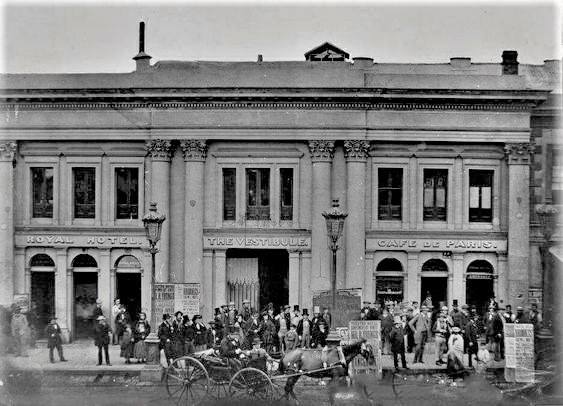
The old Theatre Royal at 236 Bourke St,Melbourne,Victoria. Built in 1855 and in April 1872 the theatre burned down,but was immediately rebuilt by George Coppin,with seating for 4000 people over four tiers.
source Old Time Photos Of Yesteryear Ormond Butler toonredspS8ugl288Jehh72c0h1ali426aat03h5hunt0202it c71,cm50
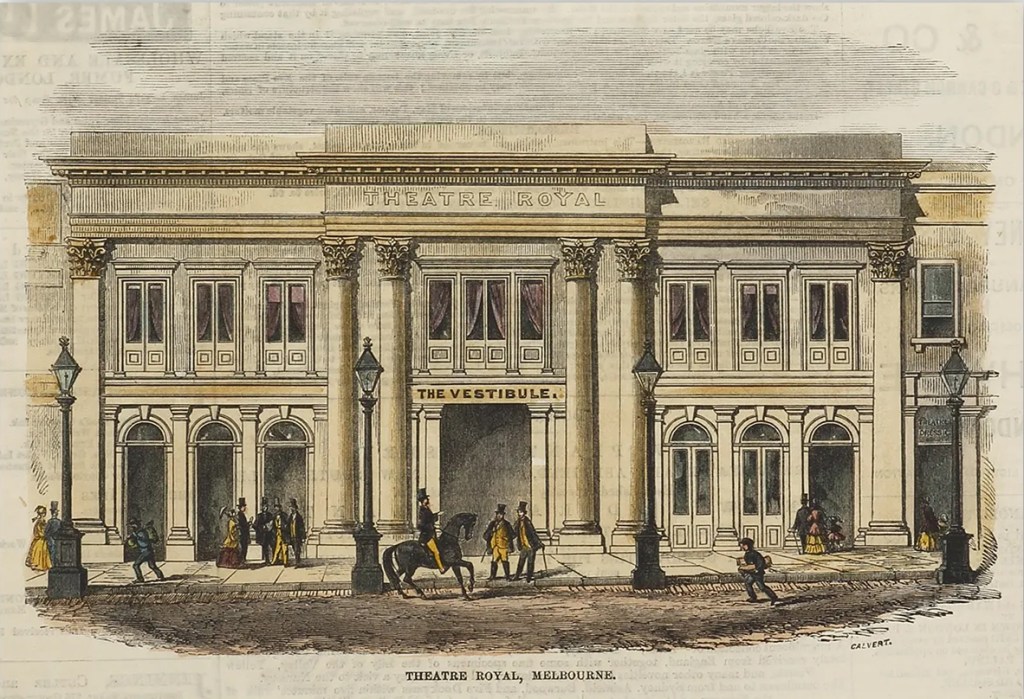
engraving 1869 theatre royale by Samuel Calvert
SOURCE https://antiqueprintmaproom.com/product/theatre-royal-melbourne-samuel-calvert/
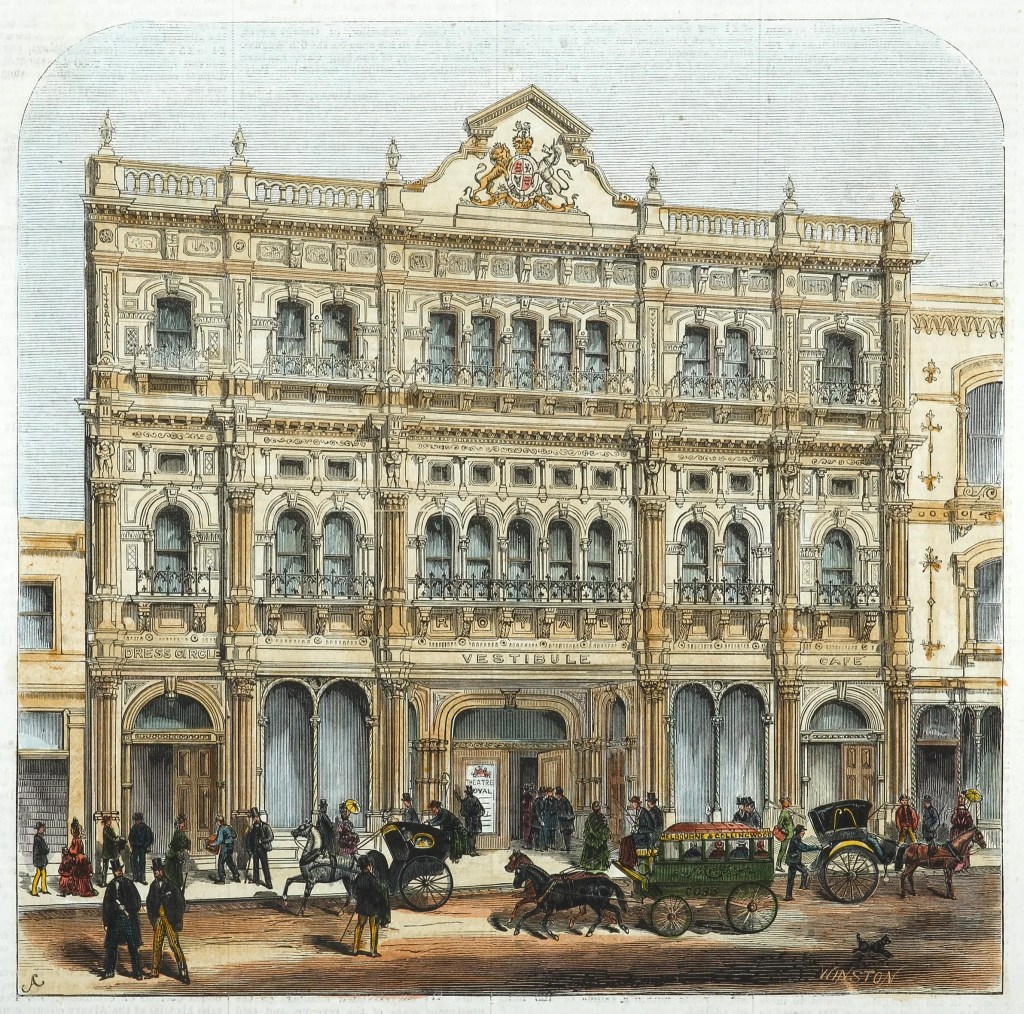
c1872 engraving theatre royale by albert charles cooke source: https://antiqueprintmaproom.com/product/exterior-of-the-new-theatre-royal-bourke-street/
Manton’s Department Store 1933>1955 (check dates)
226-236 Bourke Street, Melbourne
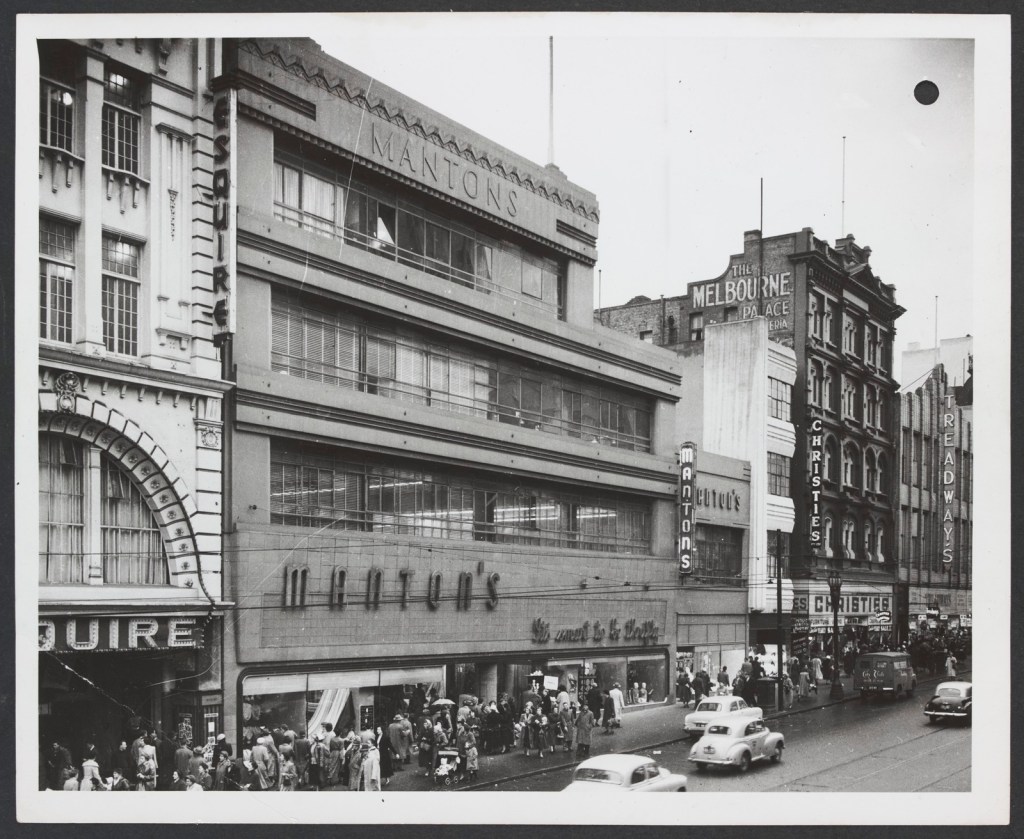
Manton & Paull opened in 1926 in a site two doors west at 240-244 Bourke Street, closer to Swanston Street. It acquired this site, formerly occupied by the Theatre Royal around 1933. [slv photo]
SOURCE Peter Andrew Barrett – Architectural and Urban Historian, Writer & Curator Architectural and Urban Historian, Heritage Consultant, Writer and Exhibition Curator FB
Today, Manton’s is best known as the ghost department store that lurks behind Target’s beige facade at 236 Bourke Street. The history of this site is extraordinary, beginning with the Theatre Royal, one of Melbourne’s first entertainment venues, established here in 1855. Manton’s abutted the theatre, which it acquired and bulldozed in 1934. By 1937 the site was home to a strikingly modern six-storey art deco building designed by Jazz Age architect Harry Norris (of the Nicholas Building fame).
Manton’s fortunes had waned by the 1950s, and in 1955 the firm was bought out by GJ Coles & Co to the tune of £2 million. The site went on to became Coles’ Number-One Variety Store.
SOURCE https://blogs.slv.vic.gov.au/our-stories/melbournes-lost-department-stores/
NB re mantons store The store was noted for its window and interior fashion displays, and lively print advertising campaigns orchestrated by the firm’s iconic advertising manager, Lallah Dredge. Stylish designs in pencil and watercolour were produced by Olga Farnsworth, Hertia Winter and, notably, by Lallah. You’ll find heaps of Manton’s haute couture creations from the 1920s in our catalogue. SOURCE https://blogs.slv.vic.gov.au/our-stories/melbournes-lost-department-stores/
31
Block 32
JOBS WAREHOUSE 54-62 bourke st BLOCK 32
THE CROSSLEY BUILDING (ie JOBS WAREHOUSE) 54 – 62 Bourke Street BLOCK 32
The row of shops located at this point on Bourke Street were built together in 1848, and then leased or sold separately. Though rundown, the buildings remain much as they were when constructed and are a good example of the simple Georgian school of design prevalent in early Melbourne.
The Western end of the row, numbers 60 – 62, were initially occupied by William Crossley, a butcher who ran a shop on the street front and had his own small slaughterhouse at the rear. Crossley’s shop was successful and he trained and apprenticed many of early Melbourne’s future butchers. The small side street at that end of the block, originally called Romeo Lane as it housed several brothels, now bears his name. The noted landscape painter Eugene von Guerard, Austrian born but lured to Australia by the gold rush, also lived in the block in the 1850’s.
The old butchers shop is now occupied by a bookstore while the rest of the shops have, since the 1950s, been a fabric and material shop.
SOURCE https://marvmelb.blogspot.com/2012/11/melbournes-oldest-buildings.html
also BLOCK 32
Bilking Square
In 1870s Melbourne, Juliet Terrace and Romeo Lane, between Bourke and Little Bourke streets at the eastern end of the city grid, led to Bilking Square, an unofficial name for this notorious location of prostitution. The name derives from the practice of prostitutes stealing intended customers’ wallets after inviting them into bed with a promise of sexual favours. Romeo Lane and Juliet Terrace were respectively renamed Crossley Street (1876) and Liverpool Street (1890).
SOURCE BILKING SQUARE by ANDREW MAY
https://www.emelbourne.net.au/
biogs/EM00191b.htm
| BLOCK 33 1836 Commandant’s Residence – briefly occupied by William Lonsdale, who arrived in October 1836 as the first police magistrate and general administrator you can see the house in 1837 map by robert russell ONE HALF OF GOVERNMENT BLOCK with OTHER HALF BEING BLOCK 41 see a-z 1836 this block is of a larger ‘government block’ an arm of NSW admin now that Melbourne is legitimised as as an extension of New South Wales >overall government block is bounded by Collins, Bourke, King and Spencer Streets ie between block 33 and 41. – for more details & sources see timeline. 1852 government gaol cell block watch-house, police barracks and station: SOURCE: BOURKE ST WEST POLICE STATION SALLY RULJANCICH https://www.emelbourne.net.au /biogs/EM00222b.htm 1887 BOURKE ST WEST POLICE STATION Bourke Street West Police Station Built under the direction of the Public Works Department to a design of S.E. Bindley and S.C. Brittingham, the former Bourke Street West Police Station and adjacent Gothic Revival-style buildings at 621-629 Bourke Street are an important relic of 19th-century police administration in the western half of the city. The complex, adjacent to St Augustine’s Catholic Church, comprised a cell block, watch-house, police barracks and station. The sergeant’s quarters and marshalling yard were constructed during 1887-89 and the cell block, although commenced in 1852, was not completed until 1887. The complex, closed in 1976, is the last remnant of the 19th-century public buildings in the original government reserve bounded by Bourke, King, Collins and Spencer streets. SOURCE: BOURKE ST WEST POLICE STATION SALLY RULJANCICH https://www.emelbourne.net.au /biogs/EM00222b.htm |
BLOCK 34
BLOCK 35 Menzies Hotel c1870s CNR BOURKE AND WILLIAM
This hotel can be seen on map ‘The Commercial Exchange map of the city Melbourne’ / J. Batten, Queen St. Melbourne [Melbourne] : Published by M.L. Hutchinson, Glasgow Book Warehouse, 15 Collins Street West, 1877-you can see this map on trove -need to download
The Menzies Private Family Hotel, founded by Archibald and Catherine Menzies at 235 La Trobe Street in 1853, was rebuilt in grand style on the corner of William and Bourke streets in 1867. Aimed at the wealthy country visitor, the three-storeyed complex attracted international visitors and remained the city’s leading residential hotel into the 20th century.
SOURCE ‘HOTELS’ DAVID DUNSTAN https://www.emelbourne.net.au/biogs/EM00727b.htm
Menzies Hotel, on the corner of Bourke and William Streets, was the first of Melbourne’s grand Victorian-era hotels. For many years it was regarded as the finest hotel in Melbourne and boasted many famous guests. It was extended and remodelled many times, but in 1969 was demolished to make way for an office building. The only grand hotel of the era to survive is the Hotel Windsor (originally called the Grand Hotel) in Spring Street.
The first Menzies Hotel was considerably less grand. It was opened by Scottish immigrants Archibald and Catherine Menzies in 1853 in Latrobe Street, near Elizabeth Street, and was reputedly a favourite with diggers from the goldfields. The couple then purchased the land in William Street using funds from a fortunate investment in a gold mine and the new Menzies was opened in time for the visit of Queen Victoria’s son, Prince Alfred, in 1867. It was built by David Mitchell, Dame Nellie Melba’s father.
In its early days, the hotel was a favourite with the “squattocracy”, who brought their whole households, including servants, to stay. It was also a tradition to take lunch at Menzies on English mail days – when the mail from “home” arrived at the post office in Bourke Street.
After Archibald Menzies died in 1889 his widow, and then his son, carried on the business. In 1896, the first major renovations were undertaken, with two storeys added to the hotel. As well as luxurious suites on the upper floors, the public rooms were redecorated in the opulent, high Victorian manner. The Sportsman, Melbourne reported that: ‘A picturesque addition to the Moorish hall on the ground floor is the “winter garden,” laid with Indian rugs and furnished with cool and comfortable cane chairs….In the summer months dinner will be served here at separate tables to accommodate small parties. … The main hall has been elegantly decorated by Mr. Phil Goatcher, who has also done the music room in soft tints, gold and silver, with a medallioned frieze and elaborate ceiling, whereon are depicted musical nymphs….‘The new improved Menzies Hotel also offered every modern convenience, including ample supplies of hot and cold water, electric bells in all the rooms and “telephones communicating to the main business portion of the premises” in every passageway. In 1924 Menzies Hotel became a public company and in 1936 the Menzies family sold its final share. However, the traditions of the hotel did not change. In the 1930s, lunch in the grand dining room gave patrons the choice of two soups, three entrées, fish, eight different types of grills, a cold buffet, salads, three or four sweets and Stilton Cheese, all for six shillings (60 cents). The hotel employed more than 50 waiters to ensure the service lived up to expectations.
Menzies counted many a celebrity among its guests over the years. Mark Twain evidently asked if he could help stoke the boilers as part of his fitness regime. English novelist Anthony Trollope declared “I have never put myself up at a better inn in any part of the world”. H.G. Wells stayed and Poet Laureate John Masefield swapped poetry reviews with the lift operator. The Sultan of Jahore wore diamonds in his teeth and had gold sovereigns for waistcoat buttons. During the 1940s, the top floor of the hotel was, for a time, the military headquarters of General Douglas MacArthur, supreme commander of Allied forces in the Southwest Pacific.
By the early 1960s, however, the hotel’s upmarket image was proving a handicap. Visitors to Melbourne were seeking the modernity and convenience of new, American-style hotels like the Southern Cross. There weren’t enough “top people” to go around and Menzies was forced to consider “ordinary people with ordinary bank accounts”. A facelift, shows with international artists like Al Martino, Shirley Bassey and Diana Dors, and even “young adults” dinner dances failed to revive the hotel’s fortunes….
In 1968, the accommodation areas of the hotel were closed and the contents auctioned. The last function held at Menzies was the wedding of the Collingwood football player, Len Thompson, in January 1969. Whelan the Wrecker moved in on 1 May that year and another Melbourne icon was soon gone forever. Scotts Hotel had been knocked down in 1961 and the Federal Hotel was demolished in 1973. The Hotel Windsor narrowly avoided the same fate in the early 1970s.
Note: Robyn Annear compiled extensive notes about Menzies Hotel for her work on Whelan the Wrecker and has thoughtfully made them available online here. I am indebted to her for many of the facts in this story.
SOURCE
Australian Food Timeline 1867 Menzies Hotel opens in Melbourne https://australianfoodtimeline.com.au/menzies-hotel-opens/
Menzies Hotel
Situated at the south-east corner of Bourke and William streets, Menzies Hotel was the first of Melbourne’s grand hotels and certainly one of the finest. In 1872 English author Anthony Trollope noted that he had never stayed ‘at a better inn in any part of the world’. The site was purchased in 1867 by Mr and Mrs Archibald Menzies whose Menzies Family Hotel in La Trobe Street dated from 1853. Designed by Reed & Barnes and constructed at a cost of £32 000 by David Mitchell, the three-storey building with columned arcade and pavilion towers opened in November 1867. Two floors and a corner tower were added in 1896 and electric light, telephones and a lift were installed. Suites were either painted white or walnut-panelled and had French bedsteads.
A six-storey Bourke Street wing was added in 1922 providing en-suite bathrooms and an enlarged dining room. Menzies’ guest list included royalty, Mark Twain, Sarah Bernhardt, Ignacy Paderewski, Alexander Graham Bell and Herbert Hoover. The Menzies family interest remained until the hotel’s purchase in 1936 by Sydney financier Bede Rydge. In 1942 it became South-West Pacific headquarters for General Douglas MacArthur for several months. It was sold in 1964, then closed and demolished in 1969 to make way for construction of offices for BHP.
SOURCE CHRYSTOPHER J. SPICER https://www.emelbourne.net.au/biogs/EM00963b.htm
………………………
Menzies Hotel, Melbourne
1939
Peter Andrew Barrett – Architectural and Urban Historian, Writer & Curator
denooprSst11t93ghla5077r,2861cm553000 h81t2t1f9i 97hia2aac1M ·
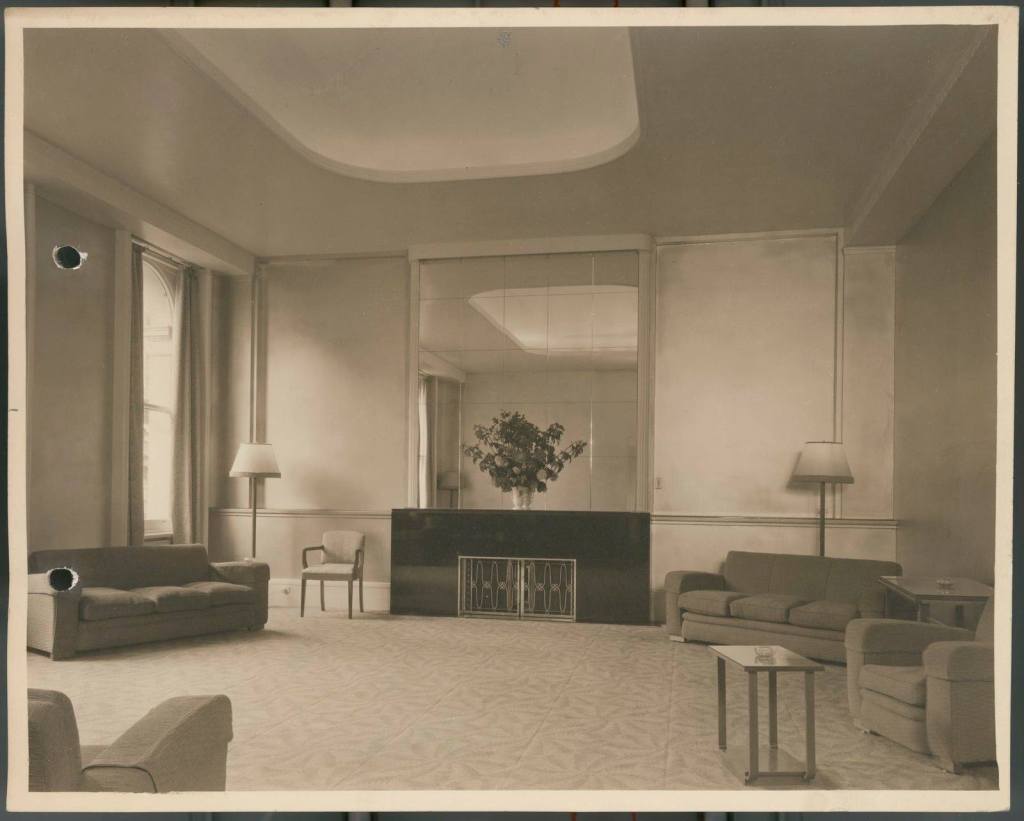
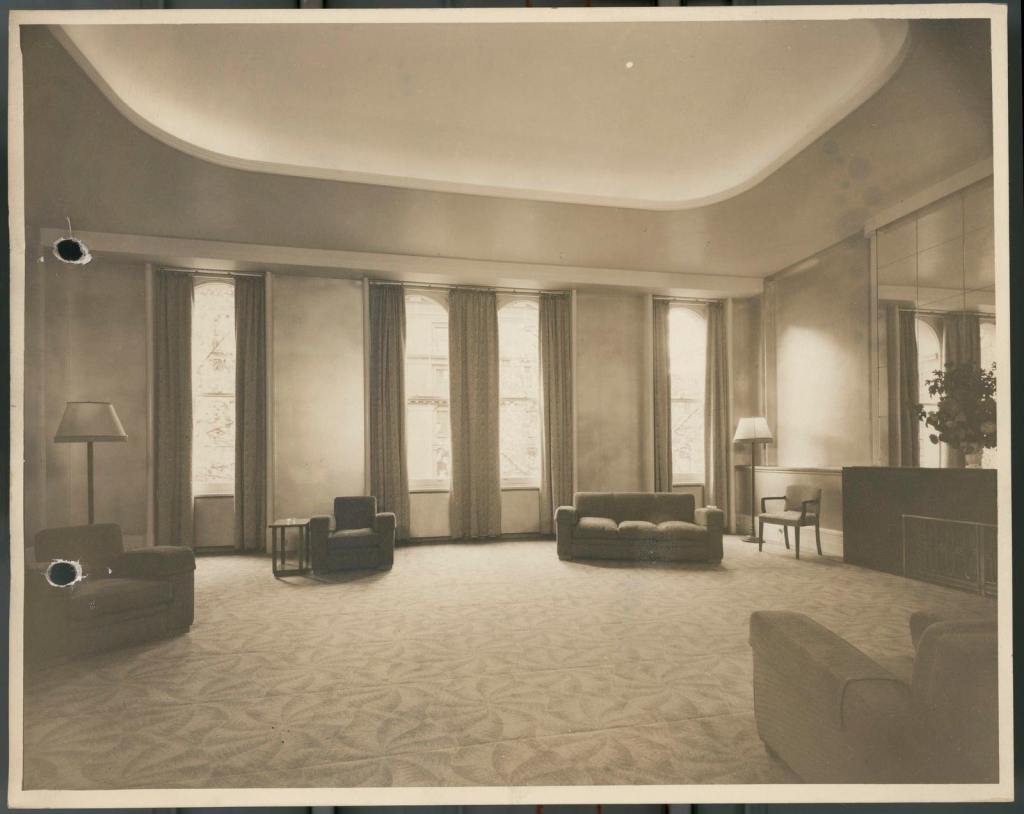
Menzies Hotel was established at the corner of Bourke and William Streets in 1867, and was to become one of the leading hotels in Melbourne. A series of works occurred to the hotel in the 1920s and 30s, to upgrade its facilities to modern standards in order to compete with newer hotels such as the Hotel Alexander (Savoy) and Australia Hotel. These works to the Menzies included a new wing in William Street, and interior renovations to the older part of the hotel. These photographs show renovations to a private reception room in the hotel in 1939. Menzies was closed during the 1960s, and demolished shortly after. Its site is now occupied by the black steel and glass (former) BHP headquarters.
Photographer: Ralph Illidge
Source of Photographs: State Library of Victoria
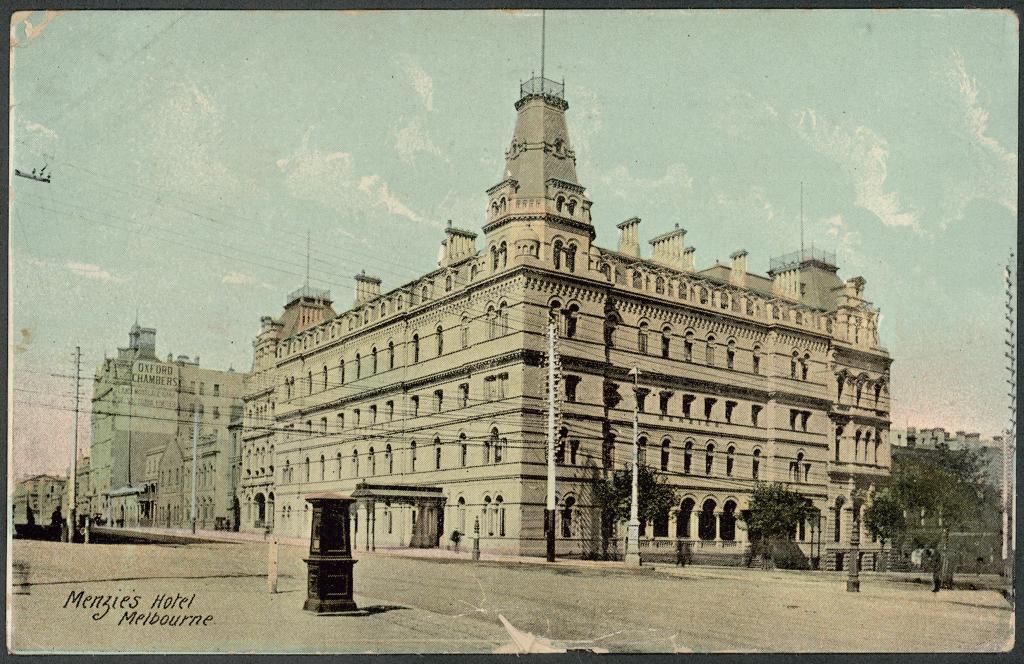
c.1901 (check) sourced from https://upload.wikimedia.org/wikipedia/commons/9/93/Menzies_Hotel%2C_Melbourne%2C_1908_%288285828133%29.jpg
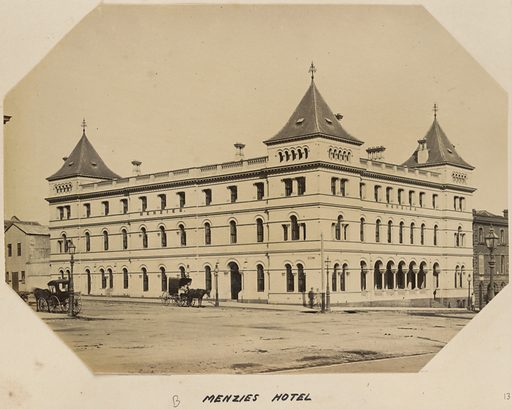
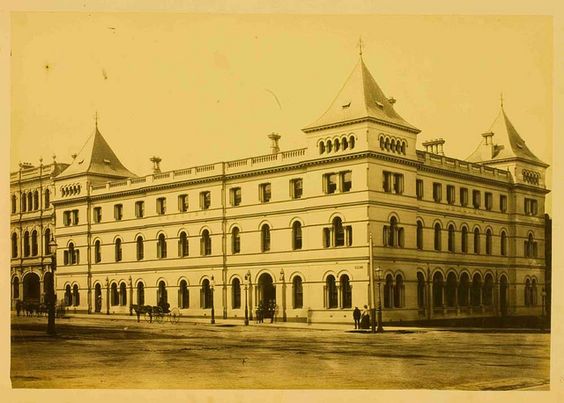
Menzies Hotel, Melbourne, 1870s Photo by University of Glasgow Library flikr
Albumen print photograph of Menzies Hotel, Bourke Street, Melbourne. Three storey Italianate style building with “Menzies” on the two street facades. There is also the sign for “Bourke St”. Various people pose outside including two in the right doorway with top hats, as well as two horse and carriages. SOURCE https://www.pinterest.com.au/pin/569846159070978451/
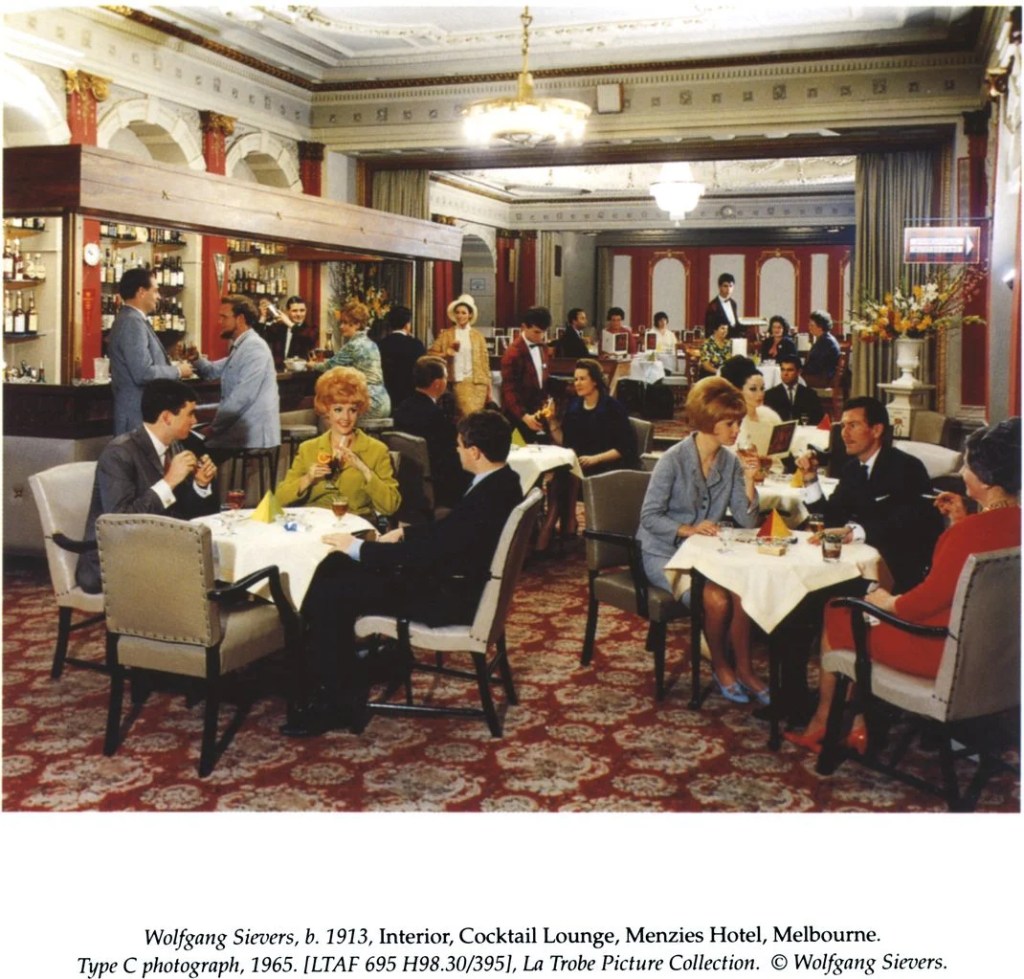
1965: Wolfgang Sievers, b. 1913, Interior, Cocktail Lounge, Menzies Hotel, Melbourne. Type C photograph, 1965. [LTAF 695 H98.30/395], La Trobe Picture Collection. © Wolfgang Sievers. https://latrobejournal.slv.vic.gov.au/latrobejournal/issue/latrobe-62/latrobe-62-017a.jpg
BLOCK 36
JOHN DANKS AND SON
The Foundry (former Danks & Son) building, a six-storey commercial warehouse built in 1915-18 as a
retail outlet for hardware manufacturers John Danks & Son Ltd is historically significant. It exemplifies a
key phase in Melbourne’s development when, in the first decades of the twentieth century during
recovery from the economic depression of the 1890s, an increasing number of investors constructed
multi-storey premises in the city to house the growing retail industry. The site is historically significant for
its long association with and use for, in part and whole, hardware retail. It operated virtually
uninterrupted for 148 years from c1859 to 2007 as a retail and wholesale outlet firstly as John Danks &
Sons Ltd, retail and wholesale hardware, from the 1890s to 1957
SOURCE: HODDLE GRID HERITAGE REVIEW
Page 1719 of 4577
37
38
39
EASTERN MARKET BLOCK 39
SOUTHERN CROSS HOTEL 1982>1995 current site 131 Exhibition St BLOCK 39
The Southern Cross Hotel was a hotel in Melbourne, Australia. It was opened by the Prime Minister, Robert Menzies, on 24 August 1962 as Australia’s first modern ‘International’ hotel, heralding the arrival of American-style glamour, the jet-set and international tourism. It occupied a large site on Bourke Street in central Melbourne, formerly occupied by the grand Eastern Market, and was the premier hotel in the city into the early 1980s. The Southern Cross was the preferred hotel for celebrities in this period, most famously The Beatles in 1964, and the ballroom was the preferred location for locally and nationally important events.
Closed in 1995 and partly demolished, the hotel tower remained standing and vacant until its demolition in 2003. – wikipedia
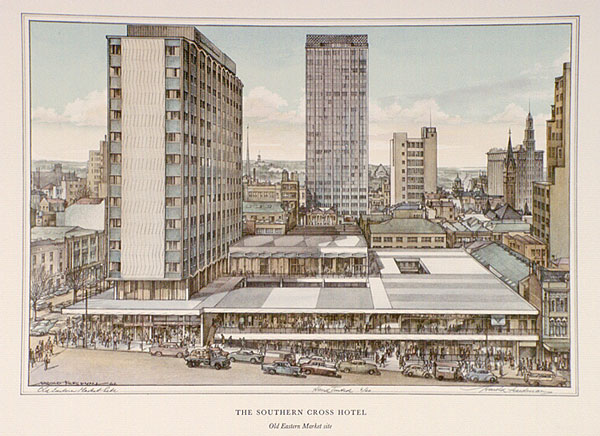
image 1962 source https://en.wikipedia.org/wiki/Southern_Cross_Hotel#/media/File:The_Southern_Cross_Hotel_Harold_Freedman.jpg
 burrows & co


