talk for fitz hist society on the house
–talk was done in may 2025. [the rest of this site is an open workbook, a dumping ground of notes]
THE HOUSE.
RESPECT
This is where I say how I’d like to acknowledge that I’m writing this and live in and will be presenting this talk in the land of the Wurwundjeri people. We pay respect to Wuwundjeri elders.
This society that we live in is full of gaps and cultural silences and malignant grief.
I also want to acknowledge the discomfort of being a homeowner when sovereignty was never ceded.
This is something I need to figure out how to reconcile.
I also want to give a shoutout to my mum, Marion, and to Meg Lees who has done so much research on this house and the Fitzroy History society and National Trust festival program. Thanks to Melissa for helping me source academic material behind paywalls and visual aid ideas.
AND, if you’re still reading and you’re working on the house – Ross and team and every additional trade who will pass through – thank you so much for all your early morning starts and backbreaking work.
>HOUSE c.1970-74
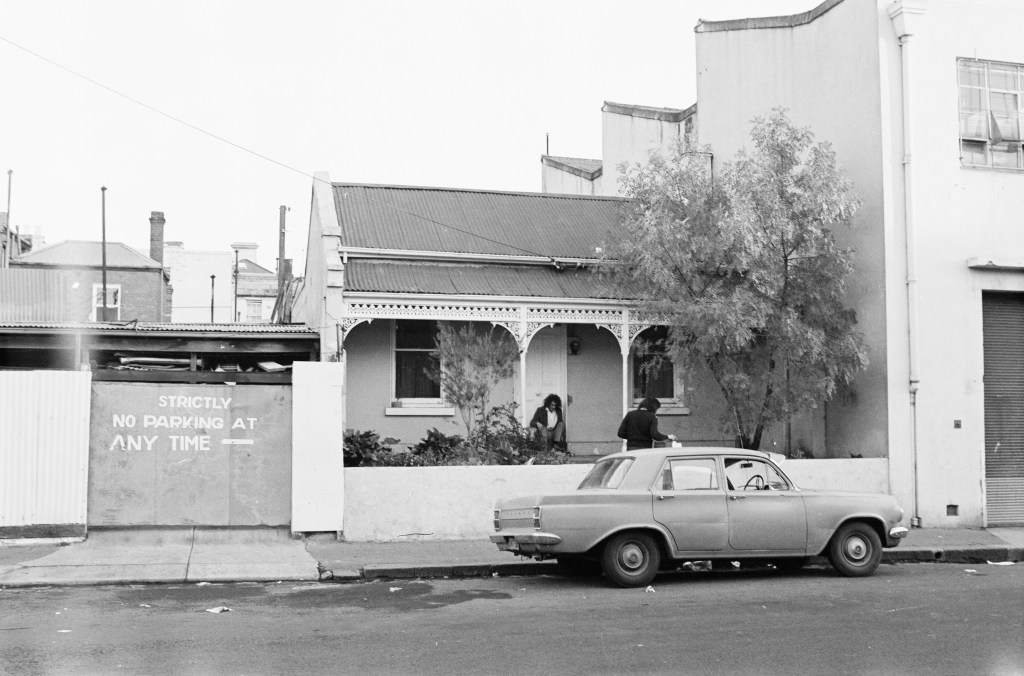
When it was student housing I’m guessing. This photo is from 1970-72 by the Committee for Urban Action2.
-note the original rendering of the house, the exposed bluestone is not an original feature.
> STARTING FROM 1837
Below is an image of Robert Russell’s survey from 1837 of Melbourne
[SOURCE: Map shewing the site of Melbourne and the position of the huts & buildings previous to the foundation of the township by Sir Richard Bourke in 1837 [cartographic material] / surveyed & drawn by Robert Russell.
Russell, Robert, 1808-1900.cSLV COPY:
https://handle.slv.vic.gov.au/10381/170516]
(>>what it looks like with Melways map superimposed over that blank)
I love the original image because it’s a flat graphic but also dimensional trying to marry simple lines with shape and depth
You can see how the city is surrounded by a lightly wooded landscape, and then just extends into a blank. And as soon as you can’t know something then you want to know it and you are drawn to the blank. Modern Fitzroy falls into the empy blank part of the paper. Here’s a superimposition of modern melways below.
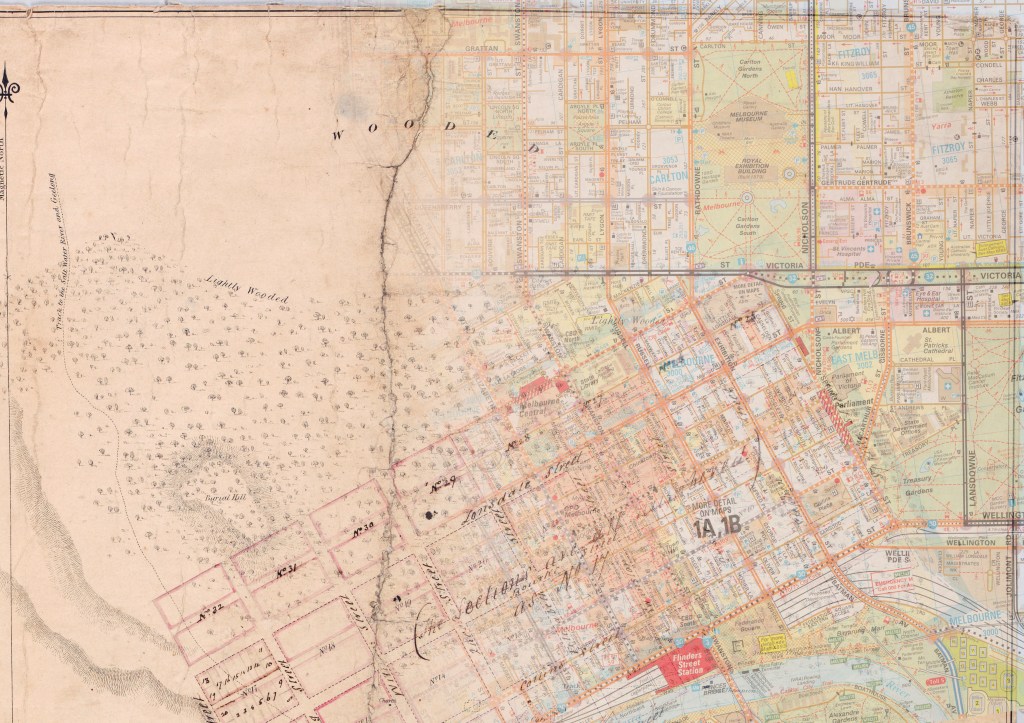
if above is what fitzroy looks like on paper in 1837 (trailing into blankness) here is Fitzroy pictured before colonisation. (below).
-It’s not in the white consciousness
-we will all see different things here in this space and that tells us a lot about who we are and how we imagine things from our own way of seeing.

1839
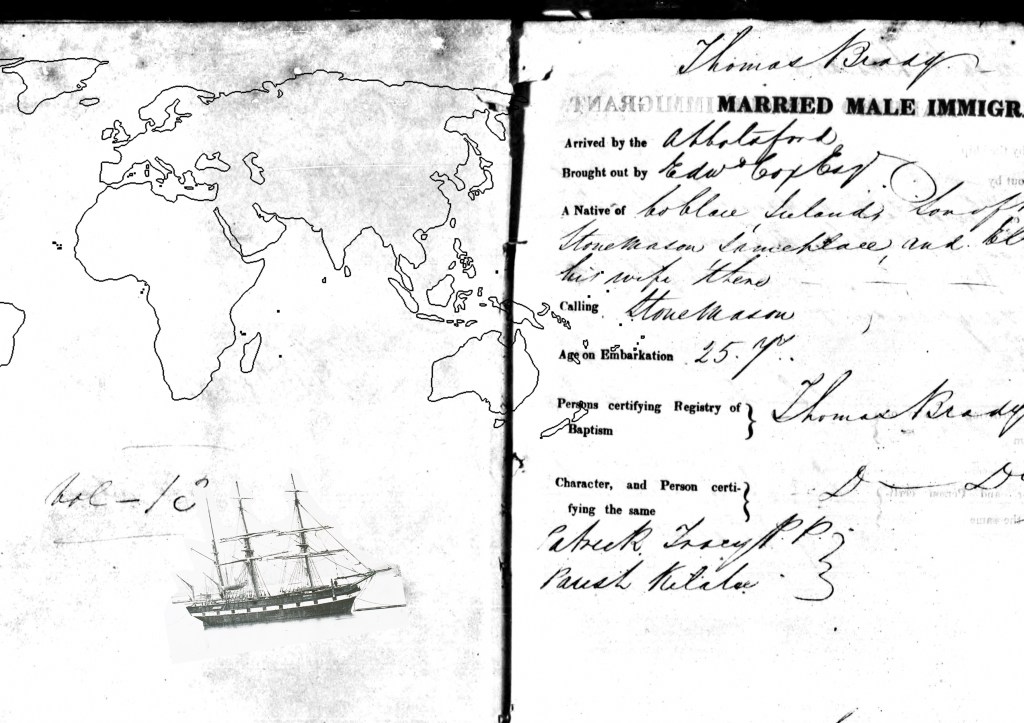
THOMAS BREADY The Irish Stonemason
Bready is in his early 20s from Clare County Ireland, a Roman Catholic stone mason like his father before him. He’s travelling out with his young wife Bridget and their 8 month old son Thomas Jnr.
They are travelling out with Bridget’s brother, also a second generation Roman Catholic stonemason, and his young family too.
Both Bready and his brother in law are bounty immigrants coming out to Sydney Australia to work on the same job for Edward Cox.
EDWARD COX The Pastoralist
Edward Cox is first generation colonist ruling class, son of William Cox.
[William Cox: Lt in the NSW Corps, magistrate for Macquarie on the Hawkesbury and helped oversee the road building through Blue Mountains]
Edward Cox is ready to build a greek revival sandstone house for his young family, so cue Thomas Bready and his fellow stonemasons….all twenty of them, to build below:
>this is it: MULGOA, Fernhilll Estate NSW
Now a part of the National Trust.
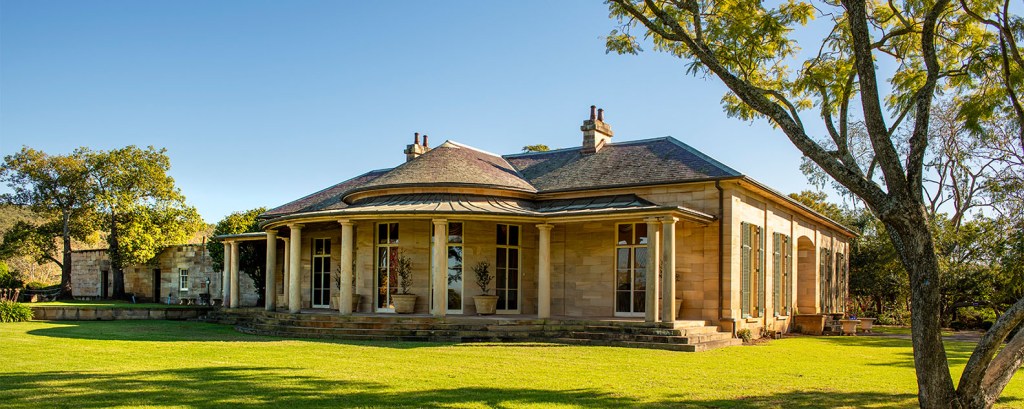
official site for the house here: https://www.greatersydneyparklands.nsw.gov.au/learn-and-discover/heritage/fernhill-estate-heritage
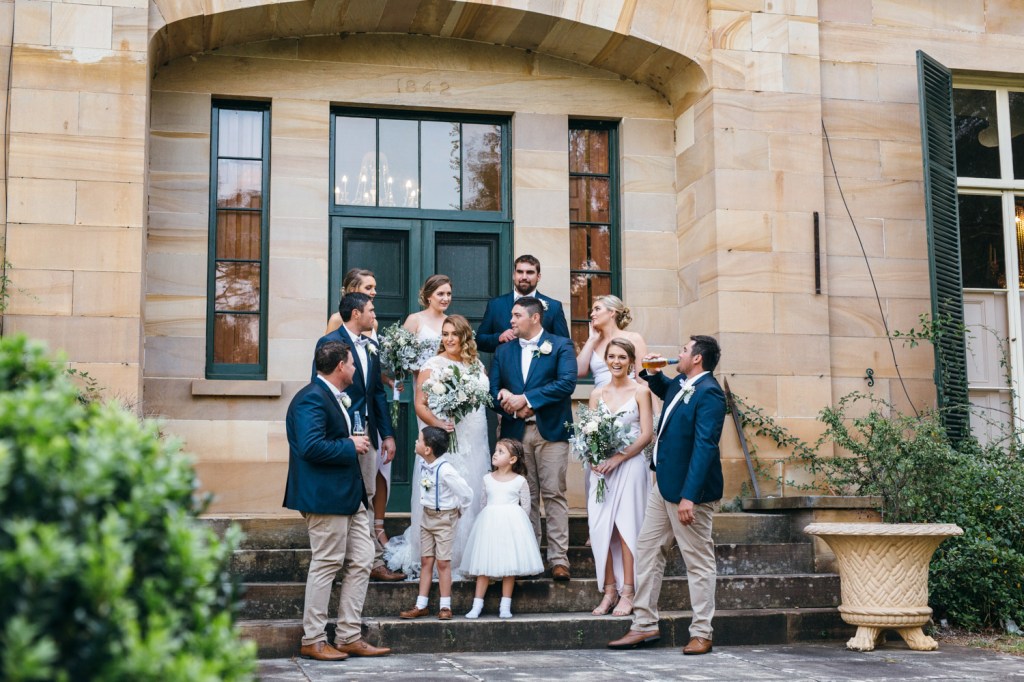
Here is Jess and Ben’s wedding at the estate from 2019 I found on the internet by “photographer pete dot com” (great domain name)
https://photographerpete.com.au/jess-and-bens-fernhill-estate-wedding/
You can see the year 1842 carved above the front door
>back in Melbourne around this time (While Mulgoa is being built)> Looking at Victoria Pde on the (modern collingwood) side of Brunswick St.
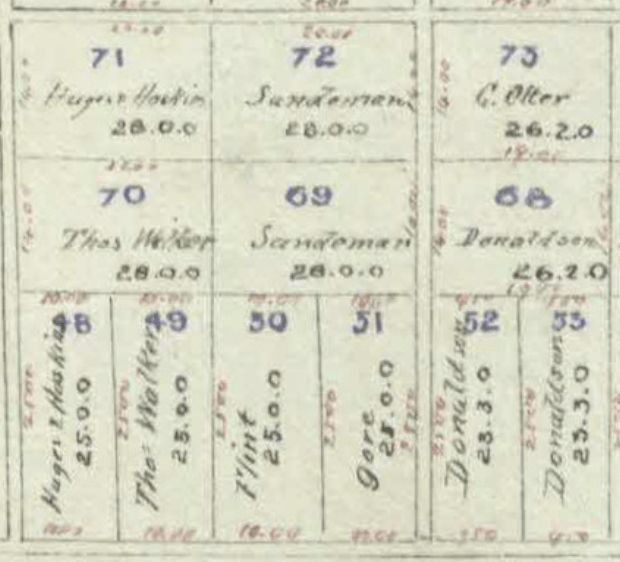
SECTION 51 from Jika Jika Parish, undated.
source – Anon (1837) Plan of the Parish of Jika Jika in the County of Bourke. https://find.slv.vic.gov.au/permalink/61SLV_INST/1sev8ar/alma9925478513607636
Modern fitzroy is planned into sections of crown land to be purchased, the land sales are done in Sydney. Here’s section 51 which is purchased by a cashed up young man for his uncle back in London.
Gore’s section 51 is Victoria Pde (bottom south), George St (Left west), Webb St (top north), and Smith St (right east).
1840
THOMAS GORE the Cashed up Nephew
Thomas has been sent to Sydney by Uncle John Gore back in London as an agent to buy up investment opportunities.
He purchases Section 51 (above) in land auctions in Sydney, as a trustee, but… maybe he’ll try and keep it for himself.
[Who is his uncle? Uncle John Gore is the largest importer of Australian wool to Britain and a founder both of the Union Bank and of the NSW and VDL Commercial Association]
Source: Barrie Dyster, ‘The Depression of the 1840s in New South Wales’, Australian Dictionary of Biography, National Centre of Biography, Australian National University, view online here, https://adb.anu.edu.au/essay/29/text40594, originally published 1 August 2022.
Looking at Melbourne CBD at this time c.1840s.
Are you thinking of the sketches and drawings and prints at this time and are they paying you a disservice.
See the first nation peoples you can see here in the CBD?
They are actually not supposed to be in frame because that’s a new rule from Superintendent La Trobe. So, if you look further afield, you’ll see there is this awkward relationship between Protector Thomas Green and first nations people where Green travels around on horseback keeping tabs on everyone and where they’re camping and trying to encourage them to move on and keep out of the city limits. Melbourne is already a town full of prospect and fortune before the gold rush, but for others it is a loss of dominion with unpredictable prospects.
source: Broome, R. (2005) Aboriginal Victorians: a history since 1800 Crows Nest, NSW: Allen & Unwin. p104
LA TROBE Now forever triggered
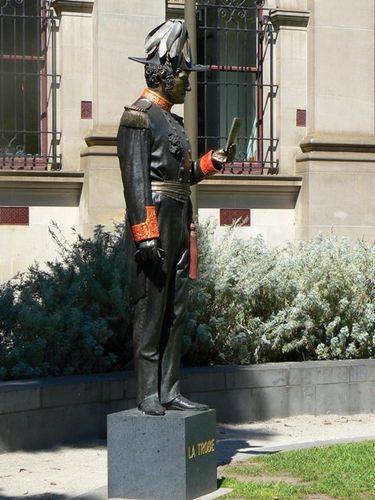
Ingenious that here is a modern monument to LaTrobe placed in the centre of the city where he is be passed by first nations people all the time and perpetually triggered. Great subversive touch, brava State Library of Victoria!
image from here
also see: https://www.atlasobscura.com/places/upside-down-charles-la-trobe-statue-landmark
1840s to 1849
The colonial real estate mania in Australia is catching up with itself and crashing after too much speculation from the likes of the Gore family.
1841: THOMAS GORE, INSOLVENT NEPHEW
Published notice of insolvency
source: Advertising, ‘TAKE NOTICE’ (1841, November 6). The Australian (Sydney, NSW : 1824 – 1848), p. 1. from http://nla.gov.au/nla.news-page4257929
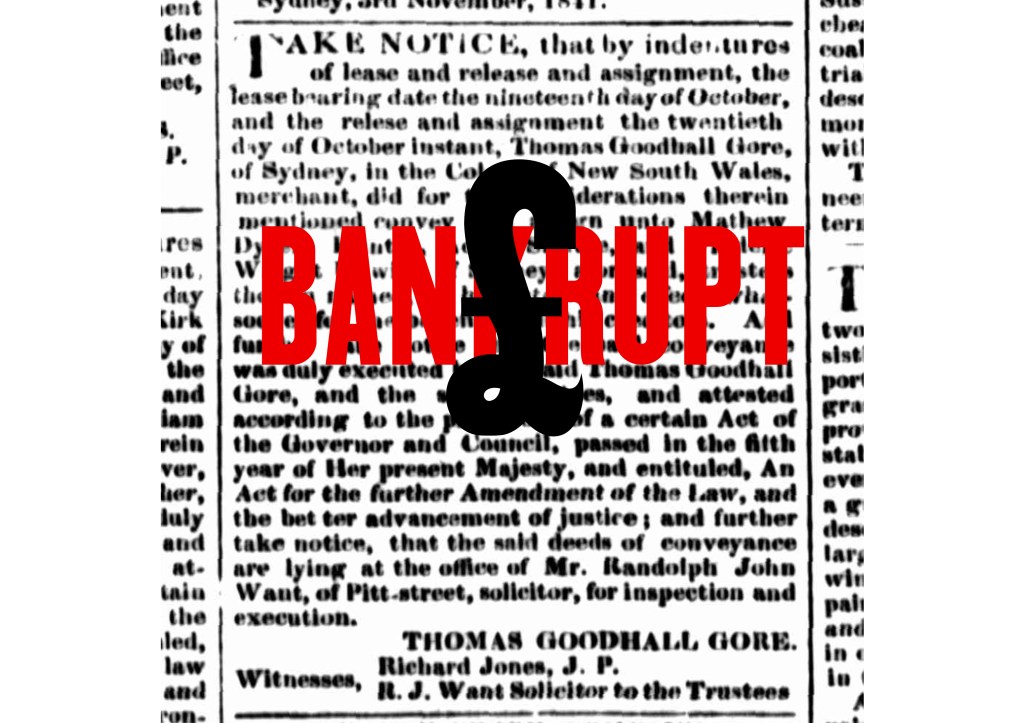
Thomas Gore turns out to be a poster boy for this economic crash because in this year
-he has lost at least £20,000 of Uncle John’s money
-gets dragged through insolvent office
-173 other claimants come forwards from Britain and Australia, estimated he owes £107,000 all up
There’s not a lot written about Thomas Gore. Someone needs to research him and family further. There’s also a Charles Gore who gets mentioned with a bankruptcy case specifically with section 51 who must be a family member going from newspaper sources at the time.
source: Barrie Dyster, ‘The Depression of the 1840s in New South Wales’, Australian Dictionary of Biography, National Centre of Biography, Australian National University, view online here, https://adb.anu.edu.au/essay/29/text40594, originally published 1 August 2022
WHILE GORE IS GOING THROGH BANKRUPTCY:
Its hard to find maps showing individual houses of the time in Section 51 but
Here’s some PUBS in the area at this time to get a sense of the european settlement (this is a bit of a cheat given the map is dated 1855) but still – here’s the Tulloch and Brown ‘Melbourne And It’s Suburbs’ map
a rough idea of how many pubs are around Fitzroy –
[Section 51 highlighted, Collingwood Hotel diagonally across cnr. Gore and Webb].
souce for map: Brown, J. D. et al. (1855) Melbourne and its suburbs [cartographic material] / compiled by James Kearney, draughtsman ; engraved by David Tulloch and James D. Brown. Viewed online here https://find.slv.vic.gov.au/permalink/61SLV_INST/1sev8ar/alma997869963607636.
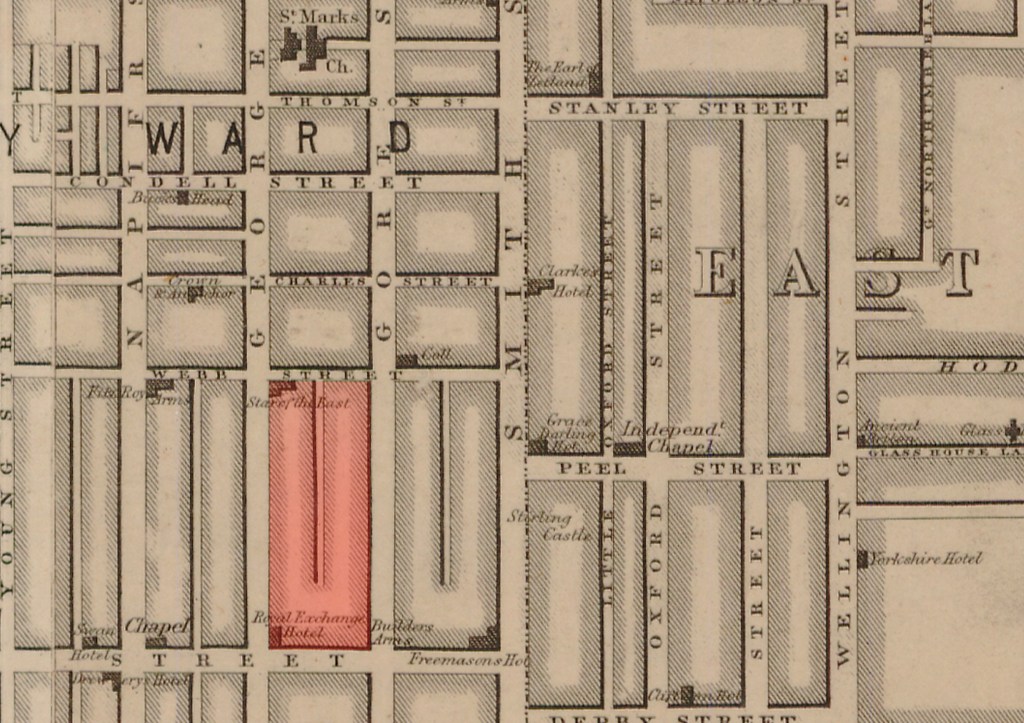
The Collingwood Hotel (NOW the Union Club Hotel) is built 1849 for publican and owner James Swords. The builder is our Irishman Thomas Bready. I imagine it may have looked like the Grace Darling hotel ie done with bluestone. Current inception is an Edwardian era rebuild, Union Club Hotel, but the basement is probably still bluestone.
Section 51 has the Star of the East pub, now brick warehouse on corner
a future Royal Exchange pub is now Gabriels cafe
Thomas also builds two other houses for Jeremiah Crowley, another publican [not to be confused with the escaped Sydney convict of the same name – awkward].
Here’s the other 2 houses:
-modern day 90 and 94 George St. -this has been researched by Meg Lees.
Here’s the Hodginskon map from 1852 superimposed over the modern street numbering of the Melbourne Metropolitan Board of Works map from 1899 to get a sense of location.
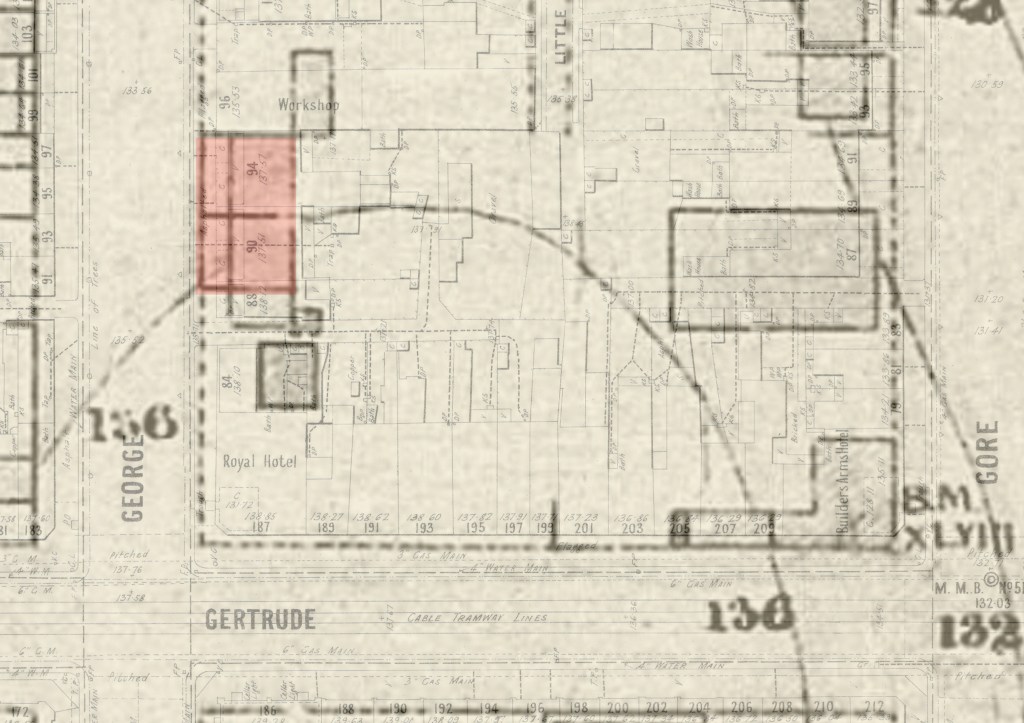
[more on Hodgkinson map: I’ve since learned the original is at public records office:
permanent link: https://prov.vic.gov.au/archive/FDB74EAA-F858-11E9-AE98-83693D179613?image=1
MELBRL3
COLLINGWOOD AND EAST MELBOURNE CONTOURED PLAN; HODGKINSON;; JIKA JIKA MELBOURNE NORTH
CITATION: VPRS 8168/P0002, MELBRL3
dated: 1852-01-01 – 1852-12-31]
Its the earliest map showing the buildings Bready built.
more on Board of Works map: source:
Anon (1899) Melbourne and Metropolitan Board of Works detail plan. no. 1202, City of Fitzroy [cartographic material]. See online here: https://find.slv.vic.gov.au/permalink/61SLV_INST/1sev8ar/alma9911645233607636
zooming back out, below is an undated subdivision that I place to be around this time of 1852
Plan of subdivision of suburban portion no. 51 situate at Collingwood in the Parish of Jika Jika in the County of Bourke (my excerpt):
source: Anon (1837) Plan of subdivision of suburban portion no. 51 situate at Collingwood in the Parish of Jika Jika in the County of Bourke. Viewed online here https://find.slv.vic.gov.au/permalink/61SLV_INST/1sev8ar/alma9925478733607636
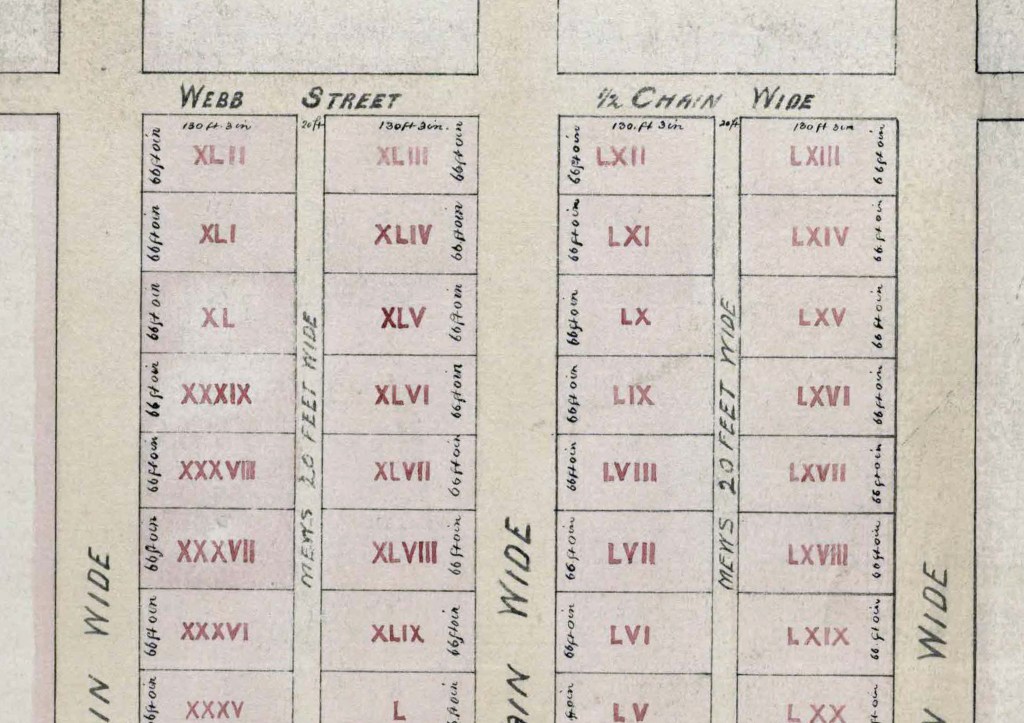
These subdivisions are now half a block long with the service road (Little Gore St) going through them for the night soil man
here’s a close up of Lot 43 on the top right. ( XLIII )
James Sword of the Collingwood Hotel has been the running pub now for two years, and has purchased lots 43 and 44 from the broken up Gore Estate:
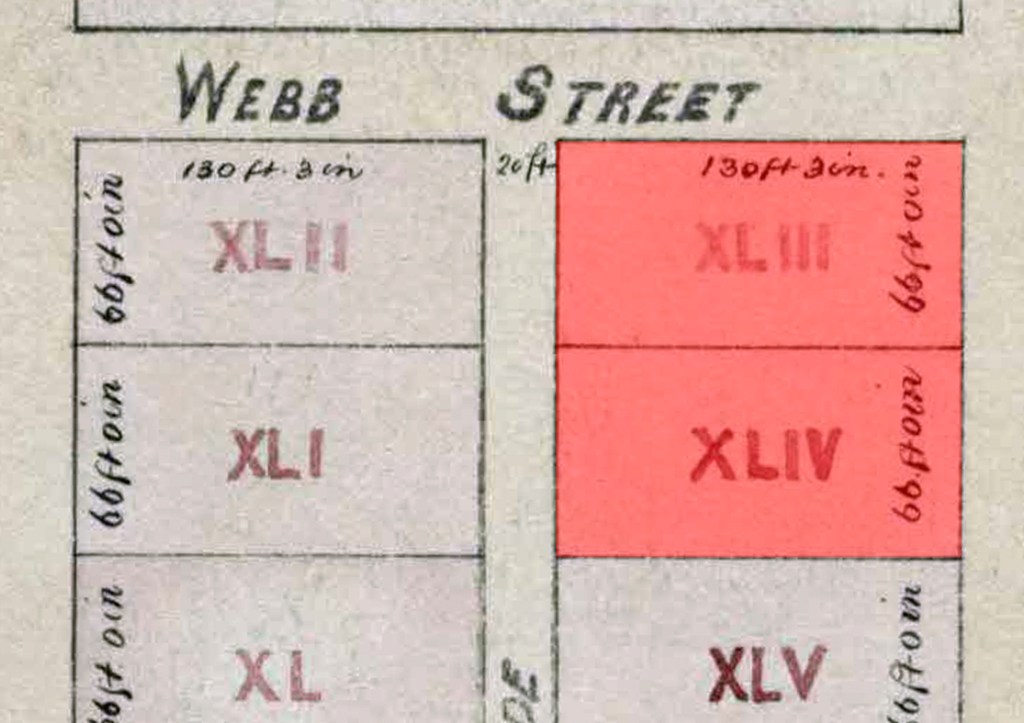
(I need to source that! its in my notes.)
and now Bready, who built James’ pub, is going to build his own house on Lot 43. (LXIII) – the lot owned by James. (There’s presumably a transfer of land somewhere along the line).(( —rabbit hole on how land deeds are done at this time pre modern land title system…see…https://prov.vic.gov.au/lands-guide))
1852 BURCHETT INDEX 28 August 1852
Here’s the first evidence of 50 Webb Street from the Burchett Index in the Miles Lewis’ Australian Architectual Index hosted by Melbourne Uni.
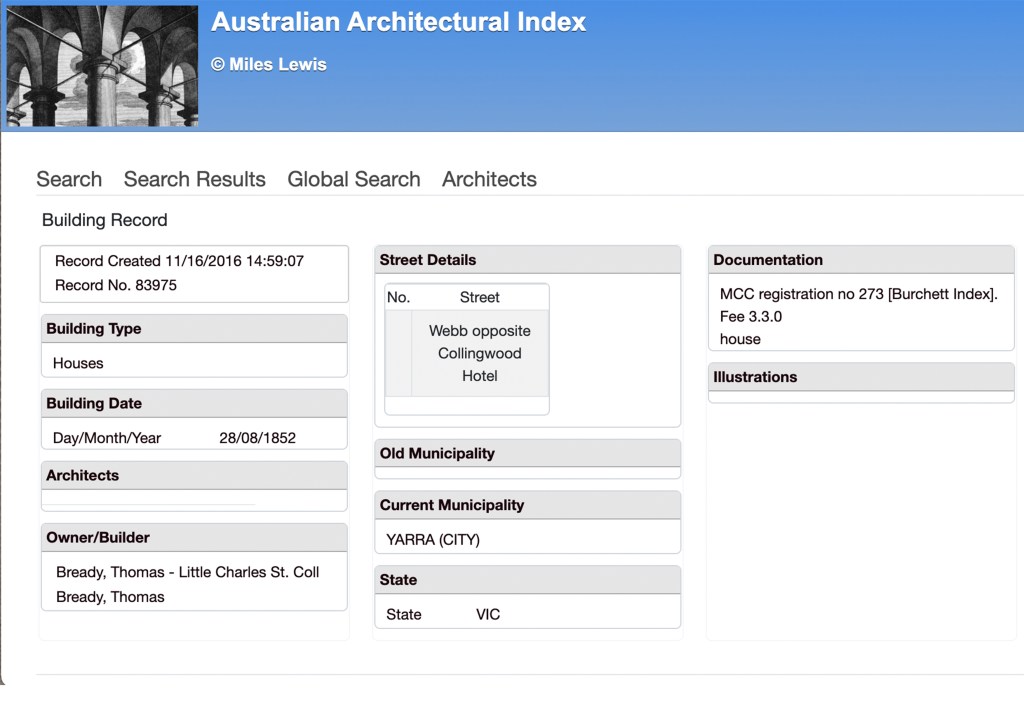
source: AUSTRALIAN ARCHITECTURAL INDEX Record No. 83975
ONLINE: https://aaindex.app.unimelb.edu.au/building-record/83975
Note Bready is associated with Little Charles St, Collingwood – either as his personal residence or as a business/office address.
Fee paid for 1 house on Webb Street, opposite Collingwood Hotel with Bready builder owner on 28/08/1852.
MCC registration no 273 [Burchett Index]. Fee 3.3.0 house
1852 HODGKINSON SURVEY
(This image is superimposed on the previous Parish subdivisions). First recorded image of current day 80 Webb Street then “the house opposite the pub”. (ie modern union club hotel then Collingwood hotel).
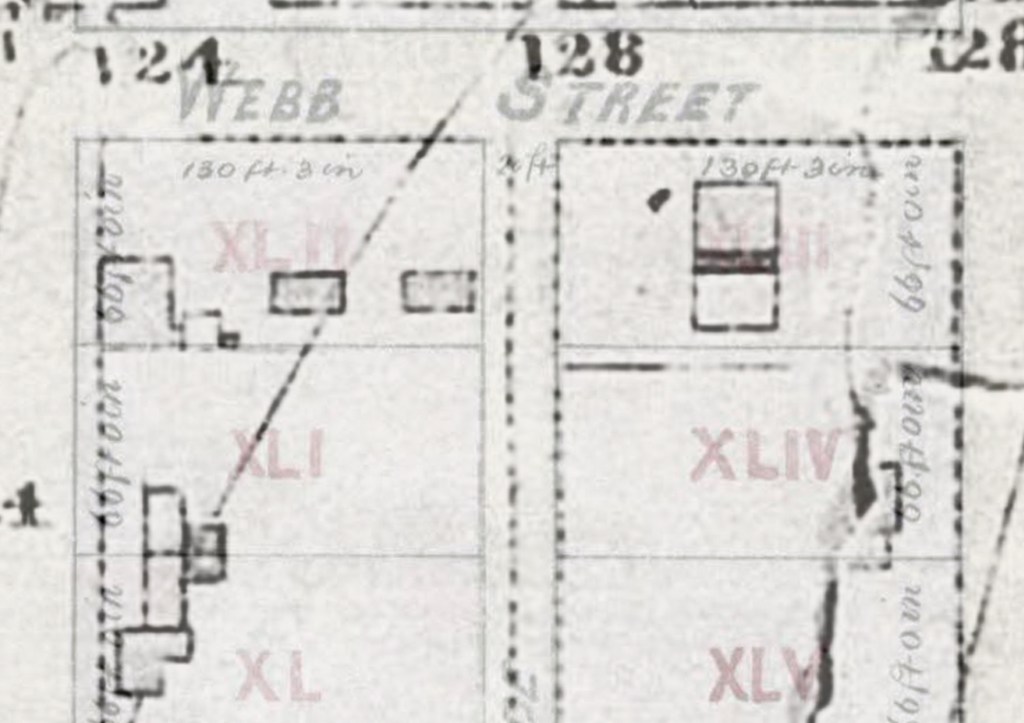
What was the deal?
James Swords owns the land, Bready built and owns the house, and future councillor of Fitzroy Thomas Rowe owns part of the house as a mortgage.
[various sources, need to cite]
1852 GOLDRUSH
Victoria is the new gold rush destination.
Here’s a shiny gold ingot from 1852. Just because it looks so mesmerising
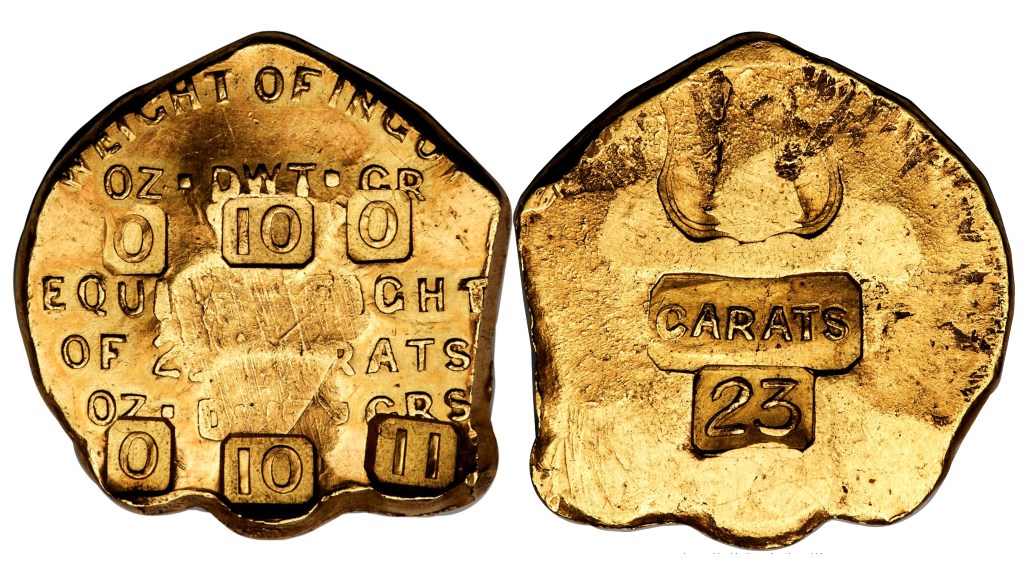
image source: South Australia. British Colony – Victoria gold “Adelaide Assay Office” Ingot ND (1852) – Type I, Australia Adelaide Assay Office, Jul 8, 2024 viewed online here: https://rareingot.com/australia-adelaide-assay-office
Thomas Bready and family drop everything for the goldfields along with the rest of the colony. [multiple sources] Much like this family of five who have just got off the boat.
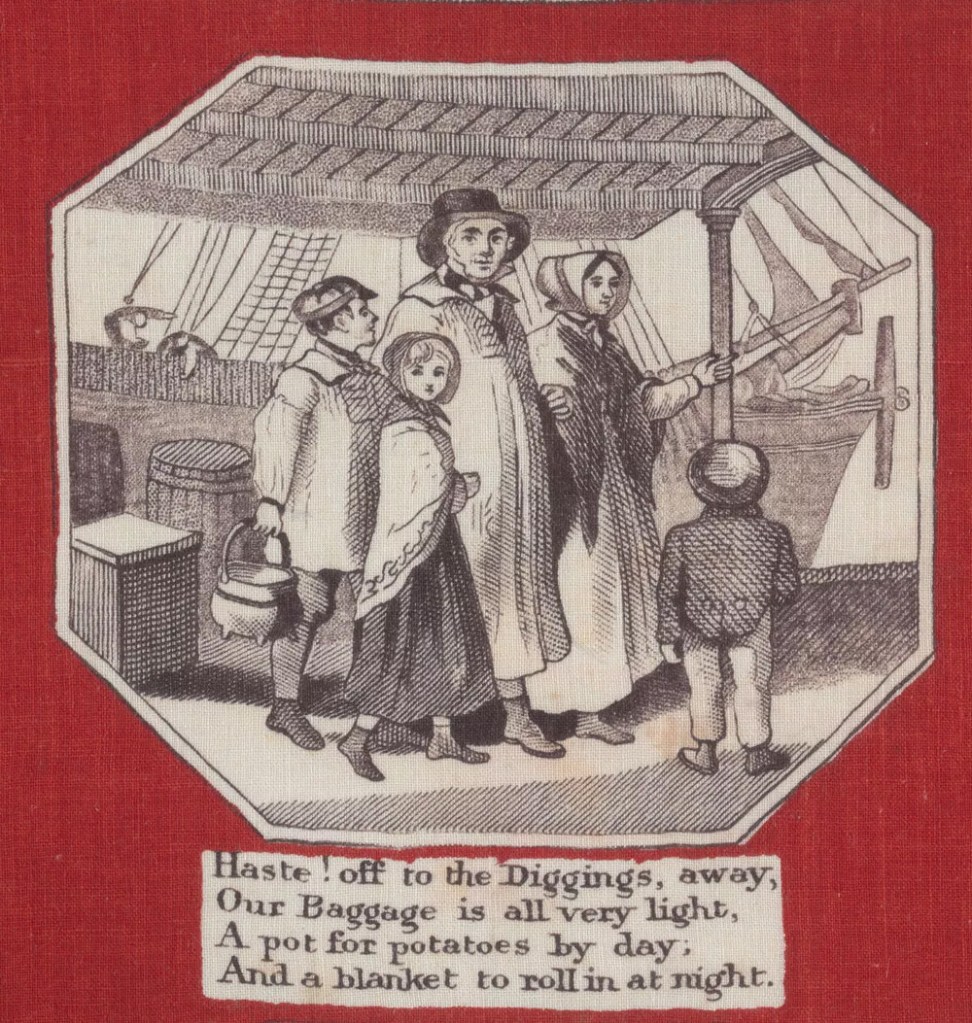
Haste! Off to the diggings, away / Our baggage is all very light / A pot of potatoes by day / A blanket to roll in at night.
taken from online here: https://www.sbs.com.au/gold/rush-for-gold/
It would have been practically impossible to build anything in Melbourne at this time, with a mass exodus of labour to the goldfields leaving labour shortages and consequently things like supply and building material shortages. the whole supply/demand economical system was kind of in freefall. Even the prisoners in Melb Gaol don’t have any bluestone to break because there are no quarried stone deliveries because there is no quarried stone.
The Golden Age: A History of the Colony of Victoria 1851-1861 by Geoffrey Serle, 1977 Melbourne University Press – i need to check page number.
1855
THOMAS BREADY THE SLY GROGGER
Fast forward 3 years, Bready is now in his 30s, a storekeeper in Sandhurst (Bendigo) selling unlicensed grog on the side. He’s living out of his store …which is a shack. Mrs Bready and her three children live in a house with two miners who are most likely lodgers.
Bready has gone from functional alcoholic> dysfunctional alcoholic to now a non functioning alcoholic.
So non functioning that he has to be watched over by his teen son or one of the miners living in the house, because he’s at risk of harm to himself or others.
Luckily Bready prepares a will
(rewritten out copy of the will from 1855)
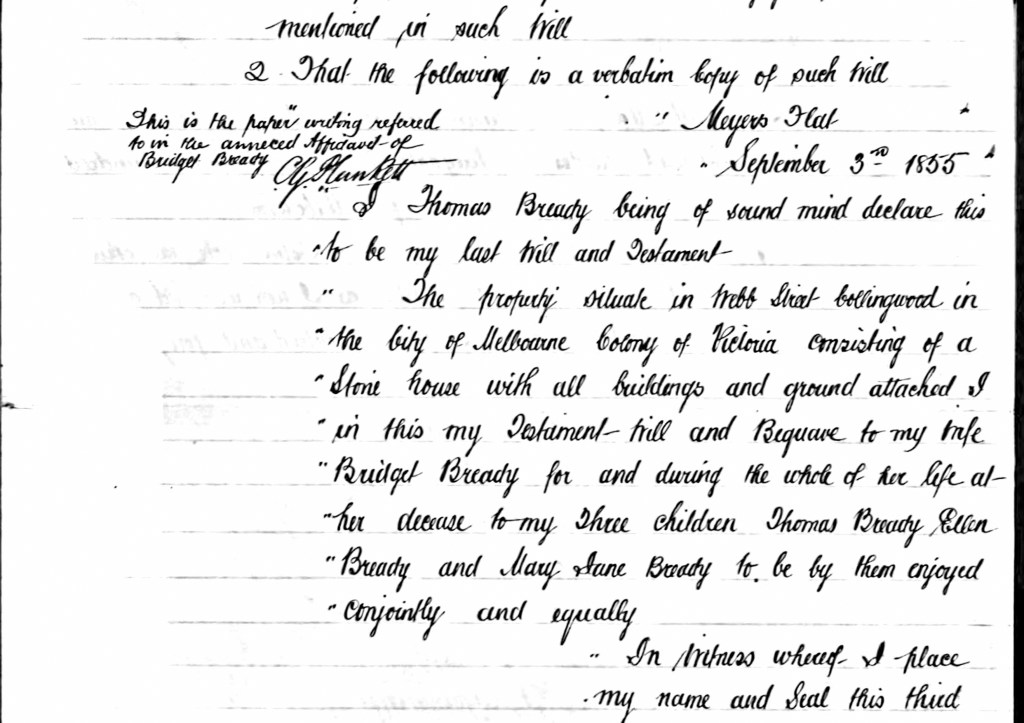
There will be questions later on (was he of sound mind, is the will even a forgery?)
As it is, the will is made and states that the Stone House with all it’s buildings and ground attached is bequeathed to Bridget [to live in]…and once Bridget dies it is to be equally owned and enjoyed by children Thomas Jnr, Ellen and Mary Jane.
source: Public Record Office Victoria; North Melbourne, Victoria; Victorian Wills, Probate and Administration Records 1841-1925; Series: VPRS 7591
Cover page: 00028-p0000-000149-0480-00011
3 Sept 1875 Affidavit of Henry Penketh Fergie see page 00028-p0000-000149-0480-00012
25 DAYS LATER
Thomas has been left unwatched and he’s found dead.
BENDIGO ADVERTISER October 3 1855:
source: SANDHURST COURT OF PETTY SESSIONS. (1855, October 3). Bendigo Advertiser (Vic. : 1855 – 1918), p. 3. http://nla.gov.au/nla.news-article88047603
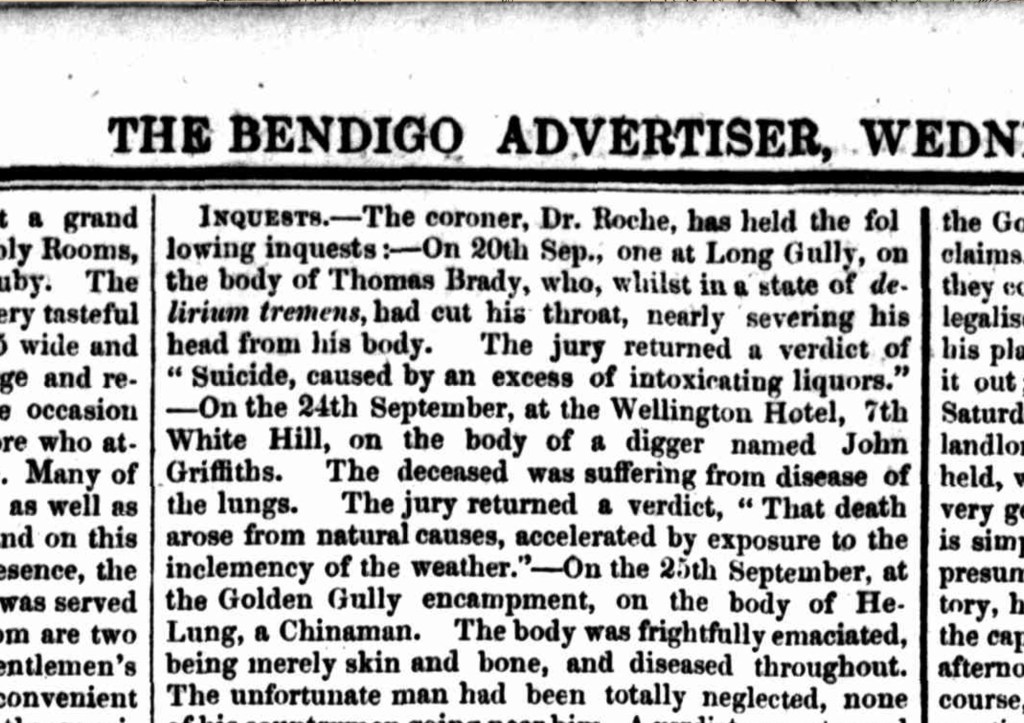
At the inquest, the Coroner finds that Thomas Bready “had cut his throat, nearly severing his head from his body” while suffering delirium tremens.
-DT is something that happens to a heavy and chronic alcohol user when they experience a drop in alcohol levels, and snaps your brains neurotransmitters.
-treatable now but it must have been a common fate for die-hard alcoholics in the colony ie half the population.
So now that Bready is dead, what happens?
Bridget doesn’t live in 50 Webb St, she continues to rent it out – well a man does this on her behalf. Thomas Rowe is a mortgage holder to the property and deducts rent payments from his loan to her. And the house is getting a clean out: Mrs Symonds needs to come collect her two dresses.
MRS SYMMONDS!
Here’s an ad from a month later, October 1855
ADVERTISING: MRS. SYMMONDS- call for your Two Dresses at 50 Webb-street, Collingwood, or they will be Sold.
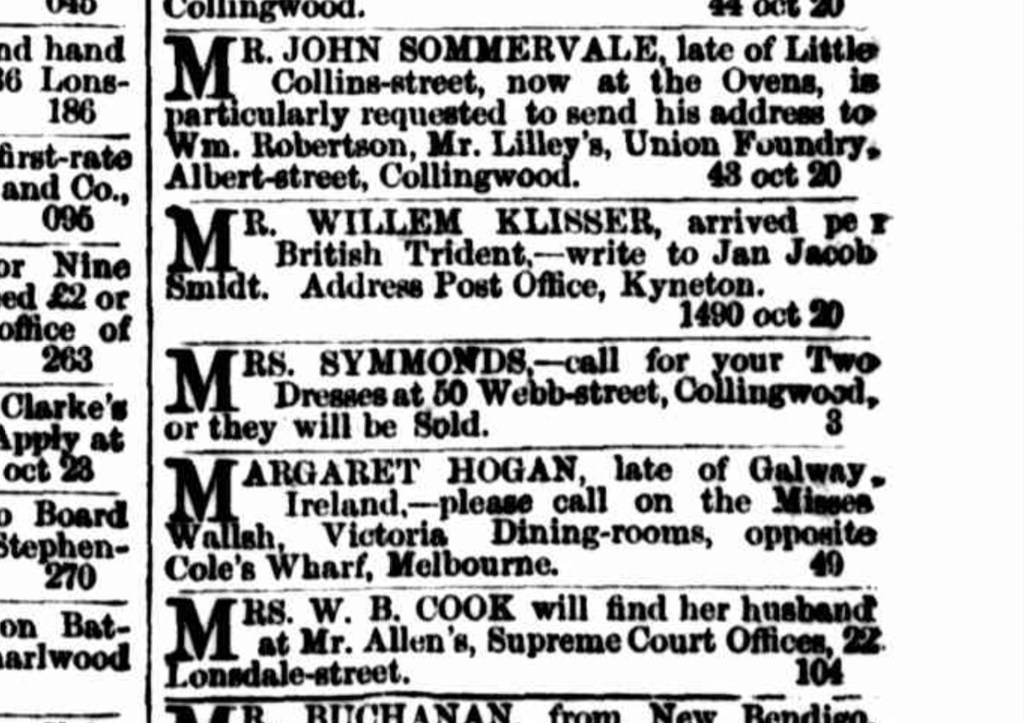
source: Advertising (1855, October 20). The Argus (Melbourne, Vic. : 1848 – 1957), p. 1. http://nla.gov.au/nla.news-article4821338
1861
there’s a new building across the street. It’s the George Wilson & Co., British Wine, Cordial, Malt Vinegar & Blacking Manufactory. Photo by Davies & Co. (Melbourne, Vic.)
See the uncropped image online here. (below is a cropped version which I’ve desaturated).
Source: Anon, Davies & Co, Melbourne (1861) [George Wilson & Co., British Wine, Cordial, Malt Vinegar & Blacking Manufactory] [picture] View https://find.slv.vic.gov.au/permalink/61SLV_INST/1sev8ar/alma9917908623607636.
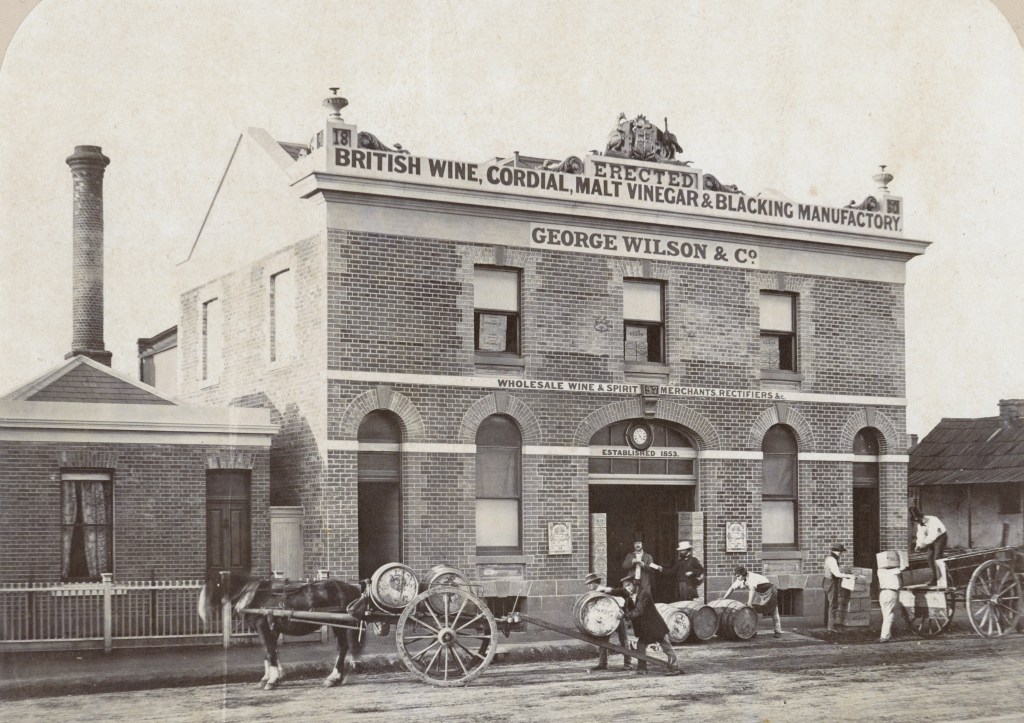
When the building first opens, they hold a ball.
The cellar: Boilers and cooling vats where the wines, cordials, vinegars are made
ground level: office space and bottled stock is kept here.
first floor: Open floor plan space with massive table where boys make the blacking.
(source: OUR MANUFACTORIES. (1862, August 27). The Herald (Melbourne, Vic. : 1861 – 1954), p. 3. from http://nla.gov.au/nla.news-article244228926)
The smells would have been wild in this building.
From what I can understand about blacking, it’s a variable mixture that you can use on iron cookware, stoves AND items made of leather, to both blacken and make water resistant
Hence blacking is also a reference to pre 1900s style boot polish – it’s a nickname for what we consider modern shoe polish as it helped protect leather with water resistance against the elements and unsealed roads (as well as cosmetically disguise wear) but blacking would also have been used in stables and was part of a kitchen and fireplace maintenance routine, as it kept fittings and hardware rust proofed and presumably easier to keep clean and wipe off food fats from cooking.
Blacking might be made from a dark vegetable matter (plumbago) it might include soot, graphite, or oxidised lead mixed with molasses or sugar (as a binding agent I’m guessing), beeswax, vinegar or tallow.
(It makes sense that this factory was manufacturing vinegar if it’s also a material used in making blacking, and there’ an obvious cross over with the cordials and sugar if the blacking used sugar in its process too).
(info about blacking sourced here: Laura Ingalls Wilder A-Z, ‘blacking / stove-blacking / boot blacking’ by Nancy S. Cleaveland, viewed online here https://shorturl.at/IMvfz)
The boys working on the first floor in this building were doing the same work Charles Dickens was doing when he was 11 going on 12 which, for Charles personally, would have been 38 years earlier than this photo. (David Copperfield’s bottling factory is based on his experience attaching labels to bottles at a blacking factory).
source: The National Archives: ‘Charles Dickens, Warren’s Blacking and the Chancery Court’ by Michael Allen, 1 October 2010 viewed here https://media.nationalarchives.gov.uk/index.php/charles-dickens-warrens-blacking-and-the-chancery-court/
AROUND THIS TIME we also have a combination of First Nations people living within white society making their own way, or living at Coranderrk on the reserve land & trying to make their own way. (Here are the skies over Coranderrk in 1877)
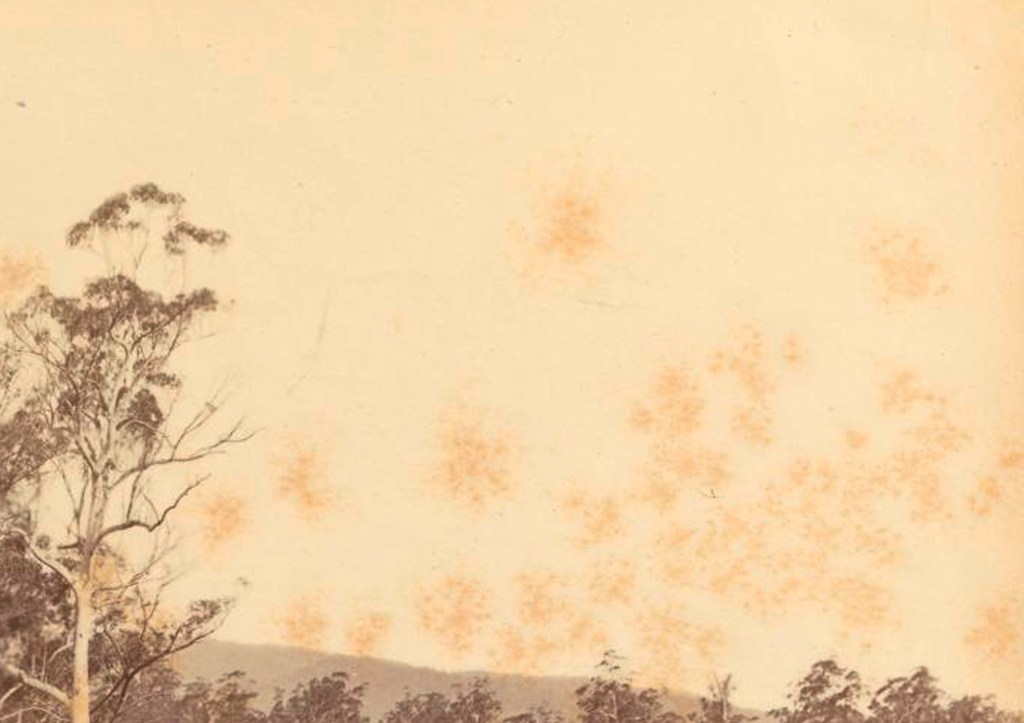
this is a visual cropped from General view of Coranderrk Aboriginal Station
(c. 1877) by Fred Kruger (see the full photo here, but it does contain images of those deceased: https://www.ngv.vic.gov.au/explore/collection/work/8866/)
We do know of one First Nations woman employed in Fitzroy between 1850-86 by Reverend Hamilton (of the Fitzroy Presbyterian Church Napier St). She was described by him later as a ‘half caste’ and was working for him under licence from the Board, for over five years. She was considered “faithful and honest”, handled housekeeping money and was allowed to go out to attend evening meetings (a privilege for a domestic servant).
(source Broome, R. (2005) Aboriginal Victorians: a history since 1800 Crows Nest, NSW: Allen & Unwin. p148)
I’m sure there are a lot of other First Nation people and stories connected to Fitzroy at this time, but they could also have been kept secret and private and hidden – passing as white -or attributing any darker skin tone to a different family background – would have been an effective social strategy to avoid discrimination as well as elegantly dodge the system.
—–
click on 2 for next page:
 burrows & co