ALL THE OTHER THINGS
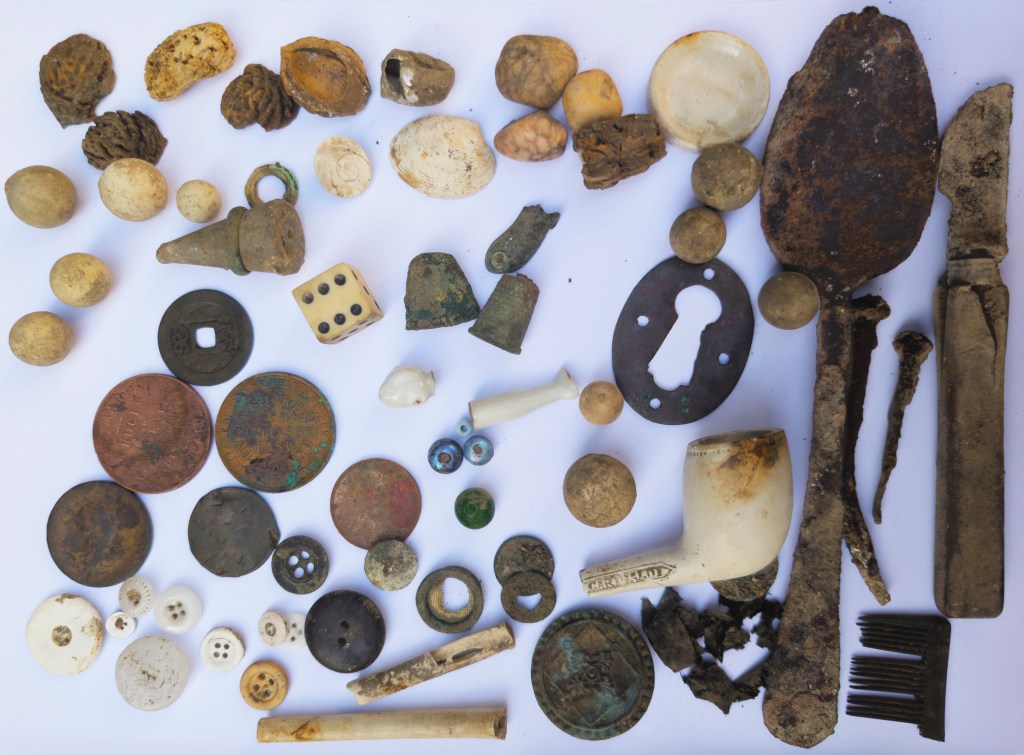
Here’s everything else from under the floorboards.
glass beads
2 Thimbles (also found in little lon archeological digs):
Clay Marbles (see again little lonsdale finds)
but wait! are they clay marbles or are they baking weights?
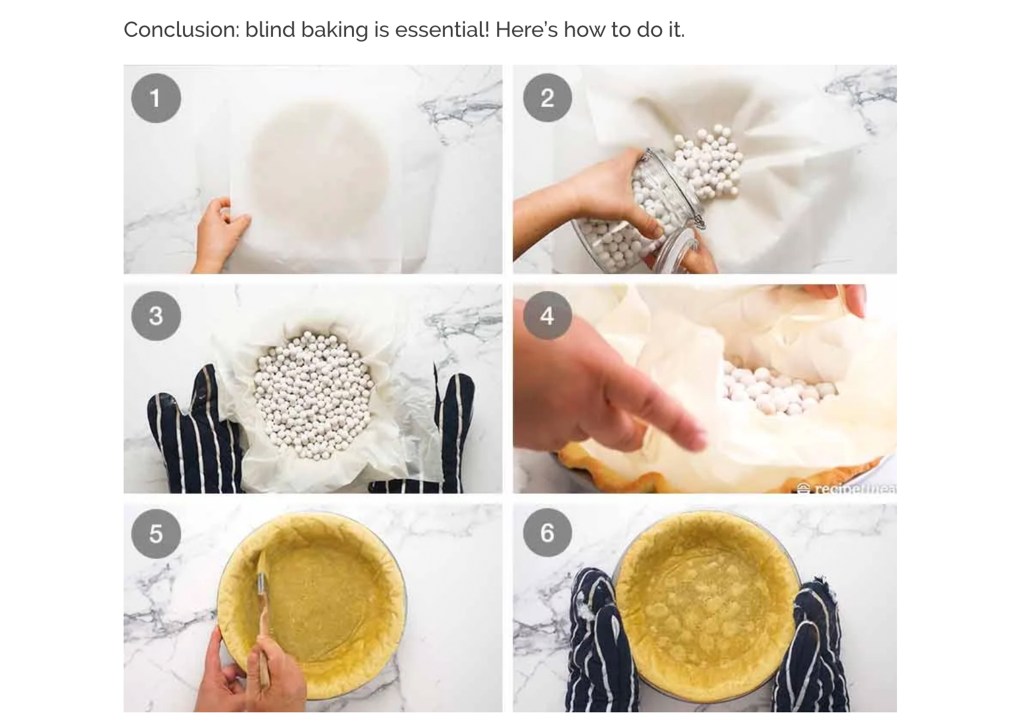
I think we can assume they are baking weights for getting that perfect baked pastry crust1 that may have also lived a second life as clay marbles.
-there’s also an old spoon, a bit of a plastic comb maybe from 1880s, and what is perhaps a woodworkers knife that a carpenter may have forgotten where he placed it when working in the front eastern bedroom.
You can also see up the top there’s nectarine/apricot pips, cork, a single turban shell and a pipi shell. Even some river stones, which are completely out of place to me. But finding oyster shells, bones and nectarine/apricot pips is clearly a kitchen discard pile.
The river stones may have been used as baking weights.
Initially when I found the pipi and turban shell I thought someone has had a day at the seaside and collected the turban and pipi shell… but actually it’s not out of place to find turban shells in discard heaps.
dont believe me? here’s all the turban shells they found in sites at little lonsdale. In with oyster shells and bones and china and other general rubbish2.
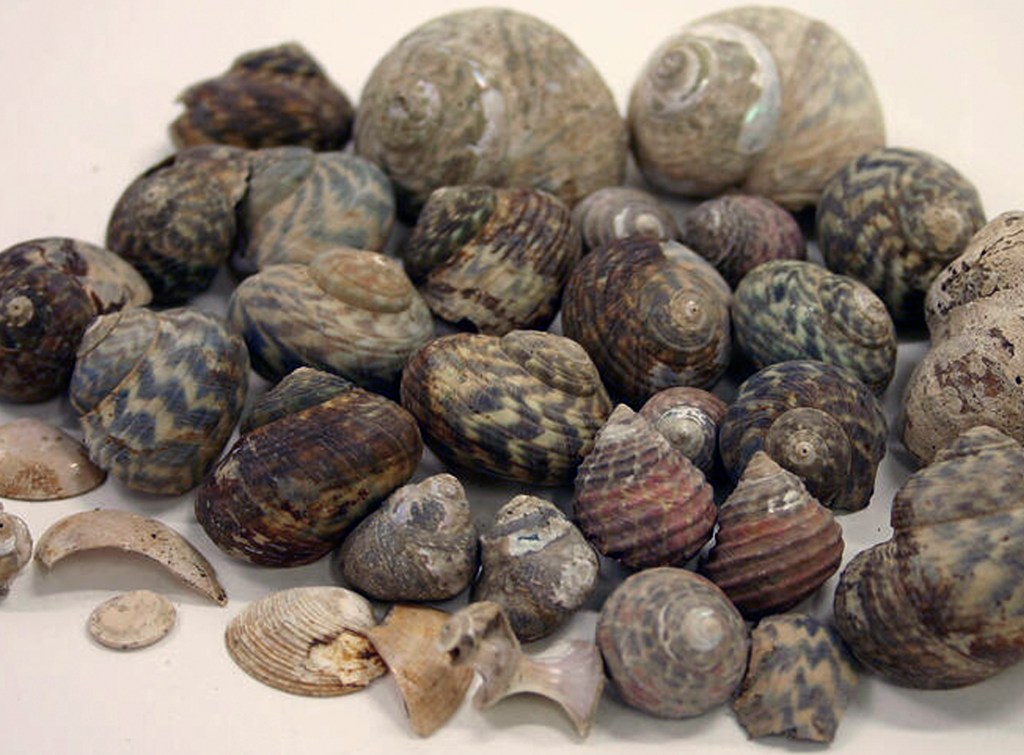
Typically these shells get categorised as non food items by archeologists and probably wrongly as suspected by academic Brendan Marshal3.
THE COINS
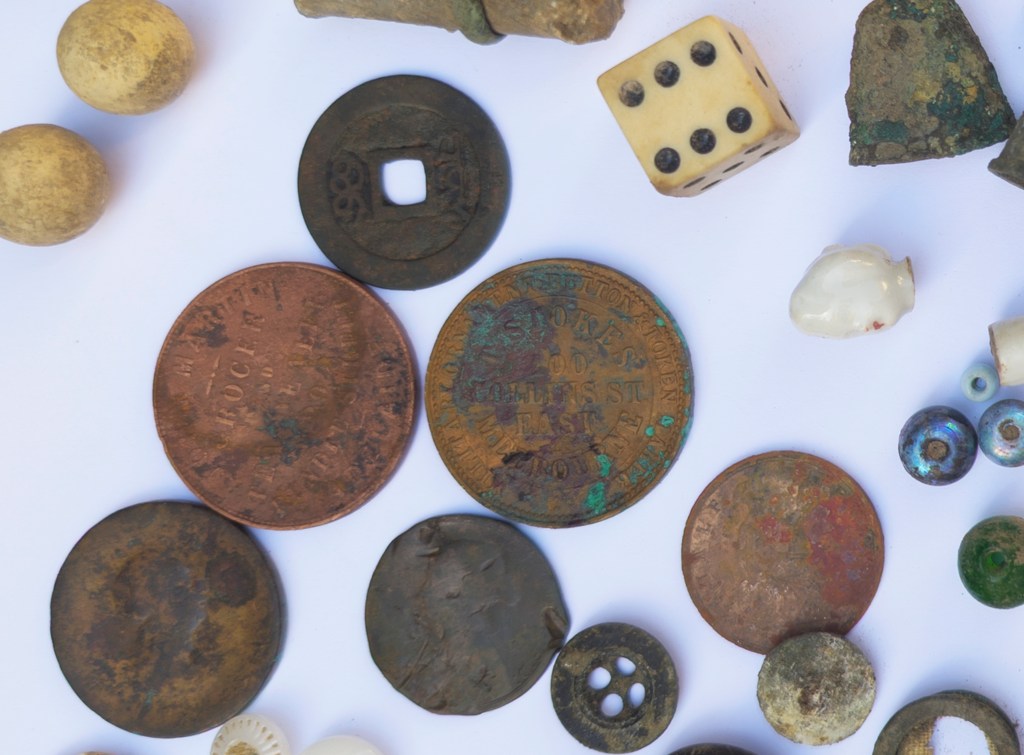
the George III Halfpenny c.1806+
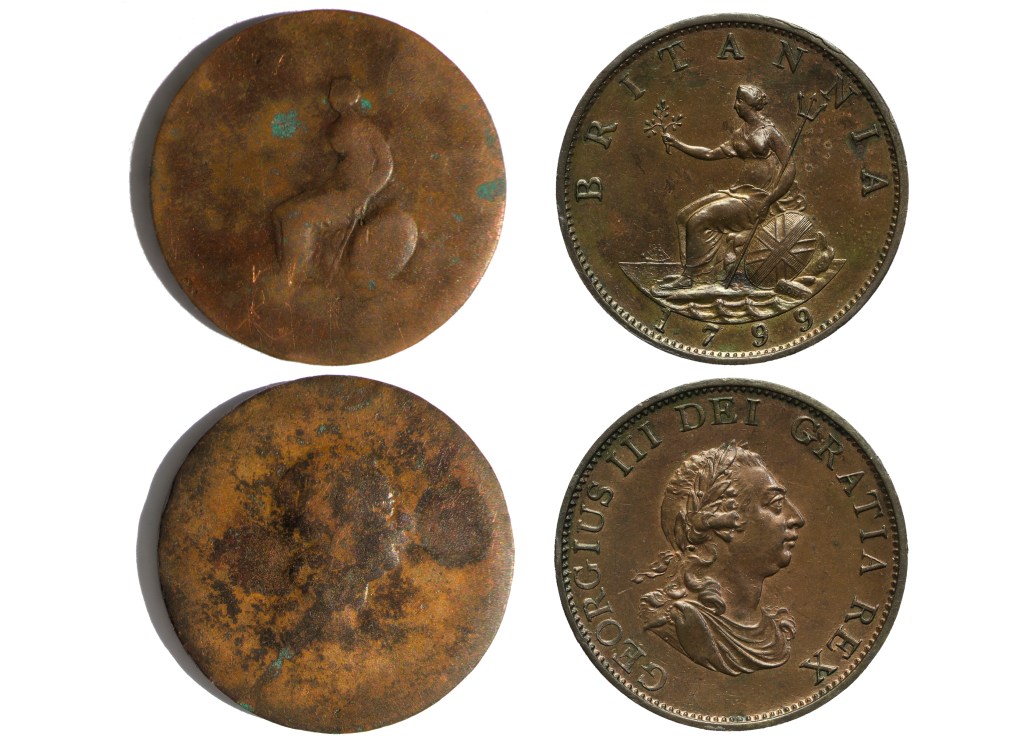
-found in the eastern (small) front bedroom under floorboards and it’s probably the earliest coin from under the house. L: the found coin,R: what it would look like undamaged courtesy of the internet.
This half penny is from around 1806 onwards, it’s NOT the first British coin to be imported into the Australian economy, (that’s the cartwheel penny, and they have found one of these under the convict barracks in Sydney4) but it’s one of the second lots of half pennies shipped over.
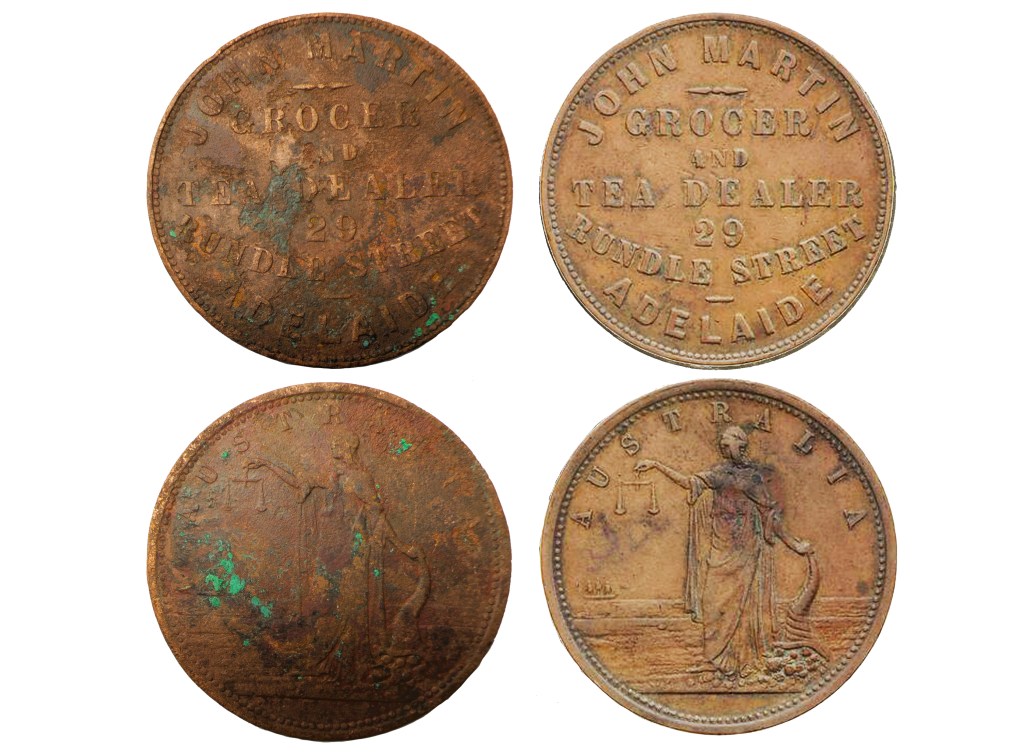
Penny token: John Martin, grocer and tea dealer, 29 Rundle Street, Adelaide c1858
Found under living room near hallway by the astute treasure hunter Mr. Harry Dyer.
L: the found coin,R: what it would look like undamaged courtesy of the internet.
I love how at this time British coinage is not only failing British society by being chronically undersupplied but also that both in Britain and Australia
illegitimate trade or merchant or copper tokens meet the demand for currency in an economy where you don’t have enough official coins circulating.
It would have already been a problem in the 1840s but the goldrush makes penny tokens commonplace. (The goldrush places all kinds of urgent pressures on colonial infrastructure, and there’s calls for a mint to be set up outside of Britain to help source the Australian economy but this won’t happen for a while).
Trade tokens tend to style themselves as semi legitimate by borrowing from traditional government institution imagery so on the reverse of this coin we have Justice, standing blindfolded with a sailing ship on the horizon
I presumed this token would have been locally made but actually it was struck back in Birmingham and shipped out
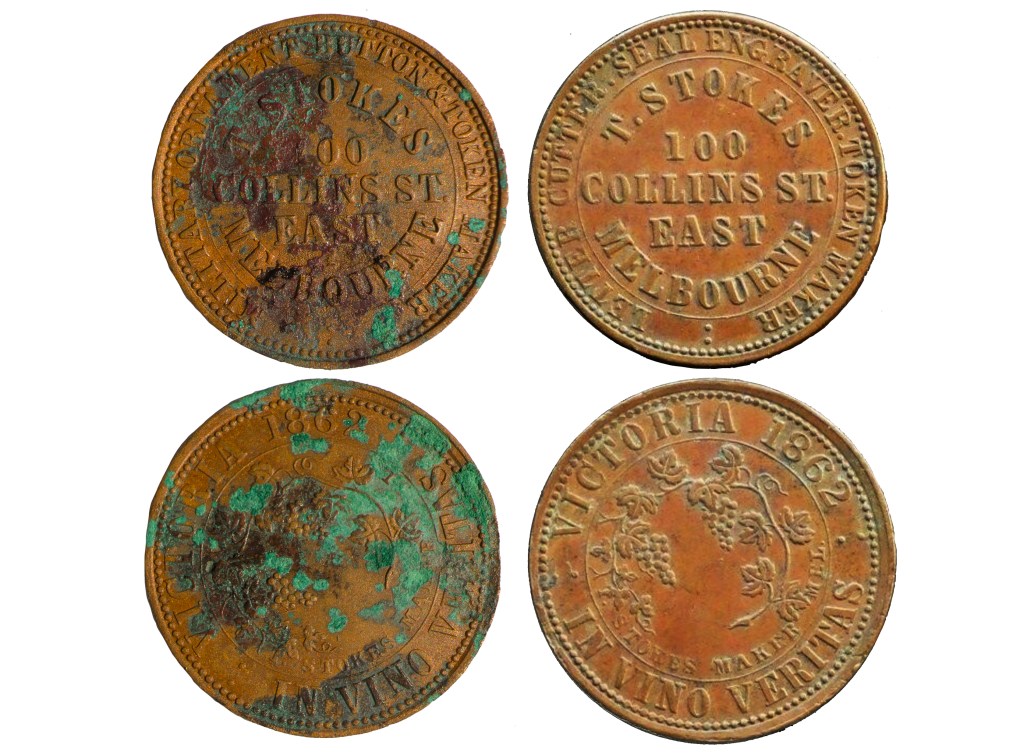
Another trade token, T Stokes 1862
L: the found coin,R: what it would look like undamaged courtesy of the internet.
T. STOKES 100 COLLINS ST EAST MELBOURNE LETTER CUTTER SEAL ENGRAVER TOKEN MAKER
This trade token is a bit more playful than the one with the figure of Justice, this token has a grape vine with “IN VINO VERITAS” which is latin for in wine there is truth.
Tokens get banned for trading in 1863
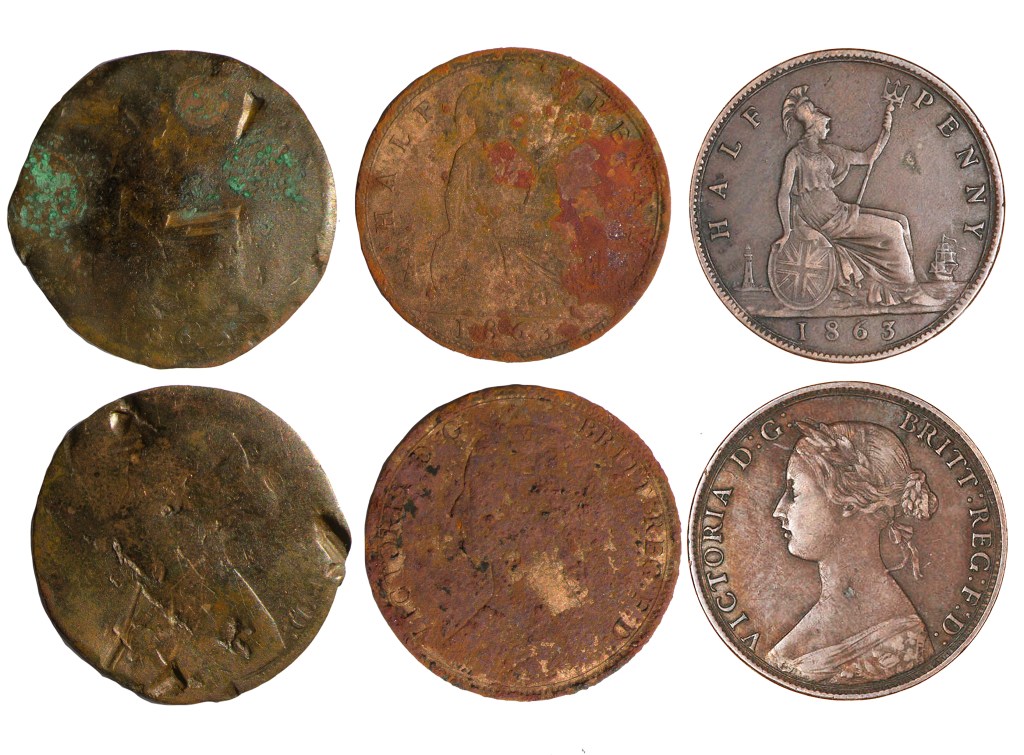
Queen Victoria half penny
1862 and 1865
L: the mashed up one underneath eastern bedroom floor next to that, a krusty one just under the heater in the living room. R, an 1863 example from the internet
tang bao aka ‘cash coin’ aka ‘chinese shilling’
Found under the eastern bedroom floorboards. From the then contemporary Qing ruling dynasty in China. Kang Xi’s reign was 1661 – 1722 but these coins would remain in circulation potentially up until coin modernisation in 19035.
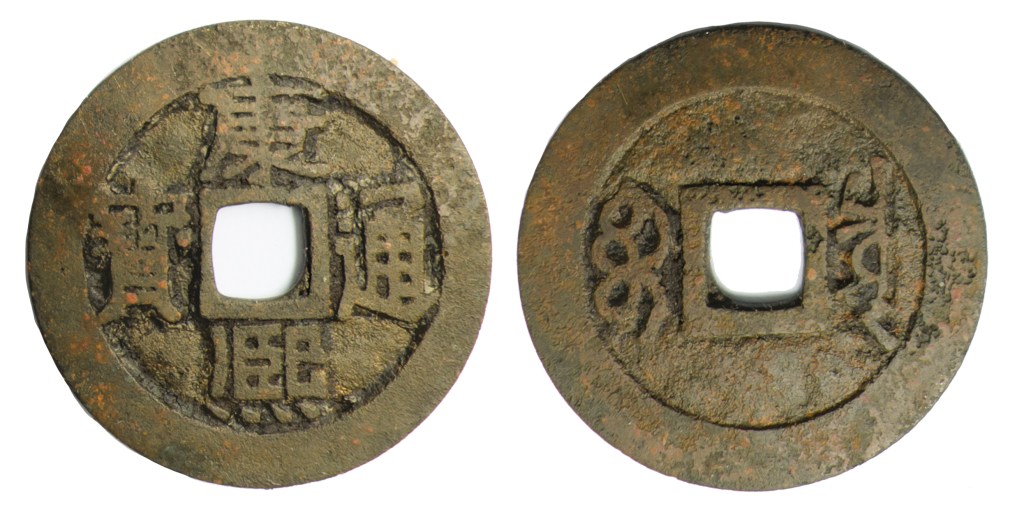
reading the text on the coin6:
康 熙 Kang Xi (Qing emperor’s reigning name in Manchu, read top down)
寳 tong (=’circulating’) 通 bao (=’treasure’) (read left to right)
so = circulating treasure of Kang Xi.
reverse:
ᠪᠣᠣ Boo (manchu for treasure) and then
ᠴᡳᠣᠸᠠᠨ the board of revenue mint in Beijing.
oh and the dice, it was with the tong bao coin
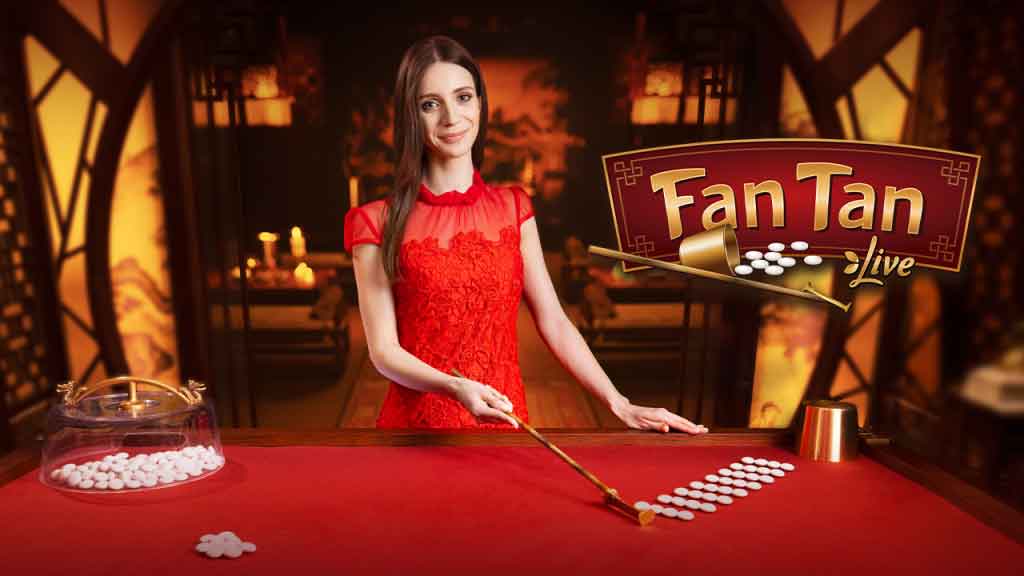
So maybe the tong bao coin was also stepping in as a token for Fan Tan, a popular Chinese gambling game…
Heres a Fan Tan scene posed in a photography studio from China in the 1890s7.
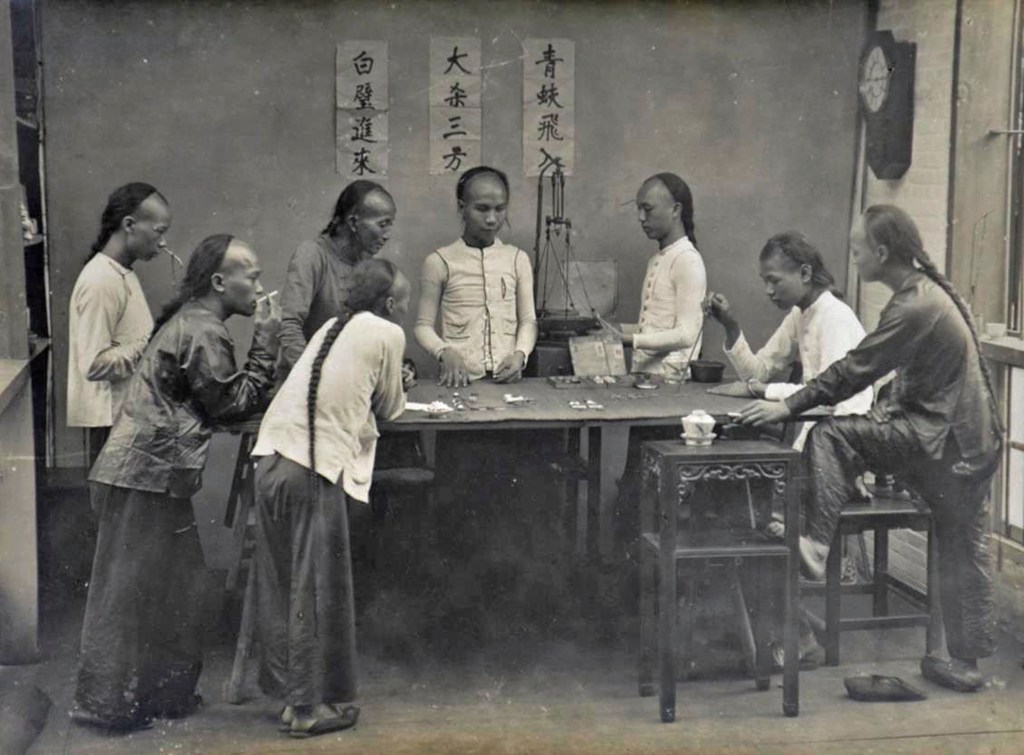
There were raids of Chinese gambling houses in Collingwood in the 1860s going by newspaper reports from the time8. Maybe some games were being played in Webb Street or the paraphernalia ended up there somehow. I do think it’s significant to find the tang bao with the dice.
I’m also pretty sure the dice is loaded.
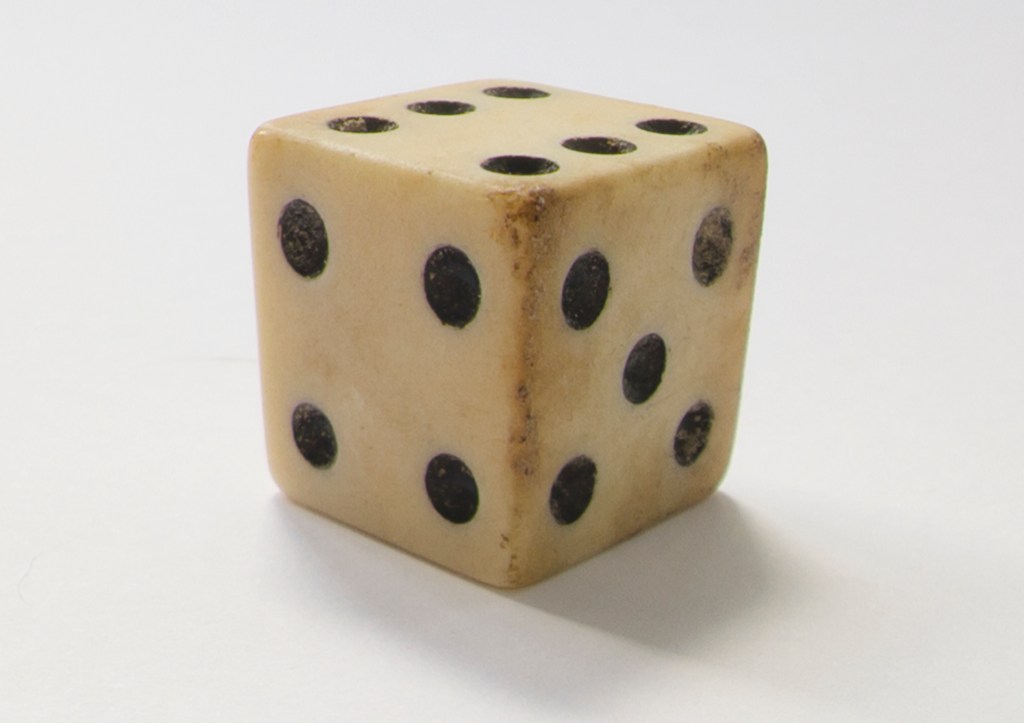
This dice could well be made from ivory, once again one similar has been found in Little Lonsdale.
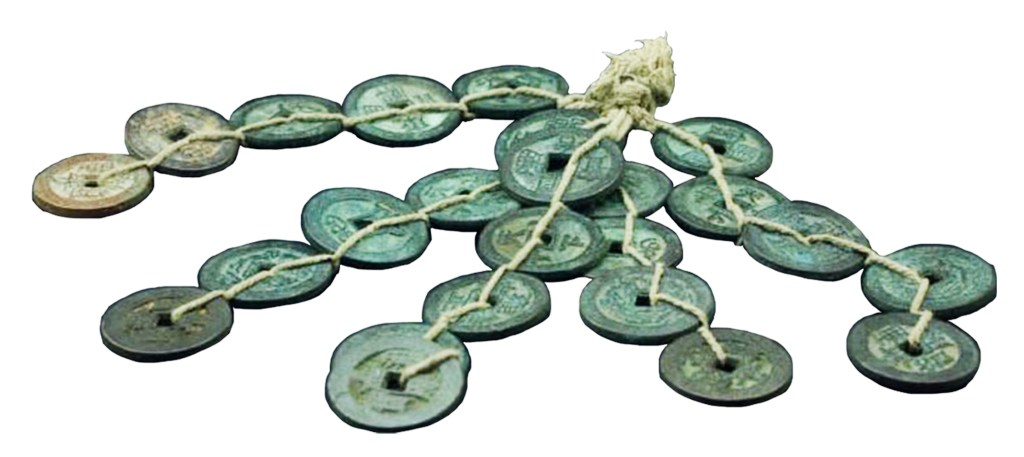
here is how you carry your tong bao coins in denominational groups of 5’s or 10’s9.
By the way Fan Tan is still a thing.
Another mystery item: The cone stone with the ring.
could it be…
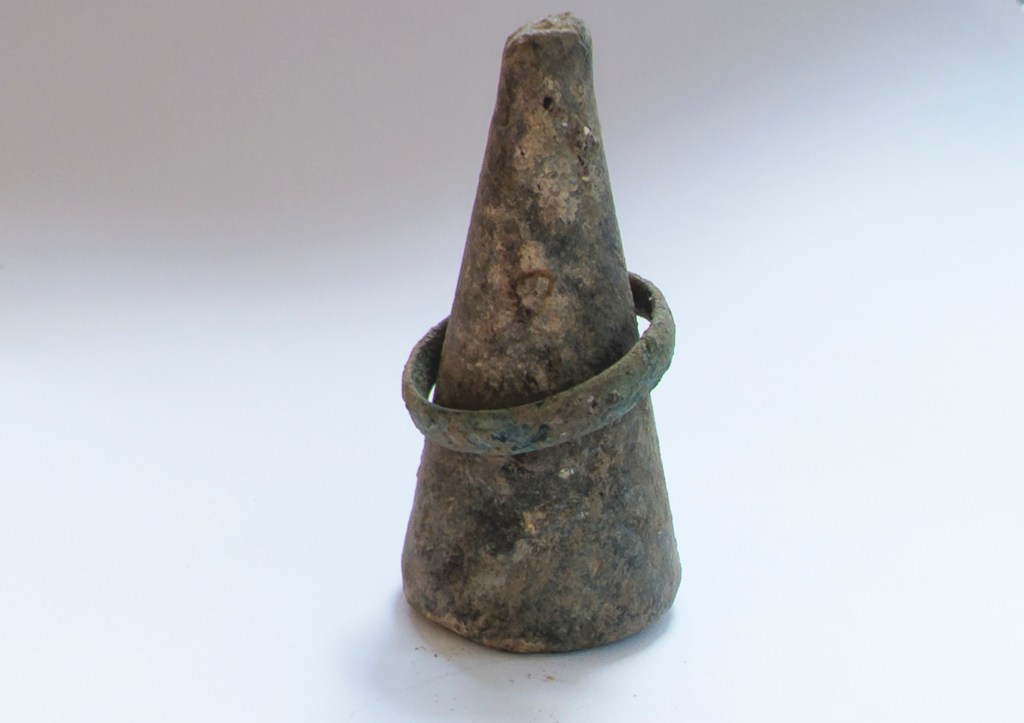
It looks to me like a jeweller’s ring sizer cone mandrel – or is it a display cone for a ring?
Maybe someone at the house was a jeweller or amateur jeweller and lost this at some point.
Or was it part of a jewellery heist stash that, as a jeweller’s instrument, got caught up with actual valuables in a break-in from Queensland in July 1864.
Because in November of 1864 police caught notorious burglar Anthony Wrench (aka Roberts aka Trenchford) with £400 worth of jewellery in a lock box at his two sisters’ residence on Webb Street10 . He tells police he has purchased the jewellery and gifted it to them, effectively making them receivers of stolen goods. (a charge which is dropped).
Wrench had already managed to pawn the greater £600 worth from the haul.
There was police concern about accompanying him back to Queensland to stand trial because he was famous for “breaking out of jail” (Sydney Gaol being highest escape on his resume) and being generally being skilled in managing to “elude the vigilance of his jailers”11.
BUTTONS
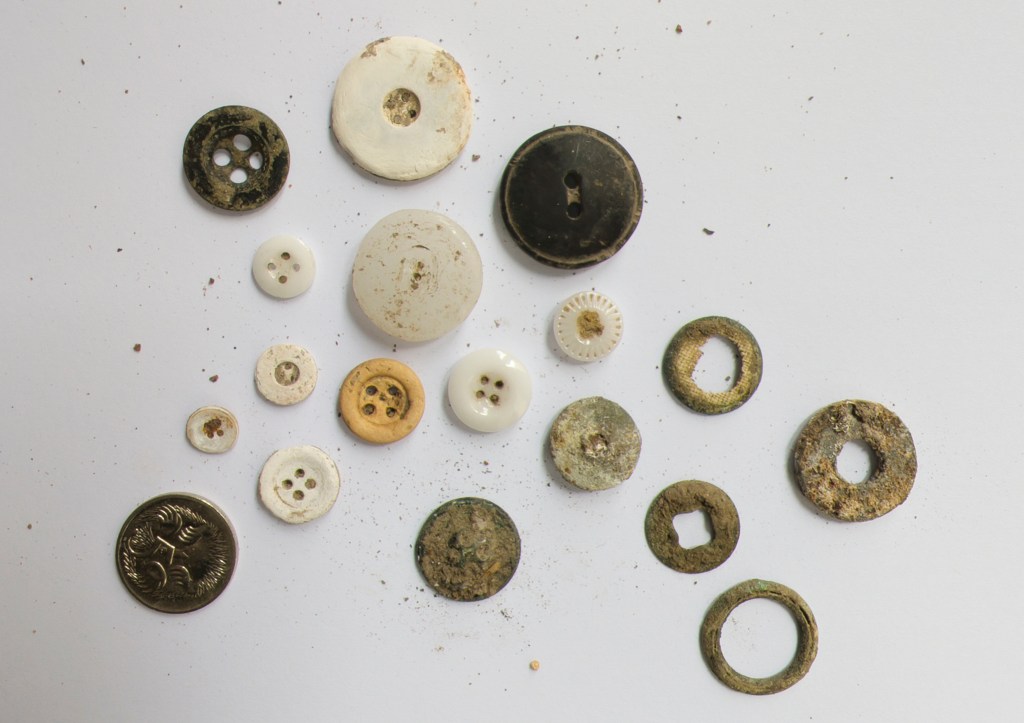
There is a similar white patterned example from little lonsdale with one dated around 1840.
click on 5 for next page:
FOOTNOTES:
- image from here https://www.recipetineats.com/apple-pie-recipe/ ↩︎
- I’ve colour corrected the photo, here it is online from the melbourn museum collection https://collections.museumsvictoria.com.au/items/1260336 ↩︎
- Archaeology in Oceania, Vol. 59 (2024): 91–124 DOI: 10.1002/arco.5310 The archaeology of 19th century oyster consumption in Melbourne by Brendan Marshal ↩︎
- Museums of History NSW, Convict Sydney: Cartwheel penny. 7 Mar, 2023 see online here https://mhnsw.au/stories/convict-sydney/cartwheel-penny/ ↩︎
- I was reduced to wikipedia. https://en.wikipedia.org/wiki/History_of_Chinese_currency ↩︎
- via: An introduction and identification guide
to Chinese Qing-dynasty coins by Qin Cao, see online here https://www.lincolnmuseum.com/assets/downloads/An_introduction_and_identification_guide_to_Chinese_Qing_dynasty_coins.pdf ↩︎ - Photo by Lai Afong viewed online here https://loc.gov/pictures/resource/cph.3b27207/ ↩︎
- I’ve developed a minor list ↩︎
- Rare Chinese Coins: Qing Dynasty Coins Overview Last updated: 09.04.23 https://www.invaluable.com/blog/rare-chinese-coins-qing-dynasty-coins-overview/ ↩︎
- AN OUT AND OUT SCOUNDRAL. (1865, December 10). Mount Alexander Mail (Vic. : 1854 – 1917), p. 2. Retrieved February 13, 2025, from http://nla.gov.au/nla.news-article197091015 and also EXTENSIVE ROBBERY OF JEWELLERY FROM QUEENSLAND (1865, November 16). The Herald (Melbourne, Vic. : 1861 – 1954), p. 4. viewed online here from http://nla.gov.au/nla.news-article244471585 ↩︎
- CURRENT TOPICS. (1865, December 8). Geelong Advertiser (Vic. : 1859 – 1929), p. 2. viewed online here http://nla.gov.au/nla.news-article147564564 ↩︎
 burrows & co