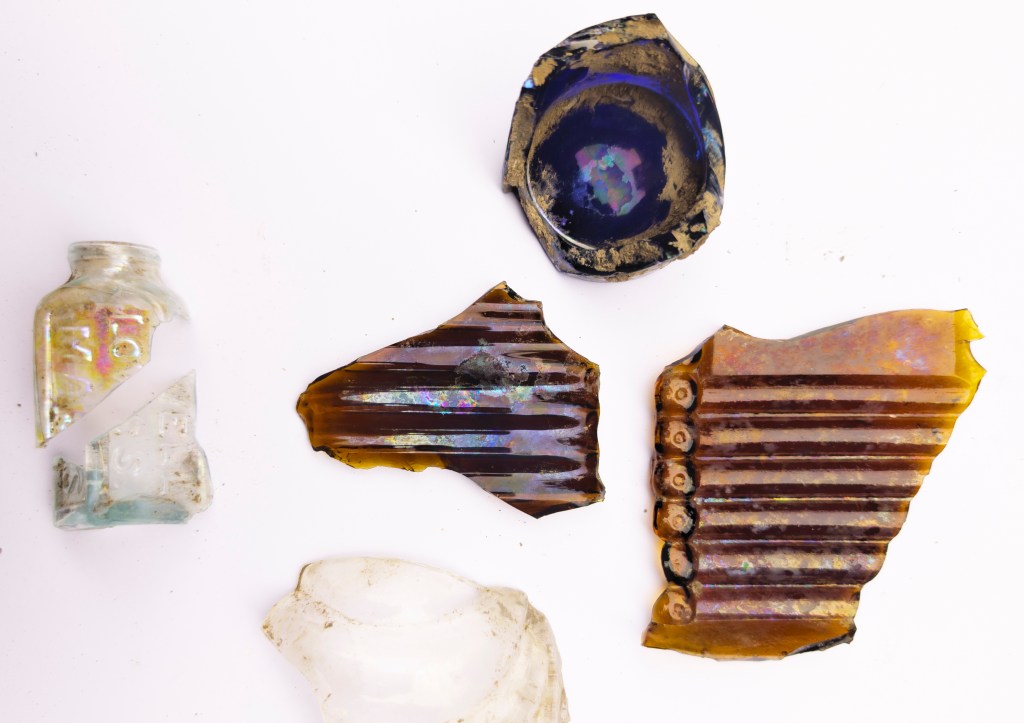
-I was really interested in this amber glass. When you are digging things up you don’t know what your context is
I just want to say a bit on the funny iridescence on these bits of glass,
-a lot of this glass has some iridescence already on it.
or if it didn’t when I found it in the dirt, as soon as I had gently washed the glass then it materialised. Especially if one is stupid enough to use warm water. Old glass is delicate and not used to temperature shocks.
-when the glass is wet, the opal effect is lost completely, then when the glass dries it comes back.
-google has taught me that the iridescence is caused by a stress in the glass due to exposure to moisture and differences in cooling and shrinkage rates.
-If you do find old glass the recommendation is to avoid using water to clean it. Just dust the dirt off or use a mineral turpentine.
What is this amber glass from though, really? this from some kind of strange ornamental lamp? is it off some ancient car headlight?
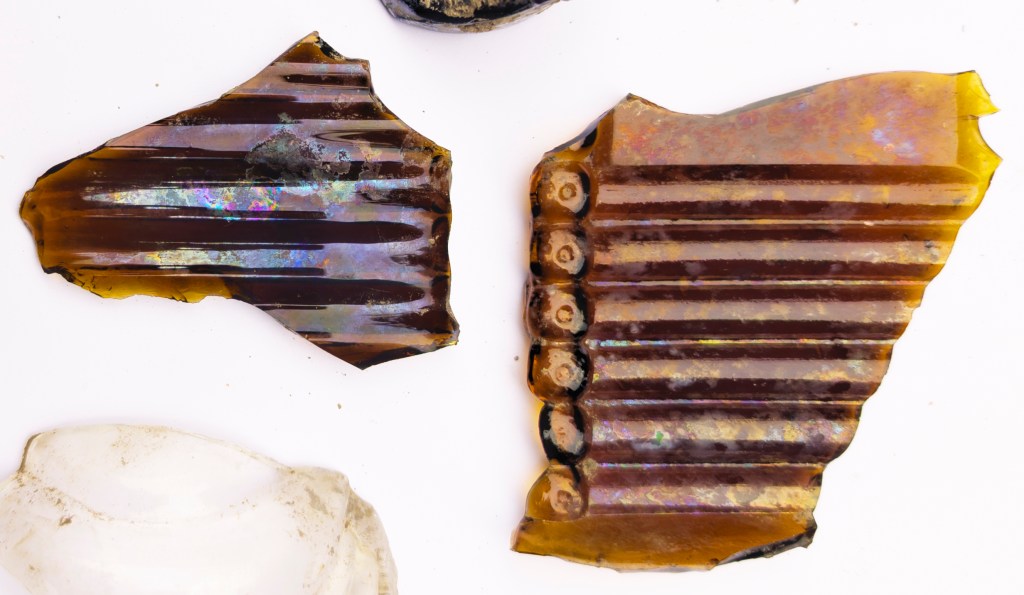
Could this be….
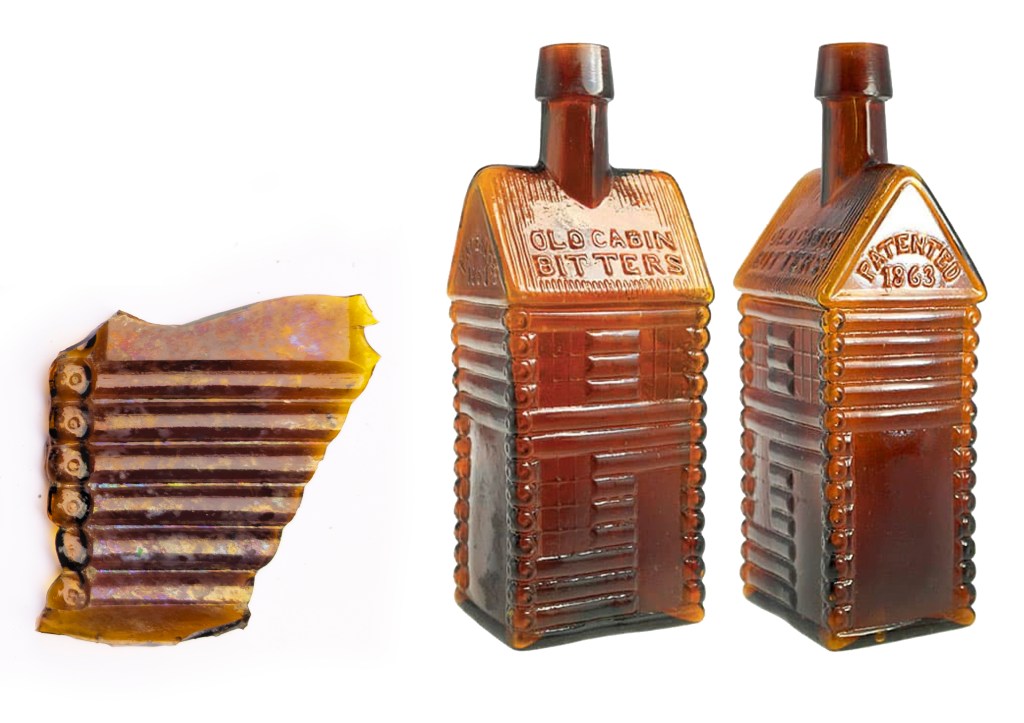
This is an ‘Old Cabin Bitters’ bottle roughly dated between 1860-1880
(source: image and information from: ‘Log Cabin Series – Kelly’s Old Cabin Bitters’ Posted on 22 December 2012 by Ferdinand Meyer V on ‘Peachridge Glass’ viewed here https://www.peachridgeglass.com/2012/12/log-cabin-series-kellys-old-cabin-bitters/ )
-this drink is straight out of the californian gold rush era but this particular brand (also later as ‘Kelly’s Old Cabin Bitters’) was never exported outside America.
This is another medicinal for the cupboard to help settle your stomach and give you a bit of a buzz. One early version of the Old Cabin Bitters was up to 47% alcohol
(source, Antique Bottles: Historic Glass Bottle Information: ULYSSES S. GRANT and the KELLY’S and THE OLD CABIN BITTERS’ by Steve Sewell Aug 6, 2010 viewed online here: https://www.antique-bottles.net/threads/ulysses-s-grant-and-the-kellys-and-the-old-cabin-bitters.331908/ )
-also contained cinchona (SIN-KO-NA) which contains quinine (KWUH neen) and gentian root, orange peel and anise. (source How a 19th-Century Bitters Brand Took America by Storm by Wayne Curtis, Imbibe, Dec 28 2023 viewed here: https://imbibemagazine.com/drakes-plantation-bitters/ )
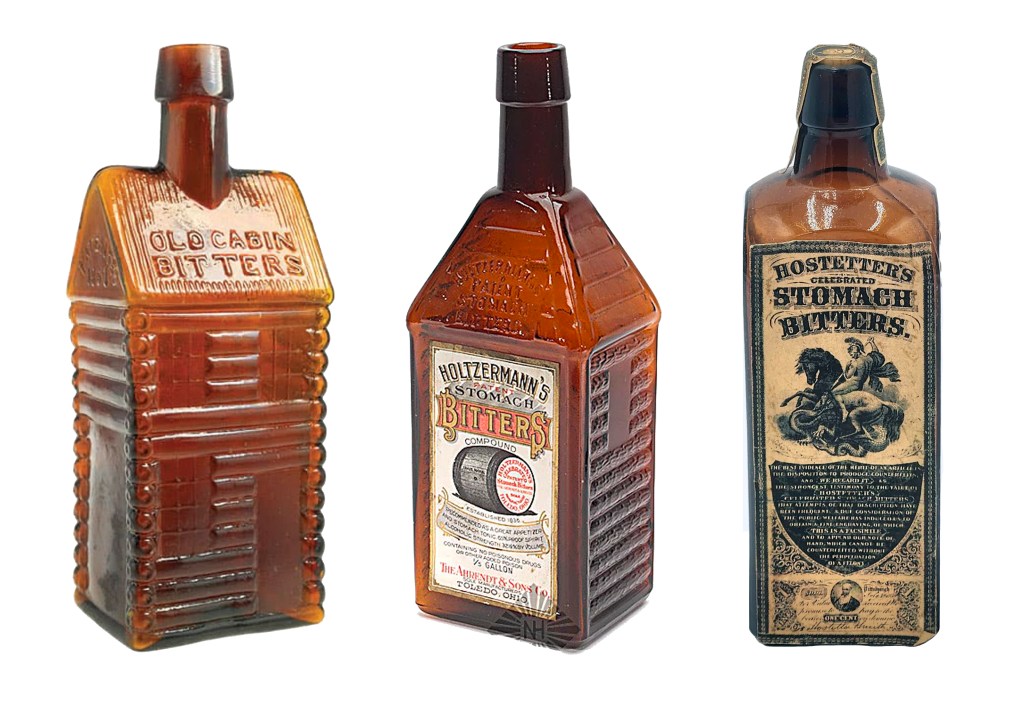
Here’s Old Cabin Bitters with it’s distinctive patented bottle shape,
(source image and information from: ‘Log Cabin Series – Kelly’s Old Cabin Bitters’ Posted on 22 December 2012 by Ferdinand Meyer V on ‘Peachridge Glass’ viewed here https://www.peachridgeglass.com/2012/12/log-cabin-series-kellys-old-cabin-bitters/ )
and one of it’s knock off rivals, HOLTZERMANN’S PATENT STOMACH BITTERS (image sourced from https://auctions.hecklerauction.com/131/view/?lot=86)
and ANOTHER Stomach Bitters for a Hostettor who is no relation to Holzermann.
(image sourced from https://thehiddensouth.com/products/antique-dr-j-hostetters-stomach-bitters-bottle-w-paper-label)
Dr Hostettors, with the image of St George slaying the dragon of your ills, was marketed in Melbourne from 1864 as
“an extraordinary preparation with a celebrity never attained by any public tonic introduced into Australia”.
(Hostetter’s Stomach Bitters. (1864, October 8). The Newcastle Chronicle and Hunter River District News (NSW : 1859 – 1866), p. 3. from http://nla.gov.au/nla.news-article128923384 )
And then you get OTHER medicinal bitters on the market also competing with Hostetters, you’ve got Hos-TEITER’s which is as strong as a knight slaying a boar and then there’s HONSTETTERS equally celebrated stomach bitters (where the asp comes back into the medical imagery getting slayed) and then you’ve simply got the no-name SUPERIOR stomach bitters1 which is a knight on the horse slaying an even bigger gnarlier wild boar.
I’ve photoshopped these knock off labels from the era on to the Hostetter bottle which is not so removed from what enterprising merchants were up to at the time.
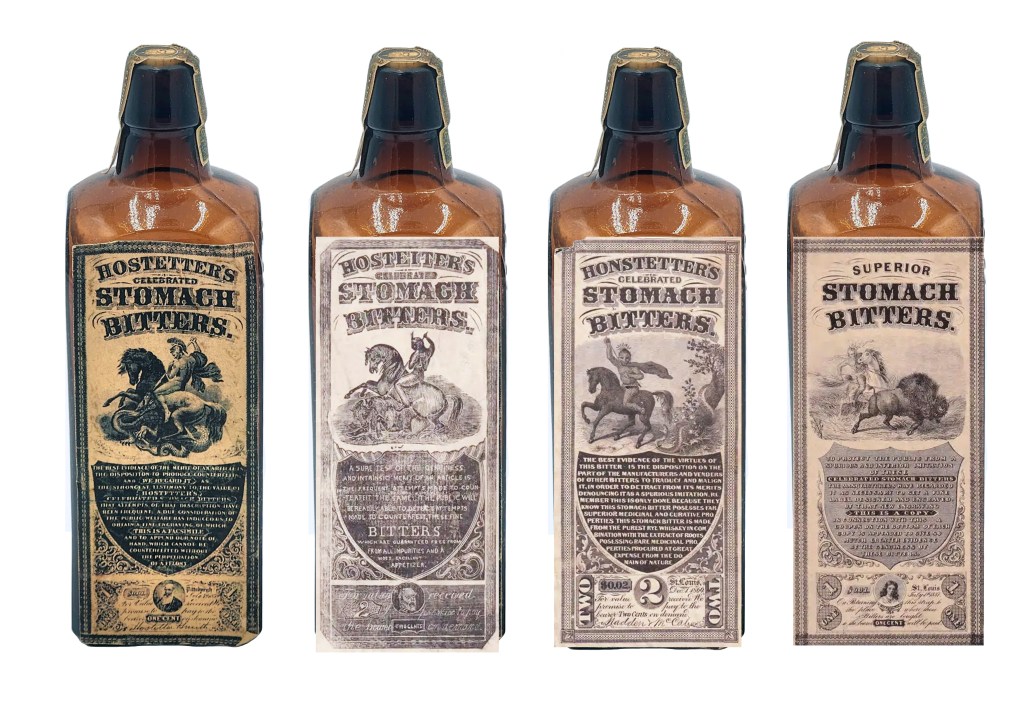
It turns out in Melbourne there is not a ‘superior’ stomach bitters but a ‘celebrated’ stomach bitters getting sold using recycled Dr Hostetter bottles. The same merchants were also reselling their own imitation bitters formulas IN recycled Dr Hostetter labelled bottles AS Dr Hostetter product2.
In 1870 it all gets too much: a Victorian agent acting on behalf of the American Dr Hostetter’s successfully gets a court injunction to stop ‘celebrated stomach bitters’ being distributed3.
OYSTERS
While you’re in the city picking up some bottles and having no idea what you’re drinking or how strong it might be, you might stop off at an oyster saloon opposite the post office for a quick stew; here’s an ad from between 1860 and 67 from a theatre circular4.
(There’s also an ad for “star lanterns” from Fitzroy St where you get your ladders and flagpole supplies)
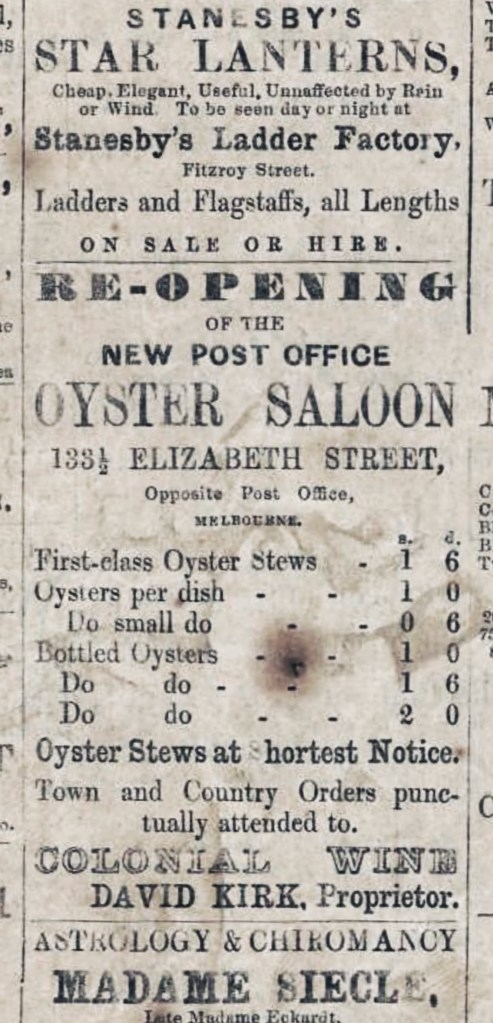
Oyster saloons sound elite but I understand they are more like basic menu supper rooms.
When they have excavated sites at Little Lon they have found the shells of
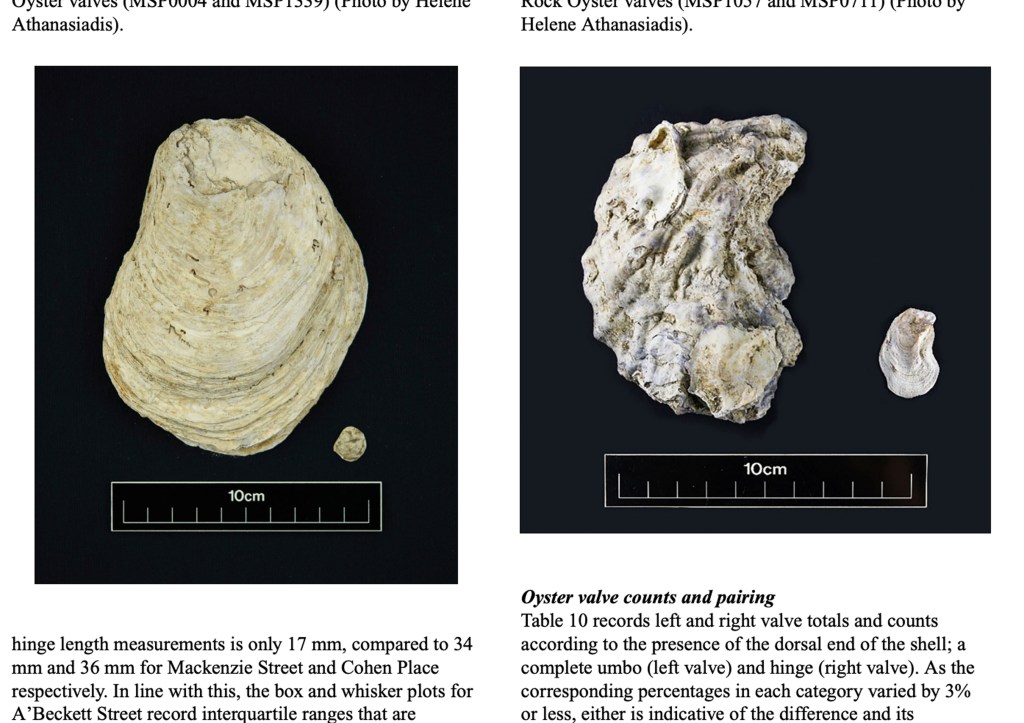
-Angasi oysters which native to Melbourne, they are flat mud oysters
alongside
-Sydney rock oysters are more narrow and angular
As early as 1841 the angasi oysters (growing around Port Albert and the Western Port bay) were prized enough to the colony that a law was passed banning the Boon Wurrung women from harvesting them5.
By the 1860s the Melbourne reefs are effectively devastated.
Here’s an image from a doctorial thesis6 from just last year [2024] about oyster shells found in Melbourne’s archeological sites.
Specifically of interest to me is where the thesis looked at the oyster shells found at the original site of the Mistletoe Hotel in Little Lons from around 1854 to 1864.
Here’s a photo of the oyster shells I’ve found under the living room area of Webb St,
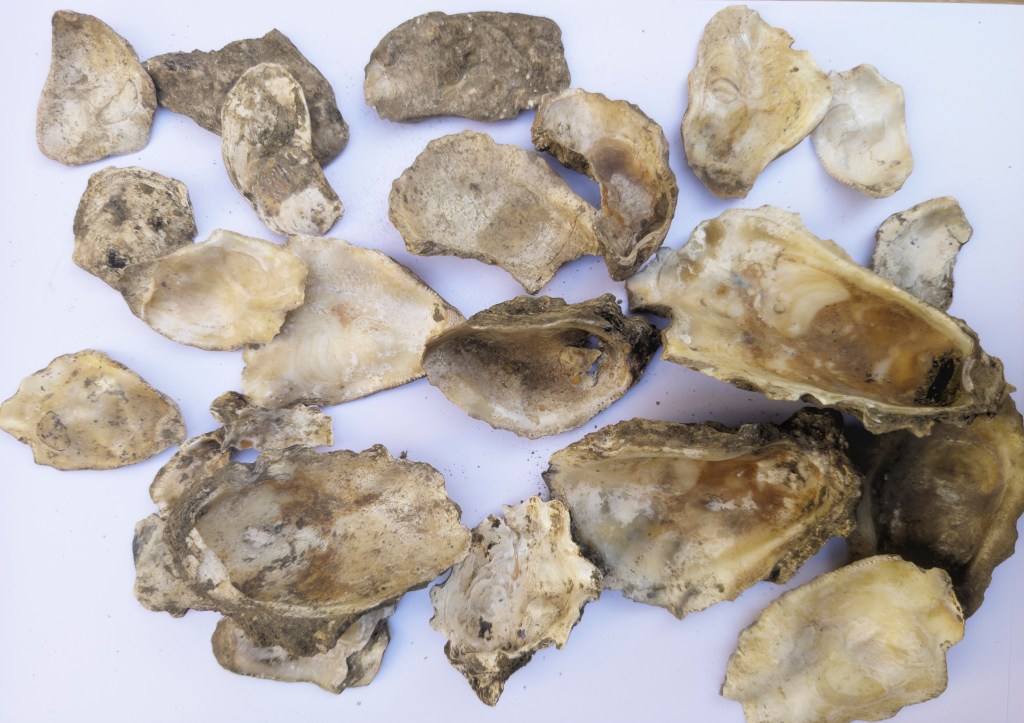
There’s a mix of the angasi shells and the rock oyster shells and most of mine are really quite small.
Laws were put in place in 1859 to stop the harvesting of undersized oysters but by 1870 all the angasi oyster beds were totally depleted in Melbourne and oysters are instead being supplied from either Sydney or Tasmania7.
Here’s an OYSTER PATTIE recipe from 18678.
Something to alternate with mince pies.
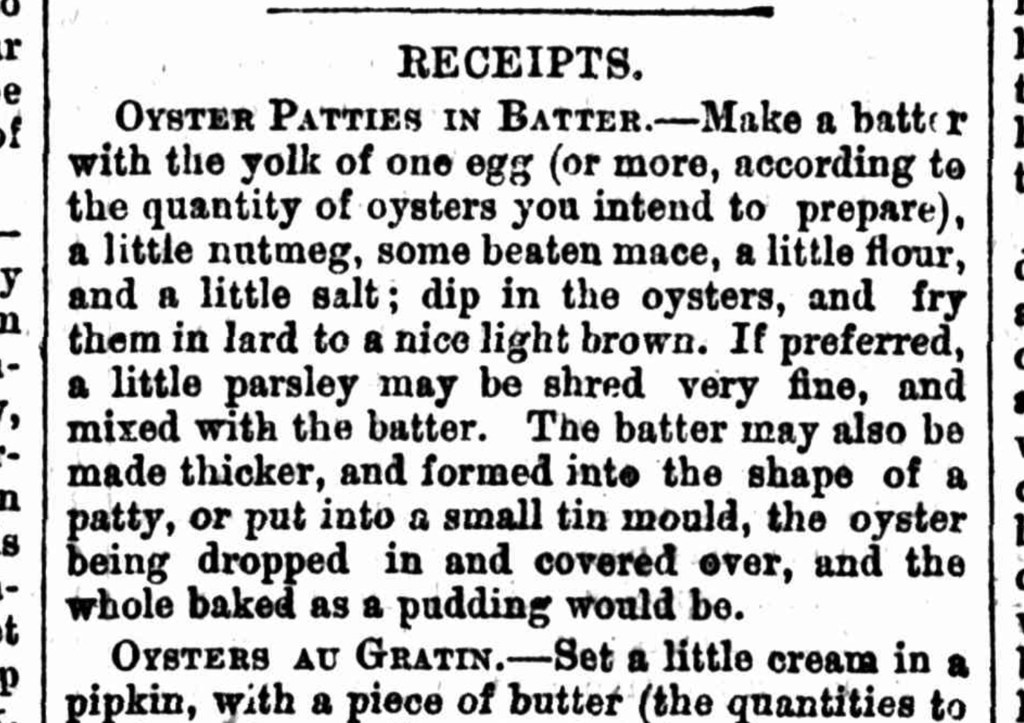
Read all the recipes here including one for oyster sausages.
What was happening in the rest of the world while people are cooking up oyster dishes at home? On the same page of this newspaper is an item mentioning the recent assassination attempt of the Tsar Alexander II (by a Polish immigrant at the Worlds Fair in Paris. But I digress.
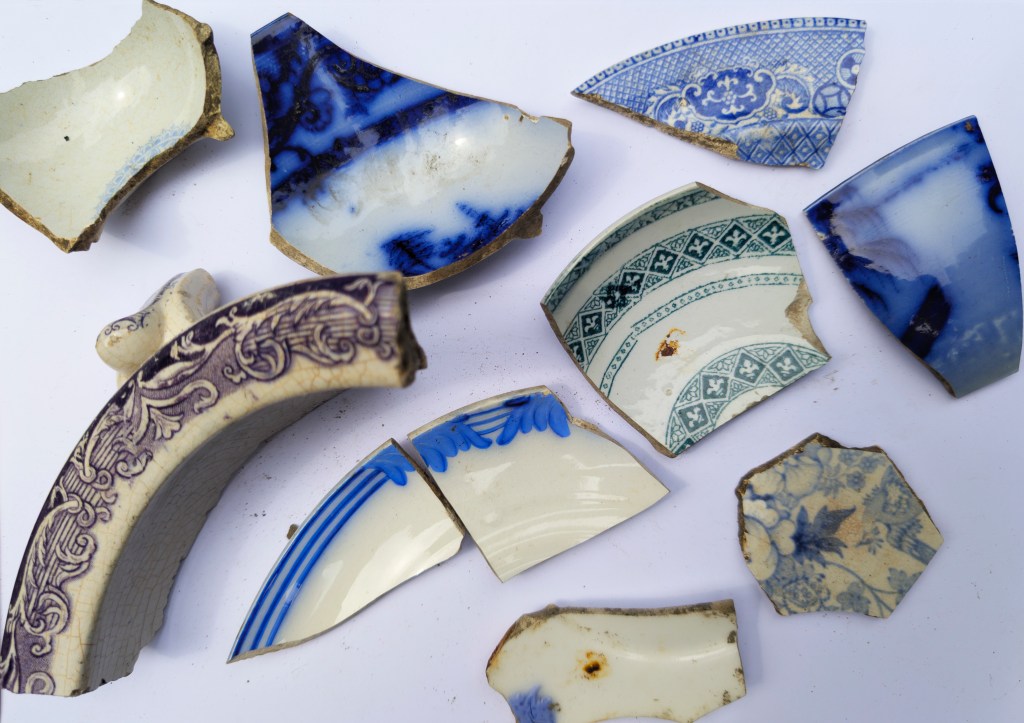
BROKEN CHINA
from under the living room floor boards. I have not included all the plain white china and stoneware. A lot of these shards came from a ditch where I think an external wall was originally, in which case this was all discard landfill.
Fragments of china from under the floorboards:
here’s a close up of a (different) flow blue shard, brother to the other flow blue shards above, as part of a bowl.
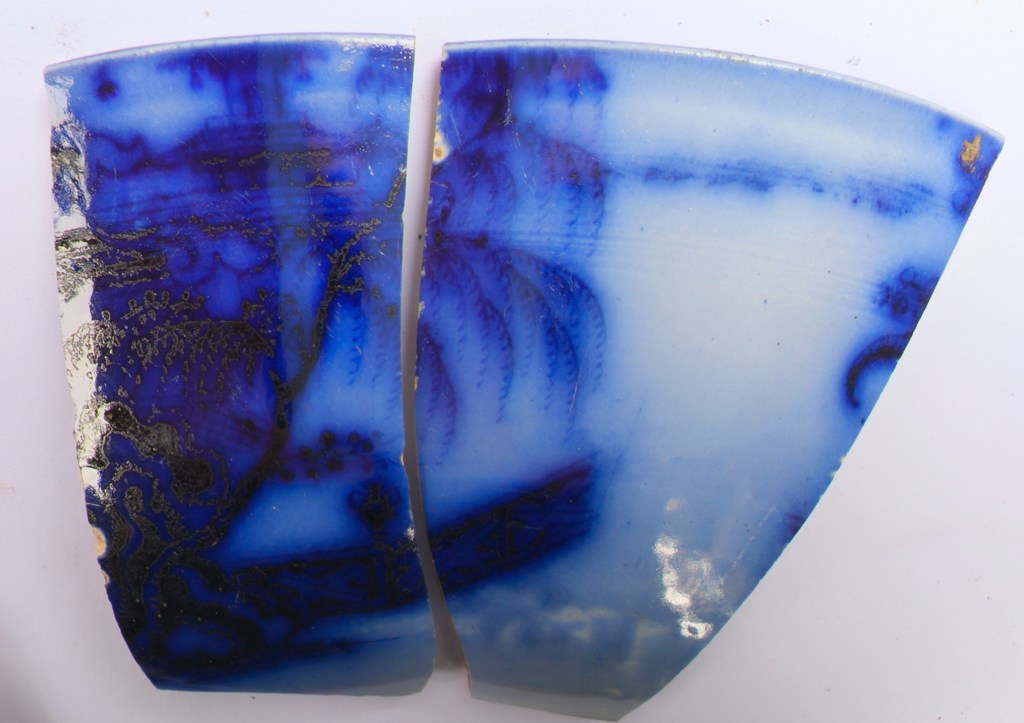
what’s that airbrushing blurred effect?
‘Blue Flow’ is a decorative technique popular in 1850s and used until 1900s. It’s the distinctive air-brush effect where the blue is made to bleed in the firing process.
The more extreme blurred blue examples may have been sold as cheaply as ‘seconds’, and were thus popular with the poorer market9.
and here’s a close up of that greenish printed transfer shard.
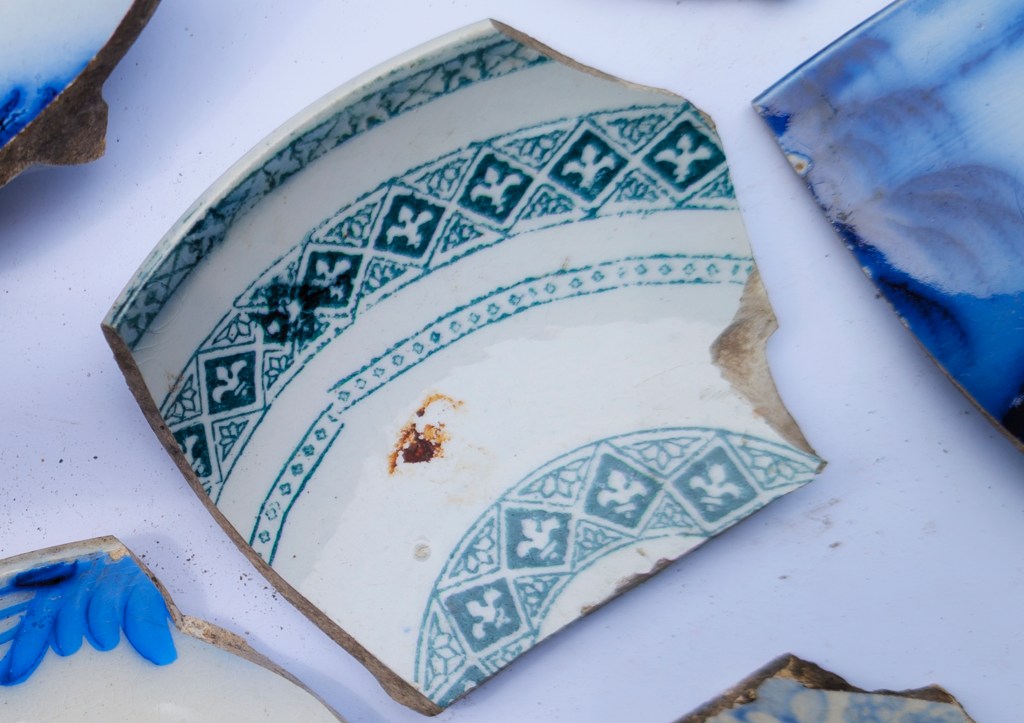
-that green transfer ink dates from 1850 in England10.
-When the transfer patterns didn’t align perfectly on the china they went to the ‘seconds’ market, so less well-to-do households are more likely to have the cheaper less perfect stock – this is following a trend for our householders at Webb St.
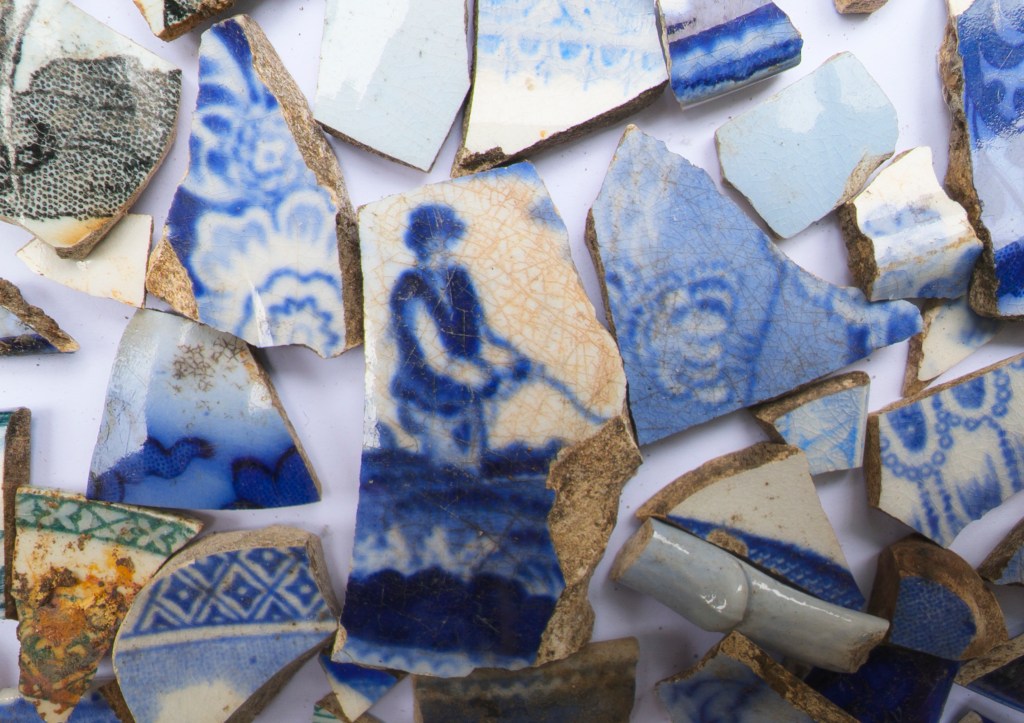
the serendipity of fragments framing little portraits: a man immersed in waves, fishing or in a field… ploughing?
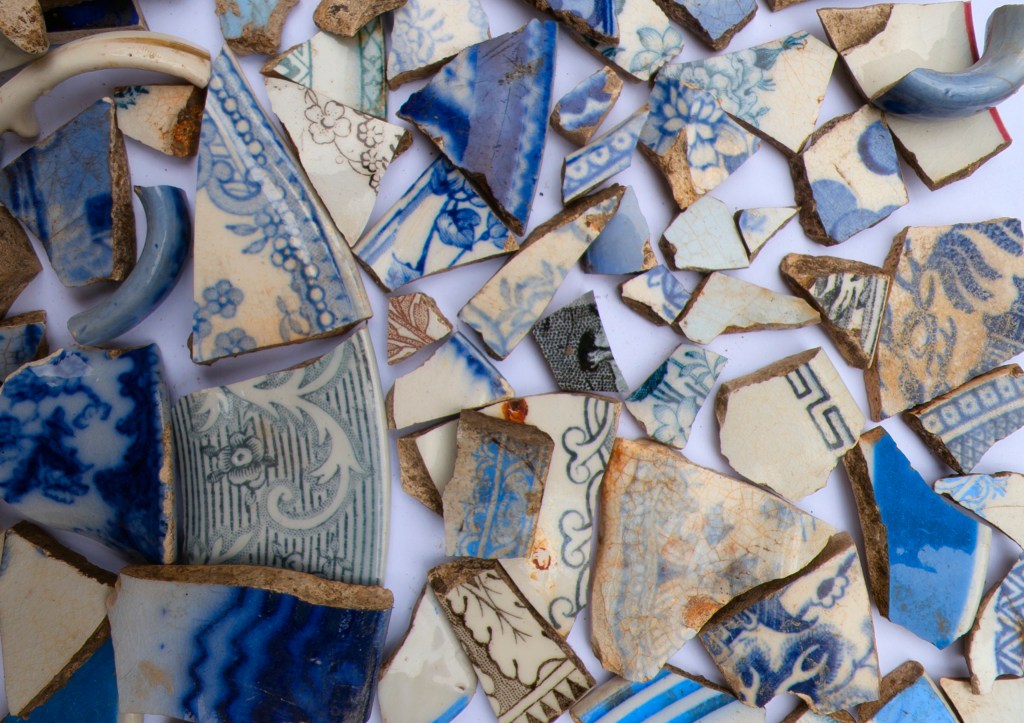
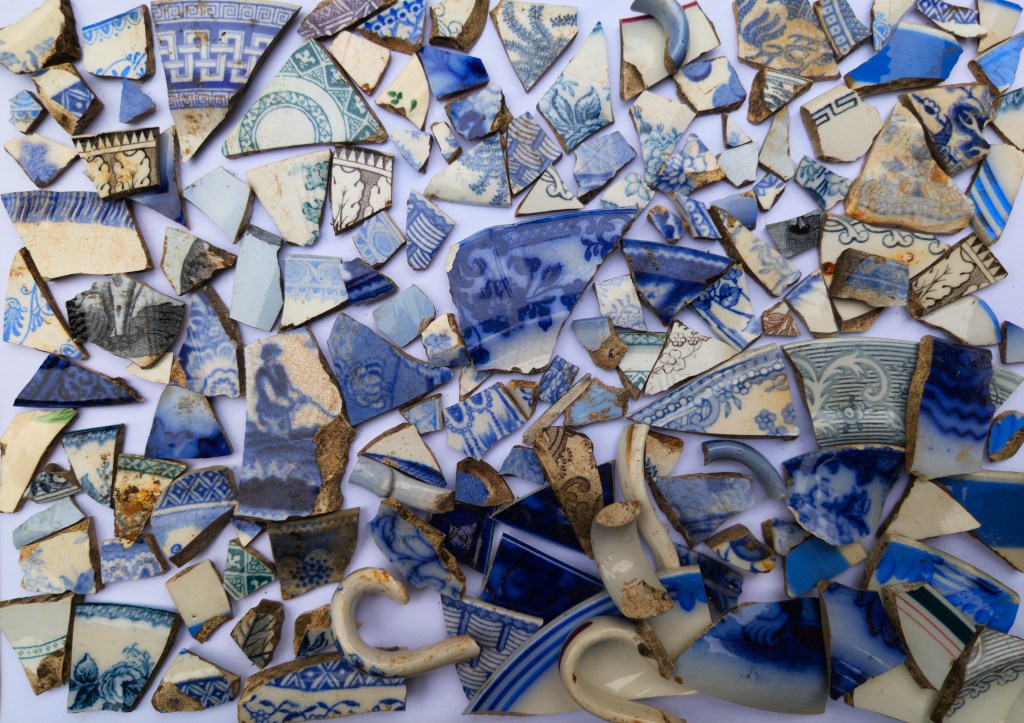
And on the left of the pic that we started with, is the the unmistakable piece of a chamber pot, similar to this blue transfer chamber pot from Little Lons.
Here’s an ad for the local night soil man11 who would have been collecting contents from said chamber pot from Gertrude St.
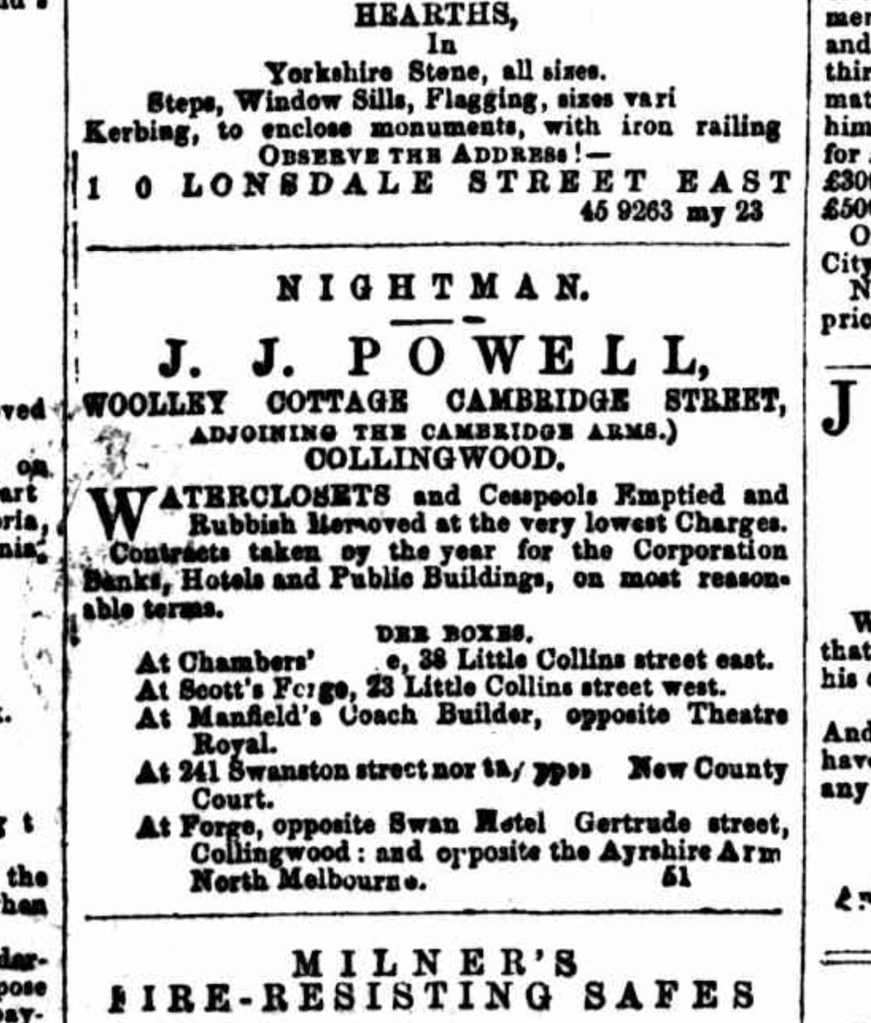
From Gertrude St collection to where? apparently it was only dumped in market gardens and farms from 1880s onwards12 but I’m sure it would have been happening earlier than that.
click on 4 for next page:
FOOTNOTES
- image credits and fab research: Jacob & David Hostetter–Dr. J. Hostetter’s Celebrated Stomach Bitters by Ferdinand Meyer V from Antique Bottle & Glass Collector | March April 2022. viewed online here: https://issuu.com/fohbc/docs/ab_gc_marchapril_2022r/s/14819697 ↩︎
- LAW REPORT. (1870, February 11). The Argus (Melbourne, Vic. : 1848 – 1957), p. 1 (The Argus Supplement). Retrieved April 14, 2025, from http://nla.gov.au/nla.news-article5812144 ↩︎
- LAW REPORT. Hostetter v. Anderson and others. (1870, February 17). The Herald (Melbourne, Vic. : 1861 – 1954), p. 3. Retrieved March 18, 2025, from http://nla.gov.au/nla.news-article244910390 ↩︎
- Theatre Royal (Melbourne, Vic.) & Royal Princess Theatre (Melbourne, Vic.). (). Entr’ acte and playbill : a circular for the amusement & information of the theatre-goers Retrieved April 9, 2025, from http://nla.gov.au/nla.obj-3435159641 ↩︎
- I do not know the primary source for this but taken from this article https://www.richardcornish.com.au/blog/flinders-oysters ↩︎
- Archaeology in Oceania, Vol. 59 (2024): 91–124 DOI: 10.1002/arco.5310 The archaeology of 19th century oyster consumption in Melbourne by Brendan Marshal ↩︎
- Archaeology in Oceania, Vol. 59 (2024): 91–124 DOI: 10.1002/arco.5310 The archaeology of 19th century oyster consumption in Melbourne by Brendan Marshal ↩︎
- RECEIPTS. (1867, September 7). Leader (Melbourne, Vic. : 1862 – 1918, 1935), p. 27. Retrieved April 1, 2025, from http://nla.gov.au/nla.news-article196637138 ↩︎
- ‘The Glossop Cabinet of Curiosities’ Archaeology History Place, The Rough Guide to Pottery Pt.5 – Blue and White Bits by Tim Campbell-Green. viewed online here https://glossopcuriosities.co.uk/2022/09/15/the-rough-guide-to-pottery-pt-5-blue-and-white-bits/
↩︎ - ‘The Glossop Cabinet of Curiosities’ Archaeology History Place, The Rough Guide to Pottery Pt.5 – Blue and White Bits by Tim Campbell-Green. viewed online here https://glossopcuriosities.co.uk/2022/09/15/the-rough-guide-to-pottery-pt-5-blue-and-white-bits/ ↩︎
- Advertising (1858, May 22). The Age (Melbourne, Vic. : 1854 – 1954), p. 3. http://nla.gov.au/nla.news-article154857760 ↩︎
- Old Treasury Building: ‘On The Land: Market Gardens’ see online here https://www.oldtreasurybuilding.org.au/lost-jobs/on-the-land/market-gardens/?srsltid=AfmBOoohEexLlshFDjFXyHT_FgFsmfedmCCp_VX-p-Vzd3AQrwsefdJ4 ↩︎
 burrows & co