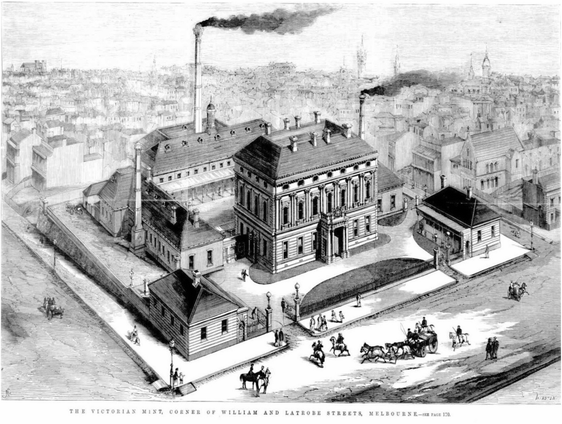
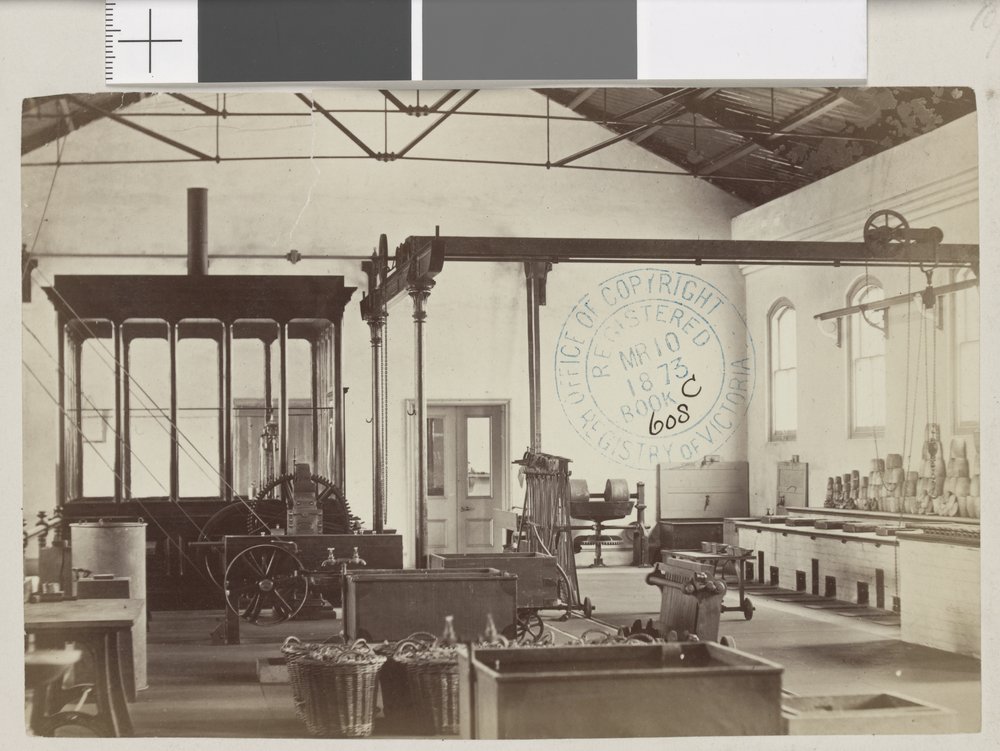
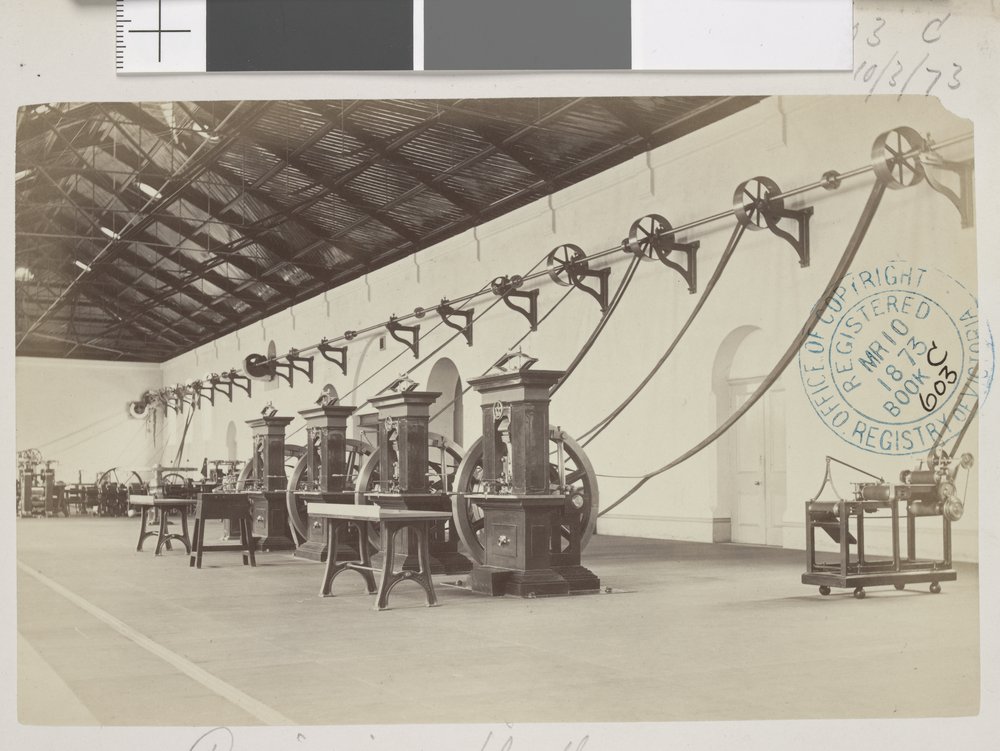
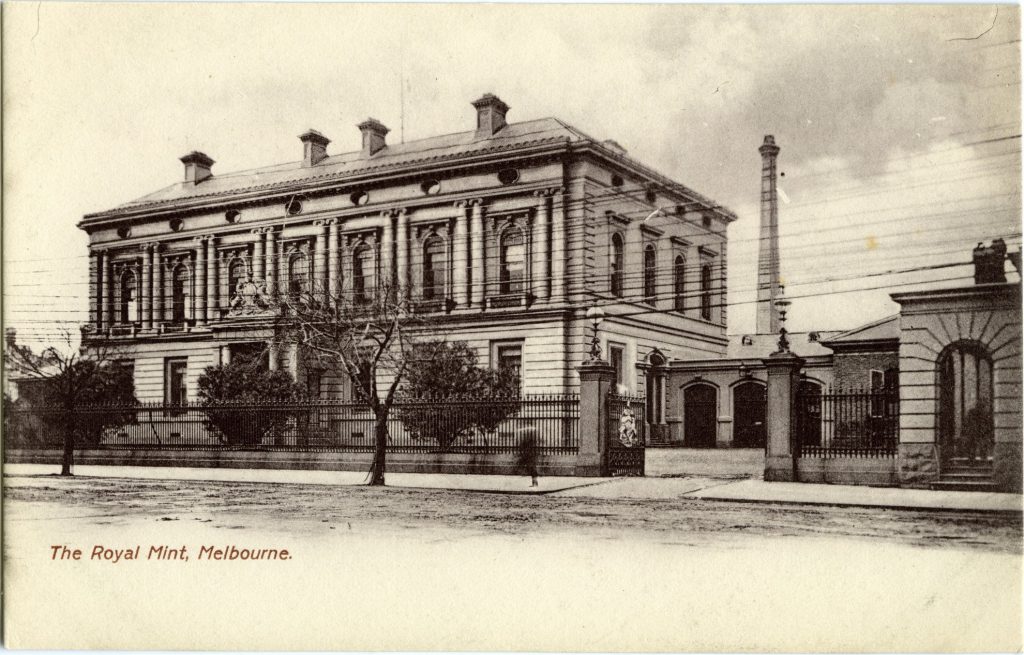
‘The mint was to occupy a site on the corner of Williams and La Trobe streets, the site of the original Victorian Exhibition Building of 1854. There were originally four structures built around a square – on the north, the melting department; on the south, the assay department, on the east the coining department and on the west, administration. Only the administration building, which incorporated the Deputy Master’s residence, now survives.’
-SOURCE ‘Establishment of Melbourne Mint, 1872’ https://collections.museumsvictoria.com.au/articles/3776
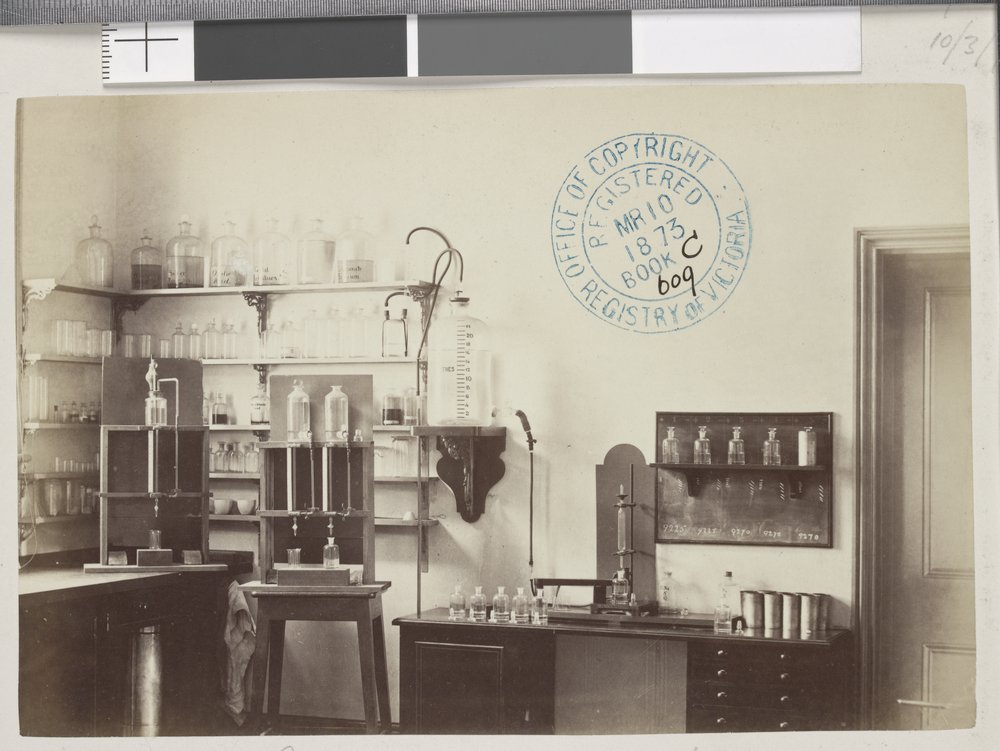
The Mint complex originally included factories, grand civic buildings, residential quarters, laboratories, furnaces, chimneys, and coining rooms.
SOURCE ‘Former Royal Mint Site’ https://www.workingheritage.com.au/places/former-royal-mint
The building architecture:
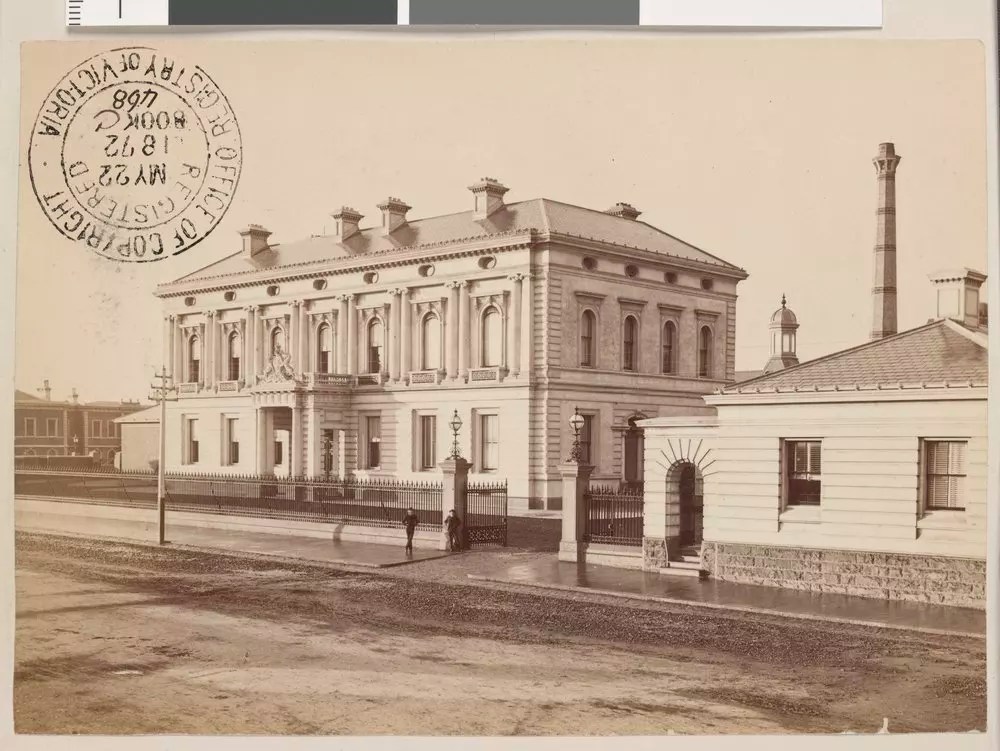
The building’s architectural style is known as Renaissance Revival, a term for a broad group of 19th century styles which were neither Greek nor Gothic Revival, but instead drew inspiration from a wide range of classicising Italian modes. Today the building is one of few surviving examples of Renaissance Revival in Australia. It is reputed that the design is based on Raphael’s Palazzo Vidoni Caffarelli in Rome.
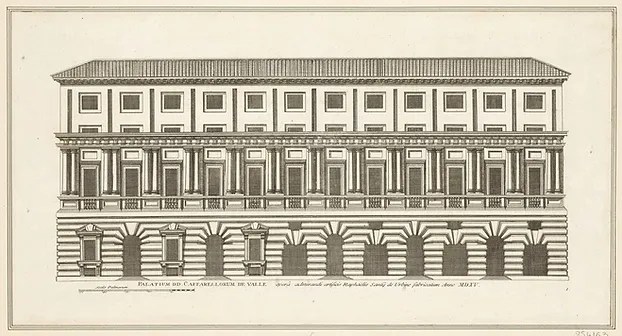
Palazzo Vidoni Caffarelli by Raphael. Etching by Joachim von Sandrart, 1675. Royal Collection Trust RCIN 854163.
SOURCE Celebrating 150 Years of the Melbourne Mint May 30, 2022 https://www.hellenic.org.au/post/celebrating-150-years-of-the-melbourne-mint
The Mint is under complete British control :
As the new colonial Mint was a British institution, it had to be under British control. This meant all employees were classed as British Civil Servants, and the officer-in-charge was known as the Deputy Master – that is, the Deputy of the Master of the Mint in London. Even the building design had to be in accordance with plans from the London Mint, and all coins had to conform to strict regulations.
SOURCE Celebrating 150 Years of the Melbourne Mint May 30, 2022 https://www.hellenic.org.au/post/celebrating-150-years-of-the-melbourne-mint
The Melbourne Mint was financed entirely by the government of the Colony (later State) of Victoria. However, its employees were British civil servants
SOURCE: ‘Melbourne Mint’ https://collections.museumsvictoria.com.au/articles/3775
1869- 1872 Construction
Construction was completed from 1869 to 1872, with the final design signed off by architect John James (J.J.) Clark from the Victorian Public Works Department. You might know J.J. Clark in connection to some of Melbourne’s other iconic buildings – the Old Treasury Building, Customs House (now the Immigration Museum) and Melbourne City Baths.
SOURCE Celebrating 150 Years of the Melbourne Mint May 30, 2022 https://www.hellenic.org.au/post/celebrating-150-years-of-the-melbourne-mint
Change to Plans/Constructions
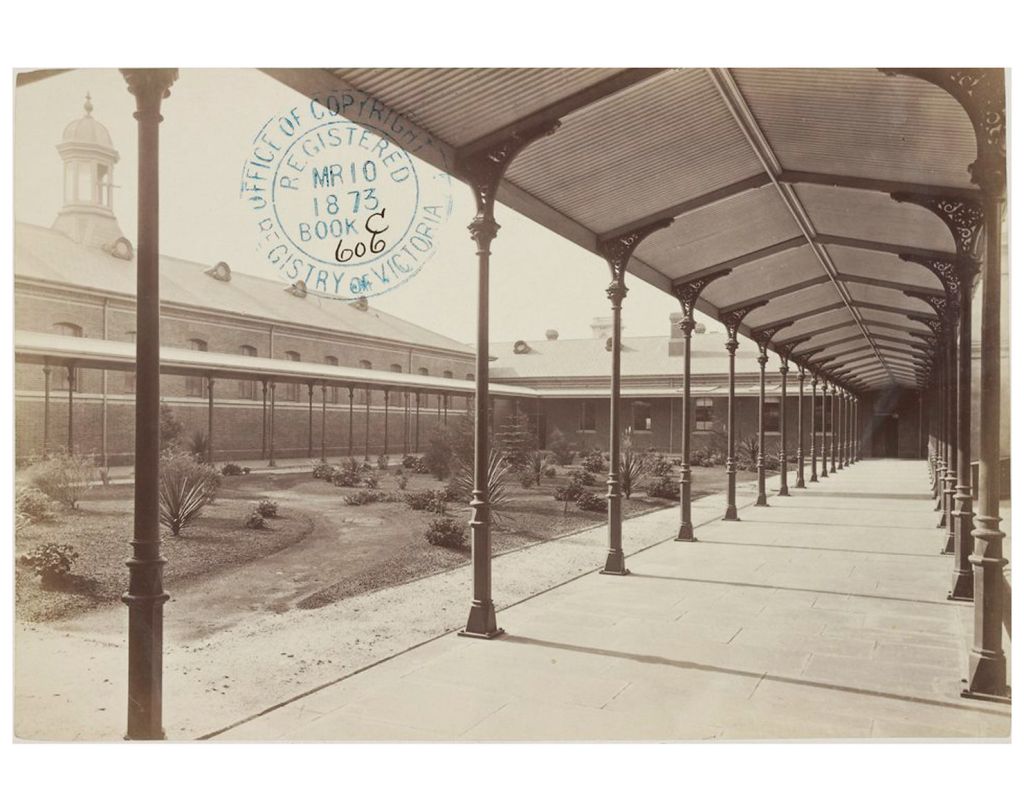
The original Mint complex was a quadrangle: a U-shaped factory, boxed off by the administration building and containing a central courtyard. It was finished with perimeter fences and two guard houses for the police and military, at the north and south gates.
The administration building contained offices, as well as quarters for the Deputy Master, his family and domestic servants. The original vision for this building was much grander, but by the time orders were signed in 1869, the state government had committed itself to several building projects and so had to devise ways to reduce overall construction costs.
With machinery already on its way to Melbourne, the design of the factory buildings had to remain the same.
And so cutting these costs fell on the administration building. One storey was removed and the overall length of the building was cut down by 80ft, with minimal ornamentation on the facade.
SOURCE Celebrating 150 Years of the Melbourne Mint May 30, 2022 https://www.hellenic.org.au/post/celebrating-150-years-of-the-melbourne-mint
1872 Opening of Mint:
The official opening of the Melbourne Royal Mint is recorded as 6 June 1872. On this day, the first two sovereigns were minted by then-Governor of Victoria, His Excellency the Viscount Canterbury KCB. The Governor kept one of these coins and presented the other to the Deputy Master. If you look closely, this date is scribed onto the Royal Coat of Arms that decorate the two wrought iron gates on William Street.
-SOURCE Celebrating 150 Years of the Melbourne Mint May 30, 2022 https://www.hellenic.org.au/post/celebrating-150-years-of-the-melbourne-mint
The mint was opened on 12 June 1872 by the Governor and Viscountess Canterbury. This was somewhat later than planned; it had ordered and paid for dies to strike coins dated 1871. It was initially manned by volunteers from the Royal Engineers who had undertaken special training in London. They were under the command of Colonel Edward Ward who had already great experience with opening a mint in Australia; he had been in charge of the original team at the Sydney Mint in 1855.
–SOURCE Celebrating 150 Years of the Melbourne Mint May 30, 2022 https://www.hellenic.org.au/post/celebrating-150-years-of-the-melbourne-mint
Colonel Ward and P.F. Comber had arrived in Melbourne in 1869 to supervise the building of the mint. Comber, who had overseen the installation of the plant and machinery, became the first Superintendent of the Coining Department. Robert Barton, formally assayer to the Bank of England, and George Foord, a chemist and geologist with wide experience on the Victorian gold fields, became the first assayers.
–SOURCE Celebrating 150 Years of the Melbourne Mint May 30, 2022 https://www.hellenic.org.au/post/celebrating-150-years-of-the-melbourne-mint
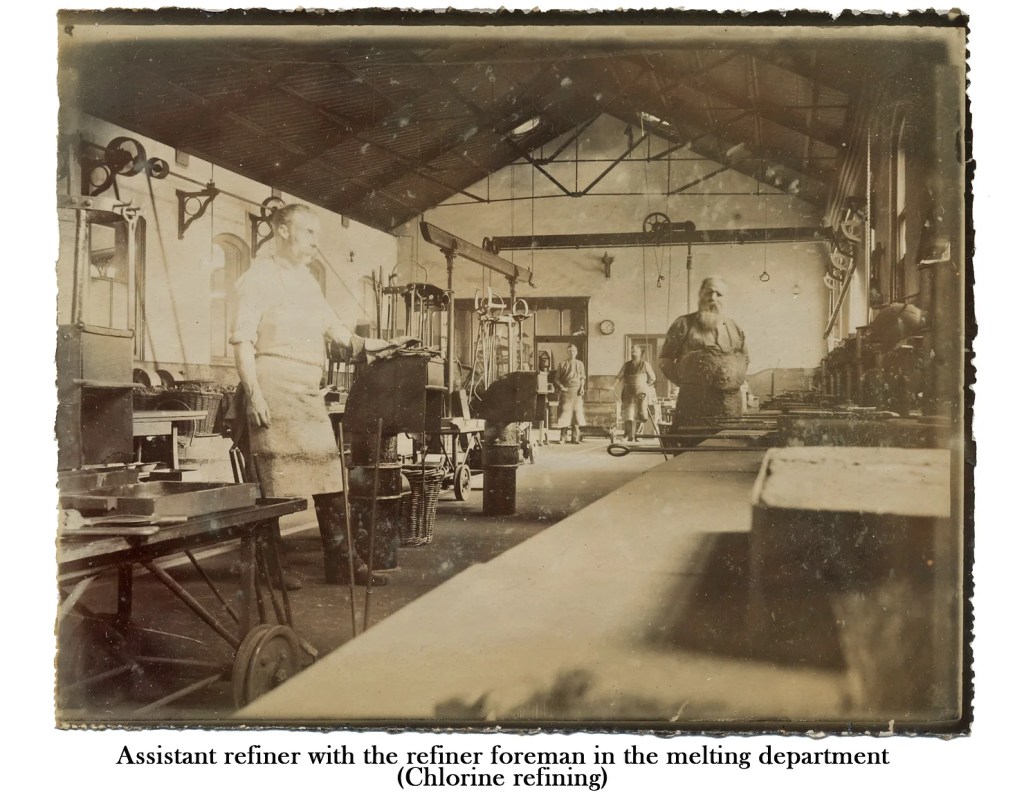
Francis Bowyer Miller came from the Sydney Mint to be the first Clerk of the Bullion Office. In Sydney he had developed an industrial scale method for purifying gold, the Miller Process. This treatment was given to all gold that passed through the Melbourne Mint. Put simply, the raw gold was melted in a crucible. Firstly oxygen was passed through the molten metal to react with any lead it contained and then chlorine gas was pumped into the bottom of the crucible. The chlorine formed salts which were not soluble in the gold and could be scooped from the surface and later treated to recover the silver. The end result was gold that was 99.95% pure. To this copper was added to make the coinage alloy of 22 carat gold used for sovereign production.
–SOURCE Celebrating 150 Years of the Melbourne Mint May 30, 2022 https://www.hellenic.org.au/post/celebrating-150-years-of-the-melbourne-mint
For the first year security was provided by the Corps of Artillery. Those on duty were instructed to move about in a brisk and soldier-like manner preventing any idle or suspicious characters from loitering or committing a nuisance. Armed police were also stationed at the mint. One of the staff, Sapper Harris, was sent back to England in 1873 because he had run up too many debts in Melbourne and was judged a security risk. His main debts were doctor and funeral fees for his eight-year-old daughter. Six others, having trained local workmen, returned to England in 1875 and the balance remained in Melbourne.
–SOURCE Celebrating 150 Years of the Melbourne Mint May 30, 2022 https://www.hellenic.org.au/post/celebrating-150-years-of-the-melbourne-mint
In the first year of operation it processed 221,904 ounces of gold; its peak year was 1899 with 1,520,739 ounces. The production of gold coins ceased in 1931, the total issue of sovereigns being 147,283,131 and half-sovereigns 1,893,559.
–SOURCE Celebrating 150 Years of the Melbourne Mint May 30, 2022 https://www.hellenic.org.au/post/celebrating-150-years-of-the-melbourne-mint
1970
All work on Commonwealth of Australia coinage was undertaken by the mint as a contractor to the Treasury. With the opening of the Royal Australian Mint in Canberra in 1965, once the immense task of preparing the first years of decimal coins had been achieved, no further contracts were available, nor was there sufficient call for purifying and assaying gold. By Royal Proclamation the Melbourne Mint ceased to be a Branch of the Royal Mint on 1 July 1970.
-Melbourne Mint https://collections.museumsvictoria.com.au/articles/3775
IMAGES
 burrows & co