this has turned into the slideshow here and below just needs to be reorganised etc.
| COINS |
EARLY 1800s
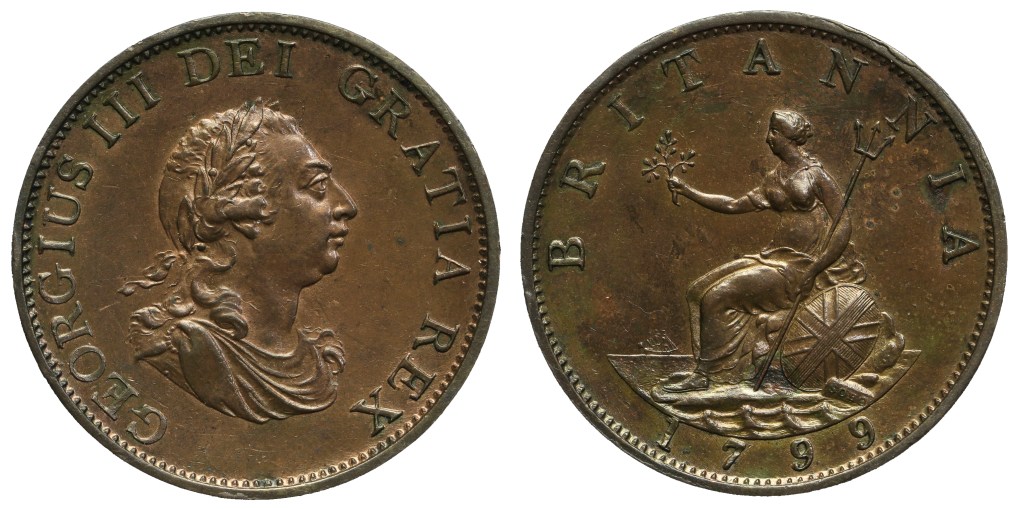
| George III Halfpenny coin 1770-1779 unknown when it would have arrived in australia but after 1800 when the first shipment of cartwheel pennies and newer half pennies were issued in 1806 even though these older ones would have stayed in circulation. mine is 30mm diameter meaning it could be from either first or second issue: 1770–1775, or 1799 (The third issue in 1806–1807 has diameter 29 mm) source: History of the halfpenny: Great Britain and beyond, 1800–1970 published by wikipedia https://en.wikipedia.org/wiki/History_of_the_halfpenny -found in the eastern (small) front bedroom under floorboards description of a clear example: obverse: The bust of George III faces right. A wreath of 11 leaves and three berries rest on his head and is tied behind the neck by a riband with one loop and two loose ends. A single dot (.) appears on the lowest fold of the drapery, caught by a clasp of 6 square jewels. GEORGIUS III DEI GRATIA REX reverse: Britannia is depicted facing left wearing a close-fitting drapery sitting on a rock surrounded by waves. Her right arm is extended, and her hand holds an olive-branch with 14 leaves and no berries. Her left arm is down with a trident clasped in her grasp of which the middle prong points just left of the first limb of the 2nd “N” in Britannia. An oval shield with a thin raised rim adorns the crosses of St. George and St. Andrew (heraldically colored) is to her left side. A 3 masted warship with five incuse gunports appears in the sea in front of her about halfway down her leg. Three raised dots appear in a triangle shape on the rock to the right of the shield. The date “1799” occurs just under the curved sea with the “1” entirely separated from the sea. BRITANNIA with the date appearing at the bottom of the coin Description of coin sourced from here: ‘Social elitism: As told by the history of English copper 1694-1807 1799 G. Britain ½ Penny P-1248 Skinner Collection’ NGC Collectors Society https://coins.www.collectors-society.com/wcm/CoinView.aspx?sc=684418 image of clear example: ‘GREAT BRITAIN 1799 1/2 HALF PENNY KING GEORGE III CHOICE CONDITION SEE PICTURES’ |
c1858
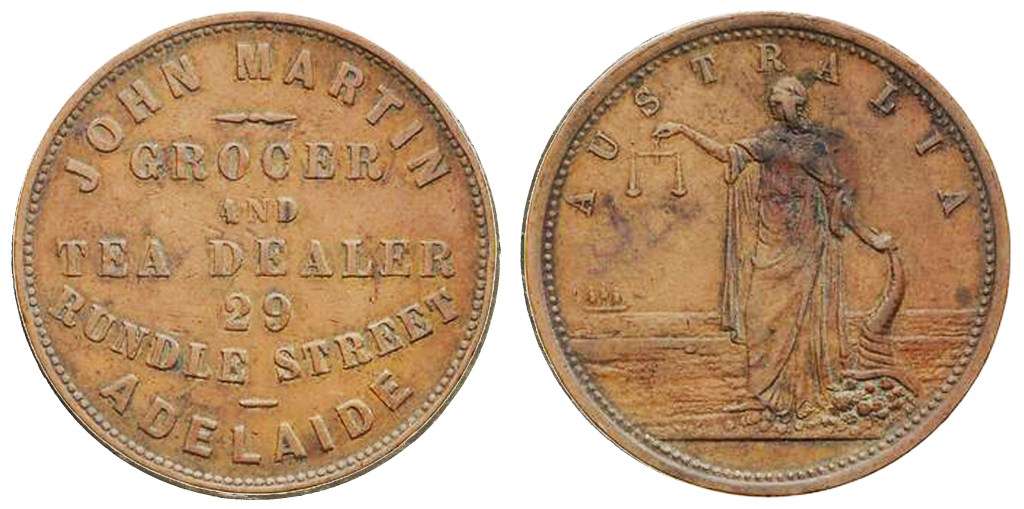
| John Martin, grocer and tea dealer, 29 Rundle Street, Adelaide copper merchant / trade token c1858 found under living room near hallway description Obverse JOHN MARTIN / _._ / GROCER / AND / TEA DEALER / 29 / RUNDLE STREET / – / ADELAIDE Reverse : Justice standing blindfolded facing to left extending right arm with balanced scales, in left hand an inverted cornucopia from which fruit flows (letter G among the fruit); above, AUSTRALIA; sailing ship on horizon at left. Description taken from here: Heaton & Sons, designer obverse and reverse John Martin of Adelaide SA penny token circa 1850s published by The Art Gallery of South Australia https://www.agsa.sa.gov.au/collection-publications/collection/works/john-martin-of-adelaide-sa-penny-token-circa-1850s/74202/ Dated to c1858 The earliest listing of a business exactly matching the inscription on the tokens (‘JOHN MARTIN / GROCER / AND / TEA DEALER / 29 / RUNDLE STREET / ADELAIDE’) was in 1858, in ‘Howell’s Directory for the City and Port of Adelaide’. The Museum Victoria Catalogue gives 1858 as the most likely year for the issue of Martin’s tokens. In 1864 the only listing for a John Martin was for Sturt Street, Adelaide. This listing continued until 1867. No advertisements for the business were located during this survey. made in England, shipped to Australia: Martin’s tokens were struck for him by Heaton and Sons of Birmingham. all info source here: Regan, A. (2005) John Martin, Grocer & Tea Dealer, Adelaide, South Australia in Museums Victoria Collections https://collections.museumsvictoria.com.au/articles/2142 Accessed 14 February 2025er, Adelaide, South Australia https://collections.museumsvictoria.com.au/articles/2142 cultural context merchant tokens not exclusive phenomenon to australia already a solution that had been employed in britain in previous times where not enough official currency was in circulation to meet demand of trade. source: Full Steam Ahead! Britain’s Cartwheel Coins by Justin Robinson, The Coins and History Foundation published 11 April 2022 https://coinsandhistoryfoundation.org/2022/04/11/full-steam-ahead-britains-cartwheel-coins/ |
1862
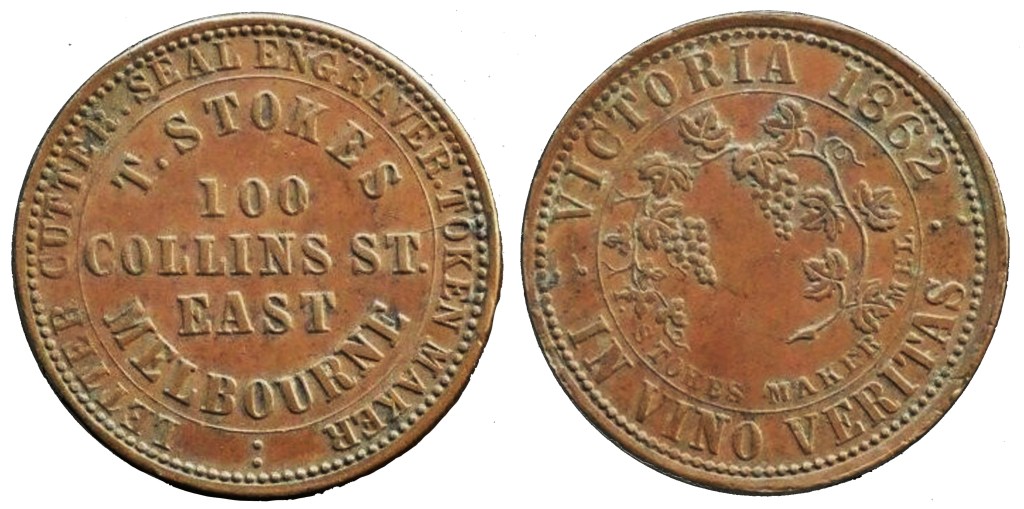
Example from internet
| T Stokes copper penny token, Melbourne Victoria Australia 1862 description obverse T. STOKES 100 COLLINS ST EAST MELBOURNE LETTER CUTTER SEAL ENGRAVER TOKEN MAKER reverse VICTORIA 1862 IN VINO VERITAS, grape vine. description from here: Australia, 1d token, Victoria, 1862, T. Stokes, Melbourne published by B Frank and Son https://www.bfrankandson.com/store/Australia-1d-token-Victoria-1862-T-Stokes-Melbourne-p243360619 Latin for ‘in wine there is truth’ contemporary equivalent is ‘drunk words are sober thoughts’ -there are other variations of the reverse design including coat of arms. cultural context this token produced in Melbourne either with the offices being in Melbourne or the mint being in the city. Tokens are to be banned for trade in 1863 so would have become junk change and scrap metal after this. |
1863, 1865
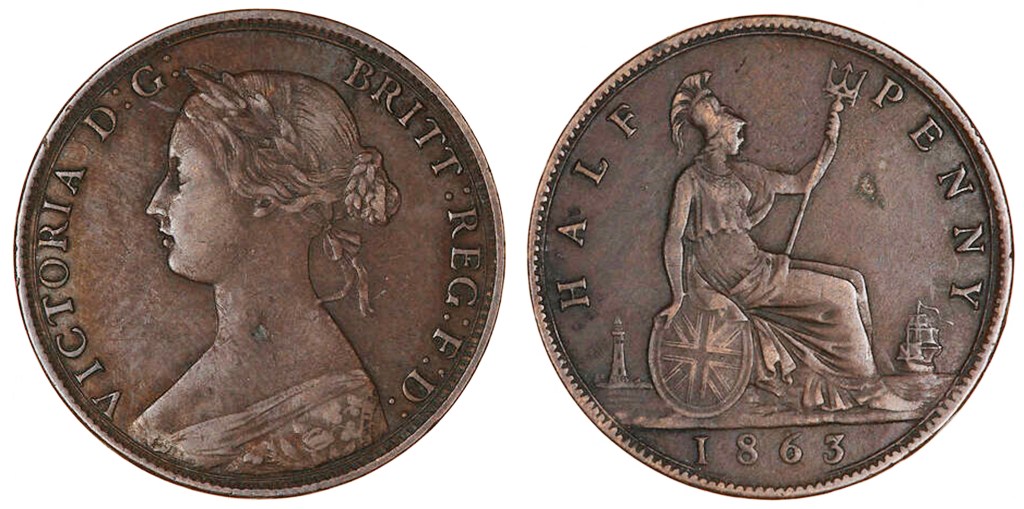
| Queen Victoria Half pennies 1863 and 1865 1865-Found in small front bedroom – smushed up -diametre 25mm 1863 – Found under the heater in living room description obverse Bust of Queen Victoria facing left wearing bodice and a mantle decorated with rose, thistle and shamrock; in her hair a wreath of leaves and berries tied at back with ribbon, her hair drawn to a plaited bun behind, she wears a circular broach; around, VICTORIA D: G: BRITT: REG: F: D: reverse Britannia seated facing right on a rock wearing a helmet and breastplate with flowing dress; she holds a trident and rests her right hand on a shield which bears the combined crosses of the Union Flag; at right a ship sailing away; at left, a lighthouse; around, HALF PENNY; in exergue, 1862/1863 description source: Item NU 1330Coin – Halfpenny, Queen Victoria, Great Britain, 1862 https://collections.museumsvictoria.com.au/items/51708 |
?1851>1911?
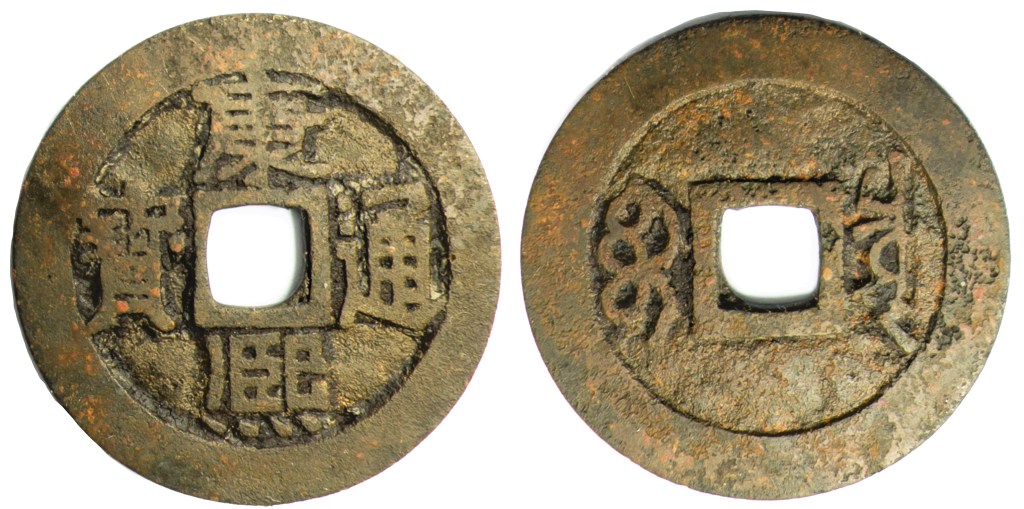
| Kangxi tongbao ‘chinese shilling’ 1 cash coin c.1644-1911 found under the floorboards in western (large) front bedroom under floorboards in corner next to prescription bottles description: obverse (front): 康 熙 Kang Xi (Qing emperor’s reigning name in Manchu) and 寳 tong (=’circulating’) 通 bao (=’treasure’) so = circulating treasure of Kang Xi. read from top to bottom first: 康 KANG 熙 XI and now read from left to right: 寳 TONG (circulating) 通 BAO (treasure) reverse all in manchu script: ᠪᠣᠣ Boo (manchu for treasure) and then ᠴᡳᠣᠸᠠᠨ the board of revenue mint in Beijing. identified via here: ‘An introduction and identification guide to Chinese Qing-dynasty coins’ by Qin Cao. publisher: ? published 2014 location available online: https://www.lincolnmuseum.com/assets/downloads/An_introduction_and_identification_guide_to_Chinese_Qing_dynasty_coins.pdf p8 and also p15 Tong Bao has also been translated as ‘universal value’1 here. other examples: —also see https://en.wikipedia.org/wiki/Kangxi_Tongbao see here https://en.numista.com/catalogue/pieces31487.html value: how much was it worth? -1 cash coin generally a low value -usually carried threaded on a string with other 1 cash coins in multiples of 100 or 1000. source: Chinese Coins Down Under: Their Role on the New Zealand Goldfields by: NEVILLE A. RITCHIE and STUART PARK publisher: year:? found online here: ? p1 here’s a pic of 25 x 10-cash threaded in groups of 5 here within china: the value of copper coins fluctuated, and in practice, the official exchange rate set by the Qing government was not used most of the time. -also note cash coins would continue to be used as legal tender despite the age or dynasty of coin A steamed bun could cost 3 cash. source: Chinese Coins Down Under: Their Role on the New Zealand Goldfields by: NEVILLE A. RITCHIE and STUART PARK publisher: year:? found online here: ? p1 within Victoria: Unknown to what degree they were used as currency within or beyond Chinese community. -were used as gambling tokens and specifically as ‘fan tan’ counters. They might also have been exchanged or gifted as good fortune tokens. source: Chinese Coins Down Under: Their Role on the New Zealand Goldfields by: NEVILLE A. RITCHIE and STUART PARK publisher: year:? found online here: ? p1 cultural context: Similar 1 cash coins have been found in New Zealand gold rush sites: Most of the cash were found singly (or occasionally in twos and threes) in and around the structural remains, suggesting that they were lost or misplaced. source: Chinese Coins Down Under: Their Role on the New Zealand Goldfields by: NEVILLE A. RITCHIE and STUART PARK publisher: year:? found online here: ? p1 to do: check out dice being connected to chinese gambling as well, from a bust in little bourke st – where the cash coins are called chinese shillings: “POLICE.” The Argus (Melbourne, Vic. : 1848 – 1957) 7 May 1858: 6. Web. 11 Feb 2025 <http://nla.gov.au/nla.news-article7294082>. October 1868: chinese gambling houses busted in collingwood: see LATEST NEWS. (1868, October 13). Gippsland Times (Vic. : 1861 – 1954), p. 2 (Morning.). Retrieved February 11, 2025, from http://nla.gov.au/nla.news-article61341898 |
//////////////////
BOTTLE MAKER MARKS
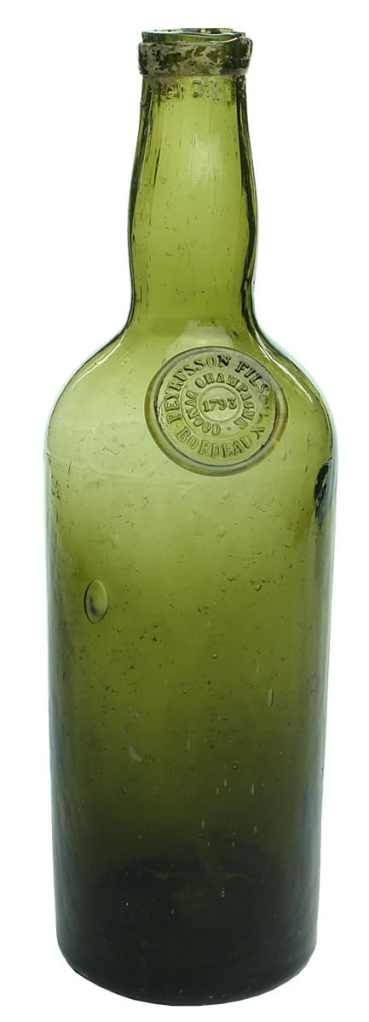
the round makers mark in the centre of green is:
Peyrusson Fils & Co / Cognac Champagne / 1793 / Bordeaux. Base mark: (Dot). Wine Cognac Applied string rim. Applied seal. Shouldered. Green. 26 oz. 265 mm. 1850s
mark m gourdal bordeaux champagne cognac 1795
a similar looking mark:
https://abcrauctions.com.au/past-auctions/2301/abcr-auction-31/936/peyrusson-fils-cognac-champagne-bordeaux-1793-antique-bottle/
the other dark black mark in the photo is a very dark green van der berg & co seal c1870:::
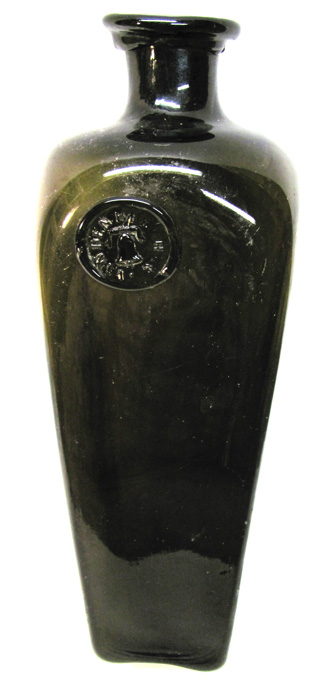
https://gin-bottles.com/VAN%20DEN%20BERGH-%20SIDE%20SEAL.htm
also here
https://www.worthpoint.com/worthopedia/antique-sealed-bell-vandenbergh-co-1920746760
descroption
ANTIQUE SEALED (BELL) VANDENBERGH & CO.PIG SNOUT CASE GIN BOTTLE You are bidding on an early, crude, applied top (pig snout) sealed Dutch Case Gin bottle. Dating between 1865-1875, this early bottle is olive-amber in color and stands 9″ tall by 3″ wide across the shoulders tapering down to 2-3/8″ wide across the base. It has a drippy, applied pig snout lip, smooth (concave) panels, a shoulder seal marked: VANDENBERGH & CO. {BELL} loads of entrapped air bubbles and a footed base.
Vieux / Cognac. Deep punt to base. Spirits Cognac Tall cylinder. Applied ring around sharply cut top. Olive Green. 26 oz. 290 mm. 1860s
Excellent. Great strongly embossed seal and lovely crude early bottle. There is a shallow flake under the ring on the front neck which would be from manufacture before the ring was added. Some internal stain. Scratches, scuffs and some patches of dullness over the surface.
 burrows & co