to do:
-create a broad skeleton structure of the talk to unpick and break off from as a ghost page of the slideshow
skeleton here
create 1874 family almanac format for bready proj
-create separate page for all the coins I’ve found under the house from ghost page
-create separate page for the bottles I’ve identified from makers marks under the house
-same with wallpaper
-set up separate page of history of maps for melbourne and fitzroy that I can turn to.
-set up page of further readings for hist of melb generally and fitz specifically
this page:
description of house and a timeline of it’s residents
wallpaper here and COIN rundown and bottles from under house here
the rest is in the slideshow section.
Further info on Thomas Bready here
Further info on De Lacy Here.
bibliog in timeline format here
https://collingwoodhs.org.au/wp-content/uploads/2021/06/Streets-Parks-and-Lanes-of-Collingwood_pub2-opt.pdf

Victorian Environmental Assessment Councilhttps://www.veac.vic.gov.au › getDownload
The first Land Act passed by the Victorian Parliament (the Sale of. Crown Lands Act 1860) provided for the reservation of lands permanently or temporarily …Read more
////
The first ‘suburban’ land allotments to be sold outside of the Melbourne town reserve were in the areas now
known as Fitzroy, Collingwood, and Richmond. The allotments were numbered 1 to 88. The first 47 made up
what was to become the municipality of Richmond, while numbers 48 to 88 covered the area known colloquially
in the mid-nineteenth century as the ‘district of Collingwood’. These ‘Collingwood’ allotments lay to the north-east
of the City of Melbourne, and covered the area bounded in the west by Nicholson Street, to the east by the Yarra
River, to the north by Reilly Street (now Alexandra Parade), and to the south by Victoria Parade (originally called
Simpson’s Road). The smaller portion of this `Collingwood’ area, the land bounded by Nicholson Street, Smith
Street, Victoria Parade and Alexandra Parade, became to be known as Fitzroy.(117)
The original allotments in Fitzroy were of varying sizes, most falling between about 12 acres (facing Victoria
Parade) and 28 acres, a size suitable for large estates, and small-scale rural or semi-industrial pursuits such as
dairy farms, market gardens, and brickyards.(118) Accordingly, land reserved by the Government for roads in the
Fitzroy area consisted only of Nicholson Street, Victoria Parade, Alexandra Parade (known variously as Darebin
or Reilly Street), Johnston Street and Smith Street.(119) In 1838-39, following the first land sale there were no
controls imposed upon the purchasers of land in Fitzroy in terms of the way they could subdivide and resell the
land. As land changed hands and was progressively subdivided throughout the 1840s, a peculiar street layout
emerged. Though the Government roads provided a framework for a regular pattern of roads which made it easy
for speculators to proceed with subdivisions, the lack of controls on the size and orientation of subdivision
allotments and the width of roads, together with a general lack of cooperation or coordination between
landowners, led to the emergence of an ad-hoc street pattern and layout of allotments in South Fitzroy (120)
The first main non-Government streets to be laid out by landowners in Fitzroy were Brunswick and Gertrude
Streets. These two streets became the most important non-Government streets in South Fitzroy, mainly because
their original line and length were extended by a number of successive landowners and subdividers. This
contrasted strongly with the disparate pattern of subdivision and street layout which developed in other allotments
in South Fitzroy.
Alignment of Streets
In 1854, the Victorian Parliament passed a special Act of Parliament, known as the Act for Improvements in Fitz
Roy Ward in the City of Melbourne, designed to solve the street alignment problems in South Fitzroy. In the
1850s and 1860s, local politics in the Fitzroy-Collingwood area were concerned largely with the realignment of
the worst of these ad hoc streets.
Building Act
The Act for regulating Buildings and Party Walls, and for preventing mischiefs by fire in the City of Melbourne
(1849) (121) came into effect from the beginning of 1850,(122) enforcing fireproof construction and minimum
street widths in the City of Melbourne, then including Fitzroy (and excluding Collingwood and Richmond). Under
the provisions of the Act wooden or iron buildings could only be constructed with a prescribed set-back from the
adjacent buildings and from the street.(123) Without a setback of at least one-third of its height (or eight feet, if
the building was less than 24 feet in height), any new building was required to be constructed of brick and/or
stone. As a result of the Melbourne Building Act, 1850s Fitzroy buildings were typically ‘cement finished bluestone
or brick, exposed rough-face bluestone, or exposed brick’.(124) At this time, the influx of gold rush immigrants
increased the demand for housing in the fledgling metropolis. The introduction of the Act considerably slowed the
rate at which new houses could be built, with the result that supply fell far short of demand. (125) By 1891, only
51% of Collingwood’s houses were brick or stone (outside of the Act) while in Fitzroy, the figure had risen to 83%
as a direct outcome of the legislation.(126)
Consolidation
The 1860s-1870s was a period of consolidation in Fitzroy’s commercial strips, as the rude structures of the early
decades were replaced with more substantial premises. This is most apparent along Gertrude and Brunswick
Streets, and along Smith Street. The 1870s and 1880s saw the replacement of many earlier single-fronted shop
buildings with rows of shops.
Public transport
The first power driven public transport to be introduced to Fitzroy was the cable tram. One route through Fitzroy
ran along Nicholson Street from the city and divided into two routes: one ran along Gertrude Street to Smith
Street and the other continued northward along Nicholson Street. Another route ran down Brunswick Street.(127)
These routes were established in 1886 and 1887. Unlike the pattern of urban development in some of
Melbourne’s then outer suburbs, where the location of tram routes facilitated and stimulated the development of
those streets into major commercial strips, the tram routes in Fitzroy were located along streets which were
already consolidated commercial precincts.
Industry
Industry, which had barely existed in Fitzroy in the 1850s had grown considerably by the 1870s and a number of
major factories were being built and extended in the 20th century up to the Great War and beyond, including the
famous MacRobertson Confectionary factory which started in Argyle Street in the 1880s.(128) The large factories
and warehouses from this later period tower above the predominantly low rise nature of the early residential
development.
Major Institutions
Along with the early development of the suburb and its proximity to Melbourne City, was the development of
major institutions on its fringe, in particular, St Vincent’s Hospital and The Convent of Mercy (Victorian Heritage
Register), both of Roman Catholic origin.
The Convent of Mercy and Academy of Mary Immaculate was founded in 1857 and consists of a number of
buildings constructed over a period of thirty years at the corner of Palmer and Nicholson Streets. The complex is
significant for its long-term and continuing association with Catholic education in Victoria (129).
St Vincent’s was founded in a Victoria Parade terrace house row by the Irish Order, The Sisters of Charity, in
1893; the complex eventually becoming the suburb’s largest charitable institution. In 1905 they moved into a new
four storey hospital building and by 1914 they were the second busiest hospital in Melbourne, benefiting from
support provided by Fitzroy Council, the Fitzroy Football Club and the legendary John Wren. The Healy Wing was
opened in 1928 and other wings followed, with the current complex covering a site bounded by Victoria Parade,
Nicholson Street, Fitzroy Street and Gertrude Street. (130) A notable recent design was the St Vincent’s Private
Hospital since added to and altered.
Conclusion
An extraordinary amount of comparatively homogeneous nineteenth century building stock has survived in
Fitzroy, as compared to either the City of Melbourne or neighbouring suburbs such as Collingwood or Richmond.
Some 22% of the buildings in the Heritage Overlay Area are individually significant compared with, for example,
other large residential areas such as 7% for North Fitzroy or 9% for North Carlton. Some 18% of South Fitzroy
buildings were erected by the 1860s as a demonstration of its early origins.
Main development era
The main development period in the South Fitzroy Heritage Overlay Area is that of the Victorian era with a
substantial contribution from the Edwardian period. There is also a contribution from some well preserved interwar buildings and individually significant places of all eras.
Contributory elements
The Heritage Overlay Area contributory elements include (but not exclusively) mainly detached and attached
Victorian-era and Edwardian-era houses, having typically:
. Pitched gabled or hipped roofs, with many facade parapets,
. One and two storey wall heights but with some isolated landmark 3-5 storey buildings,
. Face brick (red, dichrome and polychrome), bluestone or stucco walls, some weatherboard;
. Slate, corrugated iron roof cladding, some Marseilles pattern terra-cotta tiles;
. Chimneys of either stucco finish (with moulded caps) or of face matching brickwork with corbelled capping
courses;
. Post-supported verandah elements facing the street, set out on two levels as required with cast-iron (typically
mid to late Victorian-era ) or timber detailing (typically Edwardian-era or early Victorian-era ) also some use of
arcaded masonry verandahs;
. Less than 40% of the street wall face comprised with openings such as windows and doors; and
. Front gardens, originally bordered by typically timber or iron picket front fences of around 1m height;
Contributory elements also include:
. Corner shops and residences with display windows and zero boundary setbacks.
. Well preserved buildings from the pre Second War era.
. Mature street tree plantings (plane and elm trees)
. Subdivision pattern that draws from Government surveyed rectangular lots, typically of between about 12 and
28 acres, and then developed privately but within a framework that encouraged continuity of street alignment and
allotment size;
. Hoddle’s early survey grid expressed as main roads, such as Nicholson Street, Victoria Parade, Alexandra
Parade, Johnston Street and Smith Street;
. Public infrastructure, expressive of the Victorian and Edwardian-eras such as bluestone pitched road paving,
crossings, stone kerbs, and channels, and asphalt paved footpaths;
. Some distinctive rear and side service lanes or rights-of-way, with substantial boundary walls, stable and loft
structures, night soil hatches and privies;
. Early institutions such as St Vincent’s Hospital and The Convent of Mercy.
FOOTNOTES FROM THIS ARTICLE
References
117 B Barrett.The Inner Suburbs.p. 14.
118 B Barrett.The Inner Suburbs.p. 7
119 B Barrett.The Inner Suburbs.p. 7.
120 B Barrett. The Inner Suburbs.p.17, and Fitzroy History Society. p. 7.
121 referred to here as the Melbourne Building Act)
122 Fitzroy History Society. p.15.
123 Act for regulating Buildings and Party Walls, and for preventing mischiefs by fire in the City of Melbourne.
(1949). Schedule b, Part 5, p. 235.
124 ibid. p. 20.
125 ibid. p. 24.
126 Figures quoted in B Barrett. The Inner Suburbs.p. 29.
127 See Sowerwine, Charles. ‘Public Transport and the Fitzroy Identity’, in Cutten History Committee of the
Fitzroy History Society. Fitzroy: Melbourne’s First Suburb. p. 11 6, see also Allom Lovell and Associates Pty Ltd.
Hawthorn and Malvern Tramway Depots: Conservation Report. Prepared for the Public Transport Corporation,
Melbourne, 1990. pp. 5-6.
128 See C Sowerwine .’Public Transport and the Fitzroy Identity’. pp. 116-117.
—-SOURCE::::: Victorian Heritage Database Report Report generated 03/01/26 https://vhd.heritagecouncil.vic.gov.au/places/95122/download-report#:~:text=River%2C%20to%20the%20north%20by,roads%20which%20made%20it%20easy
////
to check out
‘Thomas Bibb’s [sic] Cadastral Map of Melbourne’, cited in Lewis, ‘Maps for building research’, p. 21
maps….https://prov.vic.gov.au/explore-collection/provenance-journal/provenance-2020/bibbs-map#_edn18
THE BIBBS MAP
timeline qs
what are all the maps available showing earliest houses,
timeline of street numbers etc.
Question when did melb coucnil prohibit cesspits entirely? (because they were supposed to be watertight and be regularly emptied by contractors, but they more regularly leaked and overflowed. p 17 fitz first suburb
-who became council for fitz
what year was this: the closet pan system
The more general system that was developed was the one in which nightmen called to empty or replace the pan, and this meant that privies were generally located on the back or side boundary, with a hatch at ground level through which the pan could be removed from outside p17 fitzroy first suburb
A month in the bush of Australia : journal of one of a party of gentlemen who recently travelled from Sydney to Port Philip : with some remarks on the present state of the farming establishments and society in the settled parts of the Argyle country. by Walker, Thomas, 1804-1886. >>>>walker ended up buying lots 49 and 70 London : J. Cross 1838 available online here https://viewer.slv.vic.gov.au/?entity=IE1688333&mode=browse
————————————-
TWO COLUMN BASIC TIMELINE
>1830s
pre colonisation
https://bth.humanrights.gov.au/significance/historical-context-ancient-history
Potential Reading: (hardcopy)
Historical records of Victoria : foundation series / Volume 6, The Crown, the land and the squatter, 1835-1840 / edited by Michael Cannon and Ian MacFarlane.
1837
1837
crown land sales
20 acres of sub section 51 being sold to Mr Thomas G Gore
SOURCE Fitzroy Melbourne’s First Suburb
Question: what was the date this happened?
Primary source: PROV
Public Record Office Victoria
SEE:
Consolidated Name Index to Register of Crown Grants
The recordkeeping system governing sales by auction comprises eleven series which document the chain of legal and administrative procedures and processes from advertisement of land for sale to the issue of a Deed of Grant.
…At the auction, after each individual allotment was sold, details of the purchaser were entered in the previously prepared Sale Contract Books (VPRS 873) next to the technical description of the sold allotment. Data recorded included the purchase price and the name and address of the purchaser. Upon signing the contract the purchaser would receive a receipt for the deposit paid.
VPRS 11868 – for the period 1837 to 1851
The department created a Name Index to the Register of Crown Grants. See VPRS 11863 and VPRS 11867, for the periods 1837 to 1851
Plan of the Parish of Jika Jika in the County of Bourke.
[Melbourne] : [Department of Lands and Survey?]
Date: [between 1837 and 1850]
SOURCE http://handle.slv.vic.gov.au/10381/262194
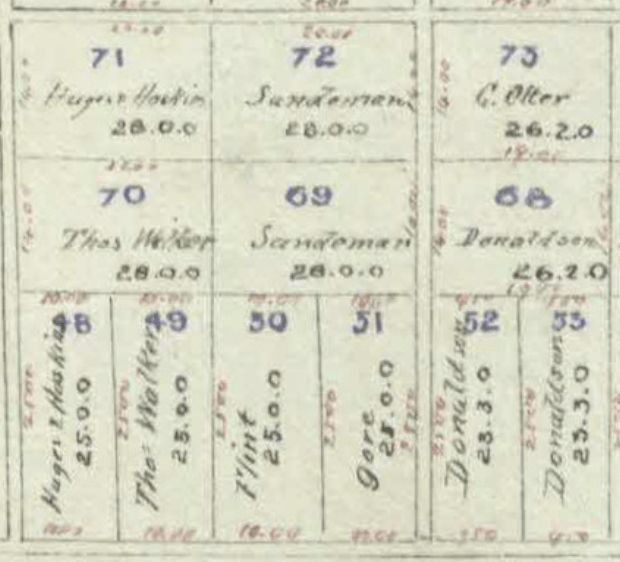
Q – what’s the exact overlap on current boundaries?
A – in circa 1920s a map was drawn to show then current streets against the crown land sales. This map is: 1852 Map of the City of Melbourne and its Extension – William Green See more info under 1852 and see primary source online here
From here, the further subdivision of section 51
Plan of subdivision of suburban portion no. 51 situate at Collingwood in the Parish of Jika Jika in the County of Bourke.
Date[between 1837 and 1860]
SOURCE HERE https://find.slv.vic.gov.au/permalink/61SLV_INST/1sev8ar/alma9925478733607636
Q What date was section 51 further subdivided?
Who buys what?
–my plot falls within XLIII (no.43 of section 51).
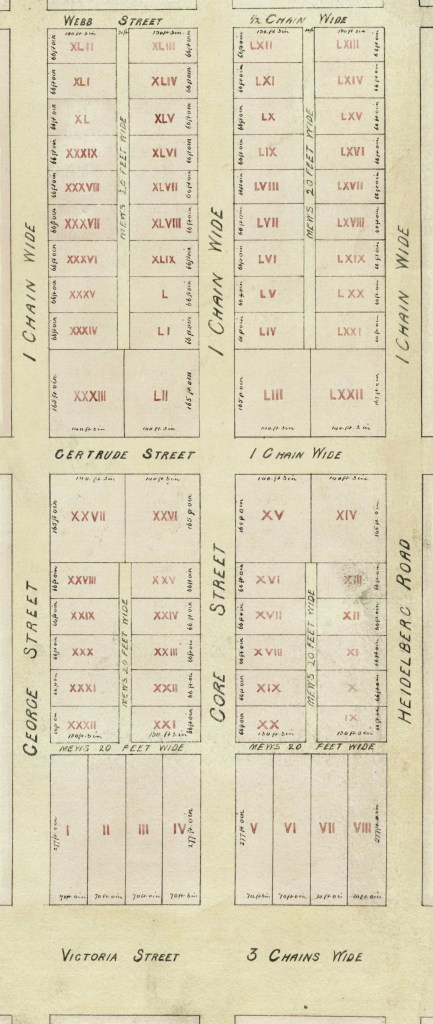
—-When Benjamin Baxter subdivided allotment 49 he quartered the allotment by creating Brunswick and Gertrude Streets…[the streets were] continued by the neighbouring owners: R.S Webb, who had brought Walker’s allotment 70, continued Brunswick St to the north; while during the later 1840s Gertrude St was contained westward as far as Nicholson St…In the 1850s Gertrude St was continued in the opposite direction through lots 50 and 51 as far as Smith St” This level of coordination was not maintained elsewhere, for, in some of the smaller sub divisions, adjoining property-owners completely ignored the layout being developed on each other’s land -p2 fizroys first suburb
—as time went on the pressure of development often left the villas fronting the major streets, and their grounds subdivided to create lanes and mews with humbler allottments concealed from the public gaze. – p14 fizroys first suburb
-First subdivisions
The first ‘suburban’ land allotments to be sold outside of the Melbourne town reserve were in the areas now
known as Fitzroy, Collingwood, and Richmond. The allotments were numbered 1 to 88. The first 47 made up
what was to become the municipality of Richmond, while numbers 48 to 88 covered the area known colloquially
in the mid-nineteenth century as the ‘district of Collingwood’. These ‘Collingwood’ allotments lay to the north-east
of the City of Melbourne, and covered the area bounded in the west by Nicholson Street, to the east by the Yarra
River, to the north by Reilly Street (now Alexandra Parade), and to the south by Victoria Parade (originally called
Simpson’s Road). The smaller portion of this `Collingwood’ area, the land bounded by Nicholson Street, Smith
Street, Victoria Parade and Alexandra Parade, became to be known as Fitzroy.(117)
The original allotments in Fitzroy were of varying sizes, most falling between about 12 acres (facing Victoria
Parade) and 28 acres, a size suitable for large estates, and small-scale rural or semi-industrial pursuits such as
dairy farms, market gardens, and brickyards.(118) Accordingly, land reserved by the Government for roads in the
Fitzroy area consisted only of Nicholson Street, Victoria Parade, Alexandra Parade (known variously as Darebin
or Reilly Street), Johnston Street and Smith Street.(119) –https://vhd.heritagecouncil.vic.gov.au/places/97362/download-report cited from B Barrett. The Inner Suburbs
—-
…the subdivision of the land down to the residential allotment size was entirely at the discretion of the owner, and there were no prescribed minima for the sizes of sites or the widths of streets. Secondly, prior to 1850 there was no control over materials and standards of buildings (((me: I think this was because it was outside the city of melb zoning where there WERE regulations–or maybe no regulations established anywhere at this time))
The consequence of this has been that the humble dwellings were generally not durable enough to survive, while the villas probably sprawled over too much land…today there is only one building in Fitzroy (the former Devonshire Arms Hotel) known to date from before 1850
–p2 firzroys first suburb
‘In 1838-39, following the first land sale there were no
controls imposed upon the purchasers of land in Fitzroy in terms of the way they could subdivide and resell the
land. As land changed hands and was progressively subdivided throughout the 1840s, a peculiar street layout
emerged. Though the Government roads provided a framework for a regular pattern of roads which made it easy
for speculators to proceed with subdivisions, the lack of controls on the size and orientation of subdivision
allotments and the width of roads, together with a general lack of cooperation or coordination between
landowners, led to the emergence of an ad-hoc street pattern and layout of allotments in South Fitzroy’
–https://vhd.heritagecouncil.vic.gov.au/places/97362/download-report cited from B Barrett. The Inner Suburbs.p.17, and Fitzroy History Society. p. 7.
1838 GOV gazette – check this out… https://gazette.slv.vic.gov.au/images/1838/N/general/370.pdf
1839
-‘The denser and more ephermeral development, which began with the tent settlement on lot 48 and continued with shanties farther to the north, can be attributed largely to the assisted immigration that began with the arrival of the ‘David Clarke’ in 1839, combined with the economic recession of 1840-1842′ p 12 Fitzroy Melbourne’s First Suburb
1839
modern day Victoria Street is known as: a government road.
“Victoria Street was reserved as a government road in 1839. The road was originally called Simpson’s Road after a magistrate who constructed a small footpath and road in 1843” – SOURCE wikipedia (citation)
Bibliographic details for “Victoria Street, Melbourne” Page Version ID: 1274751896 Page name: Victoria Street, Melbourne Author: Wikipedia contributors Publisher: Wikipedia, The Free Encyclopedia. Date of last revision: 9 February 2025 01:20 UTC Date retrieved: 21 February 2025 07:21 UTC Permanent link: https://en.wikipedia.org/w/index.php?title=Victoria_Street,_Melbourne&oldid=1274751896 Primary contributors: revision history statistics
1840::::
-economic recession p 12 Fitzroy Melbourne’s First Suburb
Sale of surburban allotments and lands advertisement. https://trove.nla.gov.au/newspaper/article/32185370
1 Oct 1840 – look up the original article on trove – the Port Phillip Herald remarked that some scenes of immortality and debauchery were becoming nightly events (in fitz) p.34 fitz first sub
—in April 1841, the residents of Newtown petitioned Superintendent La Trobe, requesting he provide them with police protection. To support their case, they pointed out that fully 600 people were living in Fitzroy in some 100 houses p.34 fitz first sub
1840s:::::
34-38 Fitzroy Street, Fitzroy (Devonshire Arms Hotel)
–has details prohibited by the [building act] such as timber projecting beyond the building face at eaves level, and the remains of a timber paling roof’ p 20 fitz oldes sub
–the inclusion of materials such as zinc and ‘tin’ (presumably galvanised iron) not known to have been used in the Port Phillip District in 1840s. p19 fitz first sububr
1841
economic recession p 12 Fitzroy Melbourne’s First Suburb
1842
January 1842
-Superintendant Charles La Trobe writes to Governor Gipps requesting that the name of New Town be changed to Collingwood, and seeking instructions for the proper alignment of the streets. Buildings had been put up haphazardly out of line, facing in different directions, and encroaching on the streets themselves’ – p14 Fitzroy Melbourne’s first suburb
-The ‘Melbourne Municipal Corporation Act’ is passed in Sydney. Hoddle foresaw that all the suburban land from Fitzroy round to Richmond would soon be built on, and therefore argued for its inclusion within the municiple area. He was unsuccessful in this, but at least the Government recognised the urban character of Newtown, or Collingwood as it was now generally known’ p15 fitzroy the first suburb
economic recession p 12 Fitzroy Melbourne’s First Suburb
March 1842
In the Supreme Court of New South Wales.
Thomas Goodhall Gore, Plaintiff
AND Adam Wilson & William Wilson, Defendants.
-Not entirely sure what this is about, presuming this is the right Gore.
see: thomas gore page
Aug 1842
–3 fitzroy applications for “authorised grog shops” before the magistrates (NB me:::this is not to say they werent operating illegally in the area already of course they were)
-Since Fitzroy still had no policeman to ‘look after the publican’ magistrates refused to issue a liquour licence. p34-35 fitz first sub
–settlement of Melbourne is incorporated as a town, thereby establishing the Port Phillip’s first local government body. p.34 fitz melb first sub
Oct 1842
-David Lyons obtains a licence (((for pub)) at a special session. His hotel, names the Travellers Rest, began trading in Novemner 1842…in Nicholson St Fitz facing Faraday St…It thus became Fitzroy’s first legal pub, ‘a popular refreshment stall for people taking a stroll out of town’ p.35 fitz first sub
30 December 1842
NOTICE in gov gazette posted by John Gore
re:twenty-five acres of land, in the county of Bourke, and parish of Jika Jika, portion No. 51, situate at Port Phillip, in the Colony of New South Wales
-against the said Charles Gore (Thomas Gore’s lawyer, no relation), for the purpose of compelling him to execute or cause to be executed proper conveyances to me, of the said allotments of land
JOHN GORE. D. CHAMBERS and HOLDEN, Solicitors.
what’s this about?
see: thomas gore page
1847 Collingwood Hotel opened —where is the original citation for this and where is the original record for the hotel ie miles lewis index
-by James Sword cnr webb and gore st
‘The original name of the hotel – the Collingwood Hotel – reflects the fact that the original Collingwood was the Fitzroy ward of Melbourne from 1847–57. The hotel’s name was changed to the Union Club Hotel in 1886.’
source: https://fitzroyhistorysociety.org.au/wp-content/uploads/2017/11/fitzroy150_walkingmap_email.pdf
-whats the formal link here, burchett index?
1844 COLLINGWOOD HOTEL gets mentioned, is this already trading before 1847??? NOPE this is a house in brunswick St
DOMESTIC INTELLIGENCE. (1844, June 5). Port Phillip Gazette (Vic. : 1838 – 1845), p. 2. Retrieved April 13, 2025, from http://nla.gov.au/nla.news-article224812268
1846 – court case over suburban section 69 – real owner being falsely impersonated etc. see:
Judicial Intelligence. (1846, January 24). The Port Phillip Patriot and Morning Advertiser (Vic. : 1845 – 1848), p. 3. Retrieved February 21, 2025, from http://nla.gov.au/nla.news-article226314442
1847
–Collingwood Hotel opened
-by James Sword cnr webb and gore st
‘The original name of the hotel – the Collingwood Hotel – reflects the fact that the original Collingwood was the Fitzroy ward of Melbourne from 1847–57. The hotel’s name was changed to the Union Club Hotel in 1886.’
source: https://fitzroyhistorysociety.org.au/wp-content/uploads/2017/11/fitzroy150_walkingmap_email.pdf
– extension of postal service from within CBD to Collingwood:
COLLINGWOOD POST-OFFICE
DELIVERY.
HIS Excellency the Governor having been pleased to sanction the appointment of a third Letter Carrier, so to allow of the extension of the Town Delivery to Collingwood. Notice is hereby given, that Post-offices Delivery throughout Collingwood, will be commenced on Monday next, the 22nd instant.
A Letter Box for receipt of unpaid letters will be fitted at the shop-window of Mr. William Sherry, in Brunswick-street, to be emptied by the letter carrier regularly twice a day, in course of his circuit. Unpaid letters deposited there will accordingly, meet the same attention as if posted at the Post-office in, Melbourne ; but this cannot be made, in any way to apply to paid letters.
HENRY D. KEMP.
Chief Postmaster.
Post-office, Melbourne;
19th February, 1847.
SOURCE COLLINGWOOD POST-OFFICE DELIVERY. (1847, March 2). The Melbourne Argus (Vic. : 1846 – 1848), p. 4. Retrieved February 21, 2025, from http://nla.gov.au/nla.news-article4761072
-drunk driving
ECCENTRIC EQUESTRIANISM — William Smith and John Wilson, were yesterday fined forty shillings each and costs, for riding at Collingwood, in a manner which betrayed their contempt for the lives and limbs of H. M. subjects there residing. It was shewn by the evidence of two consta-bles that the defendants were curvetting and prancing about in front of the ” Rose and Crown,” and exhibited a desire of run ning down whoever attempted to check them. The offence being fully proved, the fines as above were inflicted, and they may think themselves lucky in getting off so well as they did, as they were proved to be under the influence of liquor, and resisted the constables, and by their own admission, were riding unbroken animals, for doing which a higtt penalty is leviable. SOURCE Local Intelligence. (1847, December 11). The Port Phillip Patriot and Morning Advertiser (Vic. : 1845 – 1848), p. 2. Retrieved February 21, 2025, from http://nla.gov.au/nla.news-article226516491
1848
HORSE-STEALING.—On the night of the 21st, two horses were stolen from Mr Ryrie’s paddock, at the lower end of Collingwood. The animals had only arrived the day before from the interior, and were put there to graze with thirty or forty colts which had been brought to town for sale. Suspicion attaches to some parties ac-quainted with the stock, from the fact of the only two saddle horses being picked out of so large a number.
SOURCE GOVERNMENT LAND SALE. (1848, September 29). The Argus (Melbourne, Vic. : 1848 – 1957), p. 2. Retrieved February 21, 2025, from http://nla.gov.au/nla.news-article4771766
1849
INTERESTING TO LANDHOLDERS IN COLLIMGWOOD — At the meeting of the Town Council held yesterday, it was resolved — ” That it be referred to the Public Works’ Committee to ascertain and report as to the present state of Collingwood with re-ference to the want of defined streets, with the view of preventing any losses to the proprietors of allotments in Collingwood hereafter, when the corporation may im-peratively be called upon to proclaim the thoroughfares ; and to remove any doubts which exist as to the right of the Council to order and direct the opening of streets in Collingwood, without any claim for in-demnity from the owners of land through which such streets may pass,” Councillor Stephen, who introduced the subject, said that it had been referred a considerable period back to the Public Works Com-mittee, but that committee had so many subjects of vital importance under their consideration, that he believed they did not know to which to give the preference, but as the subject was one with which his own constituents were more immediately con-nected, he had ventured once more to bring it forward. Collingwood had originally been disposed of in one or two sec-tions, and had subsequently been sub-divided into an immense number of sub lots, and the place had so far been neg-lected that no regulation had yet been made for the formation of proper avenues oor streets, and there was at present but one main street nnd another which ran tra-versely. The owners of land there, were under the impression that they were at liberty to build as they liked, as in the event at any time of their property being interfered with for the purpose of forthcoming public streets, they would be enabled to come upon the Corporation. One indi-vidual who was the owner of a section there had fenced it in, and intended pur-posely to put up a building which it was quite clear when erected would stand in the centre of main street, and this cir-cumstance he thought would ensure him a handsome sum for his spec. He (Mr. Stephen) was perfectly clear that the partion were under an erroneous impression as in every sale of suburban allotments the Crown reserved to itself the right of making public ways wherever it might be deemed expedient, and also of taking away any stones or gravel or indigenous trees which might at any time be required for the purpose of making public improvements. The Crown possessed this privilege so must the corporation, but it might perhaps prevent litigation if the present motion were car-ried, and prevent parties from inflicting the injury upon themselves by erecting build-ings which would interfere with the form-ation of public streets.
SOURCE
LOCAL INTELLIGENCE. (1849, January 26). The Melbourne Daily News (Vic. : 1848 – 1851), p. 2. Retrieved February 21, 2025, from http://nla.gov.au/nla.news-article226473542
1849: is this (below) section 51? Mentions 4 room cottage!!!! pre webb st house
source Advertising (1849, October 29). The Argus (Melbourne, Vic. : 1848 – 1957), p. 3. Retrieved February 21, 2025, from http://nla.gov.au/nla.news-article4768950
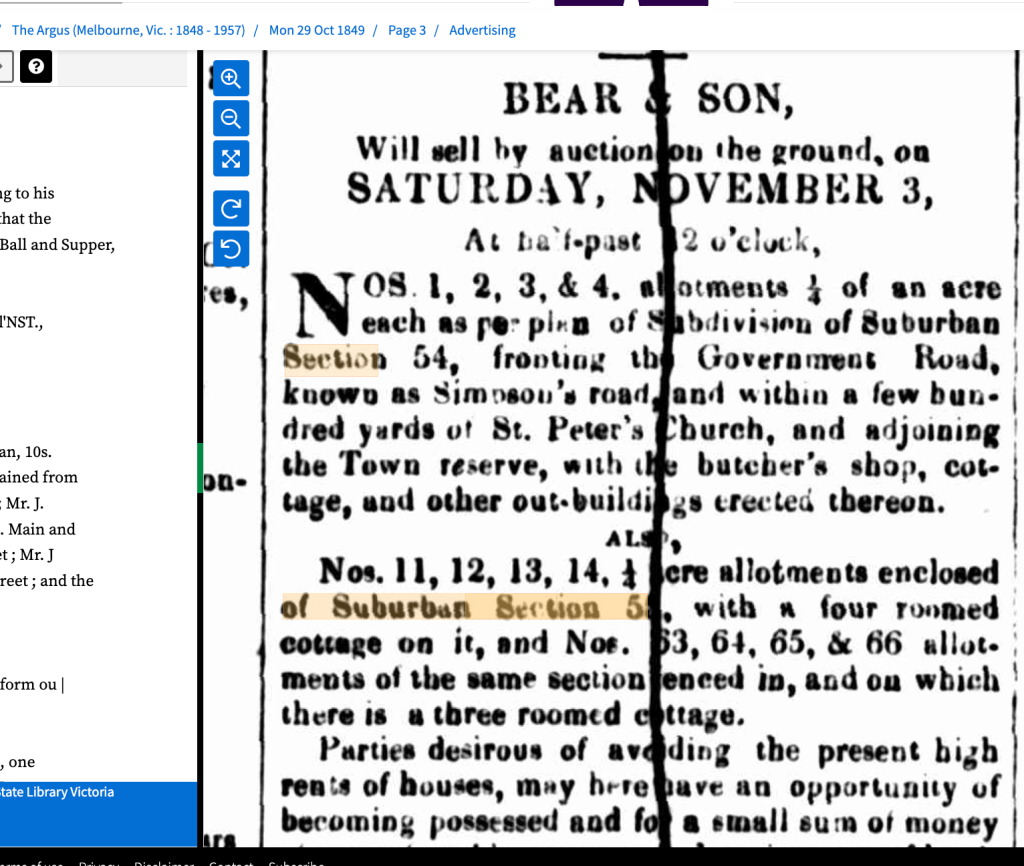
1849
—The ‘Melbourne Building Act’ was passed taking effect from the beginning of 1850 and it enforced fireproof construction and minimum street widths in the whole of what had been the original municpal area: the strip between Victoria Parade and the Yarra, plus what is now Southern Fitzroy. For example T.R. Gore’s allotment 51, fronting Victoria Parade, was subdivided early in 1850 by F.R. Gore, and consequently developed entirely under the provisions of the Act. –p15 fitzroy first suburv – dates????
Building Act comes into effect 1850
The Act for regulating Buildings and Party Walls, and for preventing mischiefs by fire in the City of Melbourne
(1849) (121) came into effect from the beginning of 1850,(122) enforcing fireproof construction and minimum
street widths in the City of Melbourne, then including Fitzroy (and excluding Collingwood and Richmond). Under
the provisions of the Act wooden or iron buildings could only be constructed with a prescribed set-back from the
adjacent buildings and from the street.(123)
The introduction of the Act considerably slowed the
rate at which new houses could be built, with the result that supply fell far short of demand. (125)
from: https://vhd.heritagecouncil.vic.gov.au/places/97362/download-report
-Iron buildings had simply not been envisaged in the Act p.18 fitz first suburb…Among those that slipped through the net were the store that is now All Saints church hall in King William St, Thomas Kidman’s iron house or shop in Napier St…and a cottage at 40 Moore St manufactured by E. T. Bellhouse of Manchester, now re-erecrted by National Trust in south melbourne. p19 fitzr first suburb
also
—-The first documented use [of bluestones] in Fitzroy is the Wesleyan Sunday School off Brunswick Street built in 1849 to the design of George Wharton, [now where housing commission are] This had some details in brick, and was obviously intended to be cement rendered in due course. This was indeed the usual approach, because apart from the excessive cost in dressing the stone to an acceptable finish, it was thought to be too dark either to be attractive or to show up fine carving to good effect (an evaluation that was partly revised under the influence of Leonard Terry in the later 1850s). Most of the exposed bluestone walls that survive in any prominent location in Fitzroy are evidence of unfifulled intentions rather than a love of the now fashionable material.
In Fitzroy buildings of the 1850s, therefore, one can expect to find cement finished bluestone or brick, exposed rough-faced bluestone, or exposed brick. -.20 fitzroy melbs first sub
1850s…AS DECADE
Within the provisions of the act, brick could be used, but locally made bricks were scarce and very unreliable at the height of the gold rush. it was then that bluestone came into its own. Bluestone had scarcely been used, except perhaps for foundations, during the 1840s. Although it was a very hard material to saw or dress it could split fairly readily, and the labour cost was not prohibitive if it was used rough faced. p19 fitzroy first sub
–the area north of Reilly Street (Alexandra Parade) was, but for the quarry allotments, still quite undeveloped in the early 1850s.
1850
1850
Thomas G Gore’s 20 acres land subdivided by F.R.Gore and developed under provisions of new Melbourne Building Act.
SOURCE Fitzroy Melbourne’s First Suburb
-in 1842 [Melbourne] town was divided at Bourke and Elizabeth Street into four wards, so that Newtown/Collingwood became a part of the northern one, Gipps Ward. This encouraged substantial development….[which] tended to further distinguish it from East Collingwood on the other side of Smith Street. The Melbourne Council paid little attention to roads of its northern suburb, as a result of which a petition was got up for Collingwood to be made a seperate ward, and in 1850 it was created the Fitzroy Ward. It was the least developed of Melbourne’s wards, but also the fastest growing’ re 1850-51: these two years were in fact critical ones, and they produced most of the oldest buldings surviving today’
p15 fitzroy first subirb
—46 moore st fitzroy: a prefabricated wooden teak house from India is built here in 1850. [survives until 1970s] source: p18 fitzroy first subiub
1850. Fitzroy is constituted as aseperate ward although still within the City of Melbourne. (Previously Fitzroy had been part of a larger ward, which also included Carlton)
source: p21- The Inner Suburbs: The Evolution of an Industrial Area by Bernard Barrett, Melbourne University Press, 1971
horse theft sale at collingwood hotel:https://trove.nla.gov.au/newspaper/article/91915931?searchTerm=james%20sword%20collingwood%20hotel
1851 MAP:
Jika Jika and Melbourne no. 18 [cartographic material] 1851-1852.
See online here:
CITY COUNCIL. (1851, May 26). The Argus (Melbourne, Vic. : 1848 – 1957), p. 4. Retrieved July 19, 2025, from http://nla.gov.au/nla.news-article4778109
CITY COUNCIL. (1851, July 2). The Argus (Melbourne, Vic. : 1848 – 1957), p. 2. Retrieved July 19, 2025, from http://nla.gov.au/nla.news-article4778854
1851
CITY COUNCIL. (1851, May 20). The Argus (Melbourne, Vic. : 1848 – 1957), p. 2. Retrieved July 19, 2025, from http://nla.gov.au/nla.news-article4777989-
–what is now known as Victoria was until 1851 the Port Phillip district of New South Wales.
-Superintendent La Trobe becomes Lt, Gov when Victoria becomes an independent colony.
p.34 fitz first sub
iron pre fab houses are marketed as fireproof and suprerior to wooden houses until the San Fransisco Fires prove otherwise, May 3-4 1851 SAN FRANCISCO.
See this blog:::
In the prefab world in 1849, iron houses were a relatively recent invention. The chance for gold rush profits accelerated their development, as just about every foundry, blacksmith, and roofer decided to get into the housing business.
Iron models were cheaper than wood frame houses and much easier to disassemble and re-erect in a new location, which seems like a nice back-up plan for a buyer following gold strikes. Plus, iron houses were marketed as “fire proof.”
Then the fire-proof claims took a big hit during the big San Francisco conflagration on May 3–4, 1851.Men who thought they were safe inside their fireproof buildings soon found that the doors swelled shut from the heat, trapping them in a noxious inferno. And while the structures didn’t burn, they certainly did melt. Yikes.
When all had cooled, to cut up and haul off the warped debris of an iron house cost more than building a replacement wood frame building.
—https://www.sanfranciscostory.com/gold-rush-prefab/
and also see: https://www.nationaltrust.org.au/places/portable-iron-houses/?ref=sanfranciscostory.com
1851 government quarries see p16 fitzroy first suburb and Collingwood stockades working on quarries
—-F Lancelott writing in about 1851 describes a typical dwelling probably built in the 1840s—-see p16 fitzroy first suburb
-Wheras previously only Brunswick and Gertrude streets were recognised as corporation responsibilities, [me ie city of melbourne corporation] the Council agreed in February 1851 to proclaim, extend and align most of Fitzroy’s streets. Many property-owners in Fitzroy did well out of this period of Melbourne Council activity. Some did conspicupusly well. David Young, for example. His land values went up, thanks to the work done extending and aligning Gore, George, Napier, Greeves, Young and St David streets…Other councillors (such as Reilly, Benjamin Bell, and John Hayward) who sat on the Fitzroy Ward Improvement Committee also prospered at their own hands…'[[]in 1854]]]p38 fitz first sub
14 FEB 1851 Burchett Index:
-Thomas Bready listed as Mason
-residing or has formal address linked to Little Bourke St
-registered as builder for two houses owned by Jeremiah Crowley.
SOURCE 14 FEB 1851 Burchett Index
>these houses are 90 and 94 GEORGE St
SOURCE untitled marion’s notes.
-90 George was Alfred Deadkin’s birthplace.
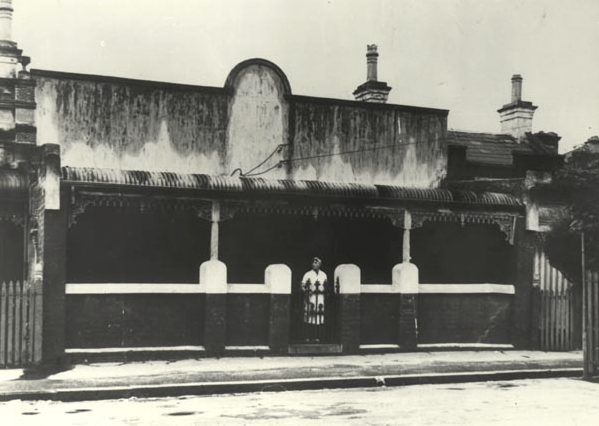
-94 George now has a Victorian facelift…have also seen this house below NOT included in Bready’s buildings.
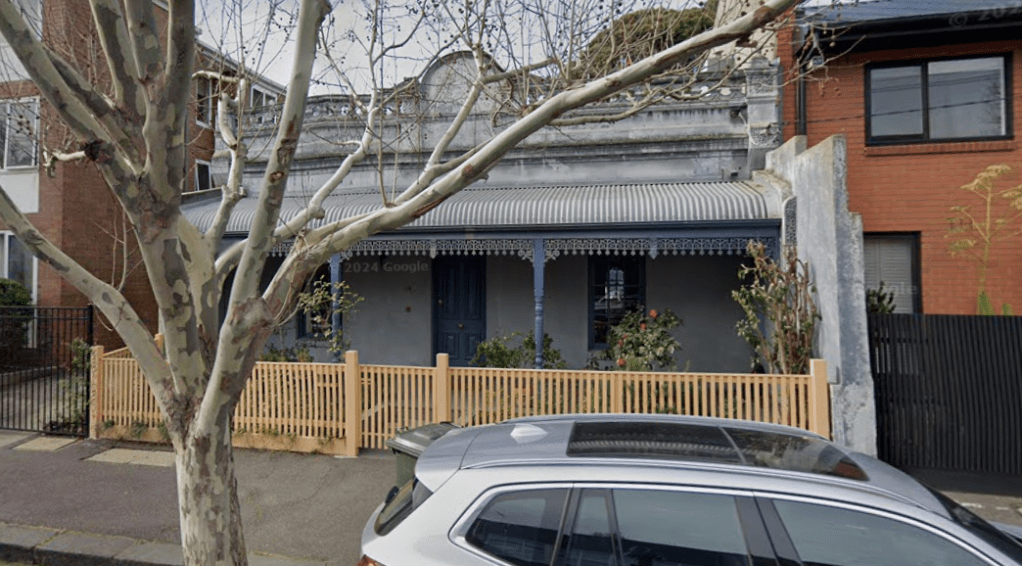
QUESTION – at what point was Collingwood Hotel built for then proprietor James Swords? (aka Union Club Hotel) 164 Gore St
A 1847 but double check
1851 cont
AUGUST 1851
-Thomas G Gore auctions sub section 51 the “Gore Estate”
-James Swords purchased Lot 43 and 44 in Webb St for a total of L105.
SOURCE Meg Lee, Citizen Historian Project 80 Webb Street Fitzroy, Fitzroy Historical Society Newsletter, 2022 issue 2 p4
alsooooooo
APA citationCITY COUNCIL. (1851, May 20). The Melbourne Daily News (Vic. : 1848 – 1851), p. 2. Retrieved July 19, 2025, from http://nla.gov.au/nla.news-article226521207
1852 MAP:
(COPY OF) MAP OF MELBOURNE 1852
1852 Map of the City of Melbourne and its Extension – William Green
A map issued by O’Connor & Co., Land Agents. It is a copy of the original map drawn by William Green, surveyor, architect and land agent, in 1852 and released in December that year. The map covers the City of Melbourne and inner suburbs. It probably dates from the 1920s as by the 1930s PJ O’Connor had begun practising as an architect.
See online here
Research done by East Melbourne History Society:
“A map issued by O’Connor & Co., Land Agents….It probably dates from the 1920s as by the 1930s PJ O’Connor had begun practising as an architect.
…An advertisement in the Argus of 9 December 1852 shows that the original map was available for purchase.”
Source: 1852 Map of the City of Melbourne and its Extension – William Green see online here https://emhs.org.au/catalogue/emdf0402
1852
[more on Hodgkinson map: I’ve since learned the original is at public records office:
permanent link: https://prov.vic.gov.au/archive/FDB74EAA-F858-11E9-AE98-83693D179613?image=1
MELBRL3
COLLINGWOOD AND EAST MELBOURNE CONTOURED PLAN; HODGKINSON;; JIKA JIKA MELBOURNE NORTH
CITATION: VPRS 8168/P0002, MELBRL3
dated: 1852-01-01 – 1852-12-31]
Its the earliest map showing the buildings Bready built.
more on Board of Works map: source:
Anon (1899) Melbourne and Metropolitan Board of Works detail plan. no. 1202, City of Fitzroy [cartographic material]. See online here: https://find.slv.vic.gov.au/permalink/61SLV_INST/1sev8ar/alma9911645233607636
1852
28 August 1852
Bready associated with Little Charles St, Collingwood – either as his personal residence or as a business/office address.
Fee paid for 1 house on Webb Street, opposite Collingwood Hotel with Bready builder owner on 28/08/1852.
MCC registration no 273 [Burchett Index]. Fee 3.3.0 house
SOURCE: AUSTRALIAN ARCHITECTURAL INDEX Record No. 83975
ONLINE: https://aaindex.app.unimelb.edu.au/building-record/83975
BUILDING virtually STOPS
—In Melbourne, including Fitzroy Ward, building virtually stopped for a full year between March 1852 and March 1853 when only 41 buildings were put up—-look up footnote 23. page 18 fitxroy first sub
****DOES THIS INCLUDE WEBB ST?????? fee paid AUGUST 1852!!!! (see thomas bready timeline for source)
-In effect, building activity was confined to the newly sold land in North and South Melbourne, and the earlier suburban lots in East Collingwood and Richmond, where as early as September 1852 William Howitt found “thousands of little tenaments, and almost every one of them one storey high’. p18 fitzroy first sub —whats the footnote for that???
the primary source is:
On his return to England, in 1854, [William Howitt ] published “Land, Labour, and Gold: or two years in Victoria with visits to Sydney and Van Diemen’s Land.”
source WILLIAM HOWITT. (1872, August 27). Evening News (Sydney, NSW : 1869 – 1931), p. 4. Retrieved December 30, 2025, from http://nla.gov.au/nla.news-article114738580
1853
[in this year 1853] the number of buildings in the municipality nearly doubled, and this is the beginning of Fitzroy’s great period of bluestone building. p18 fitzroy first sub
>>>Map
Melbourne North – Fitzroy & Collingwood. OPR 78, Jika Jika — Melbourne North [microform].
1853
Historical maps and plans collection. Old proclaimed roads, OPRMelbourne North – Fitzroy & Collingwood. OPR 78, Jika Jika — Melbourne North [microform].Available Phone 03 8664 7002 to arrange delivery from Maps Collection – 2 business days notice. For use only within the Library MAPMF Historical plans collection OPR 78 Check other locations
citation is: Victoria. Division of Survey and Mapping. (1853). Melbourne North – Fitzroy & Collingwood. OPR 78, Jika Jika — Melbourne North [microform].
1855 MAP – shows ‘Collingwood Hotel’ Webb St cnr current day Union Club Hotel on cnr.
Melbourne and its suburbs [cartographic material] / compiled by James Kearney, draughtsman ; engraved by David Tulloch and James D. Brown.Author / CreatorVictoria. Surveyor-General.Date1855.
see online here:
https://find.slv.vic.gov.au/permalink/61SLV_INST/1sev8ar/alma997869963607636
‘About 1855, [re modern collingwood] Collingwood’s businessmen were alarmed by a decline in local land values, rents and business and by the district’s poor reputation. In order to bring about improvements, it would be necessary to bring Collingwood under a system of municipal government. But this would mean municipal taxation on local property. The businessmen wished to minimize this taxation and to maximize returns. Therefore they shrewdly avoided being absorbed into the existing City of Melbourne. Melbourne City Council, they realised, was committed to the improvement of the heart of the city – a rival business district. >>nb this had direct implications for infrastructure being fragmented including sanitation and “the suburban councils failed to combine with the City of Melbourne in providing money for the proper disposal of sewrage”
source: pp9-10, The Inner Suburbs: The Evolution of an Industrial Area by Bernard Barrett, Melbourne University Press, 1971
note; fitzroy severed from melb city council in 1858 for above same reasons
source: p14, The Inner Suburbs: The Evolution of an Industrial Area by Bernard Barrett, Melbourne University Press, 1971
1855
QUARTERLY LICENSING DAY. (1855, March 7). The Argus (Melbourne, Vic. : 1848 – 1957), p. 5. Retrieved July 19, 2025, from http://nla.gov.au/nla.news-article4805315
APA citationFITZROY WARD IMPROVEMENTS. (1855, July 13). The Age (Melbourne, Vic. : 1854 – 1954), p. 4. Retrieved July 19, 2025, from http://nla.gov.au/nla.news-article154895003
CITY COUNCIL. (1855, April 24). The Argus (Melbourne, Vic. : 1848 – 1957), p. 5. Retrieved July 19, 2025, from http://nla.gov.au/nla.news-article4807177
-Collingwood becomes a distinct municipality p.38 fitz first sub
Kerbing, chanelling and flagging works done for houses if you pay for the service. this involves the permanent levelling of streets using dirt from around the place. see below.
19 April 1855
THE MELBOURNE CORPORATION.
To the Editor of the Argus.
Sir,—It would really seem that the Melbourne Corporation, so far from being moved by the sufferings to which it is subjected on every side, or endeavoring to atone for past misdeeds, was determined on tantalising its unfortunate victims to the uttermost, by openly showing how beautifully and systematically its “loaves and fishes” are divided amongst “our noble selves,” its own members. In the advertisements which from time to time appear in your columns respecting the “tenders” which have been, and are being received for “flagging, channelling, and kerbing” certain portions of the city, we are not only informed of the locality where such improvements are about to be effected at the public cost, but, with a candor that is perfectly stunning, from its very rarity, we are enlightened as to the very names and dignities of the “select few.” Thus, in reference to the FitzRoy ward, for instance, I read that the sum of £150 has been appropriated to the flagging, channel-ling and kerbing of the pathway “in front of the property” belonging to Mr. Reilly and also that (amongst other civic dignitaries) a tender is solicited for similar improvements in “front of the property” of Mr. Councillor Bell, and so on, I presume, through all the rest. Now I will not affirm that the inhabitants in general may not be benefited by their means of access to the worthy alderman’s “bar and tap” being rendered smooth and easy, or that my neighbor, the councillor, is undeserving of having the value of his property enhanced by the contemplated improvements; but I do think that I have reason to complain bitterly that Webb-street, (where I carry on business, and have property, for which, in common with others, I am heavily taxed, as well as other streets in the close neighborhood of these gentlemen’s properties, is left without even a mark of improvement, except where the Corporation laborers dug a few pits (which they afterwards filled up again with soft earth) to procure the material for the permanent level of streets in other fancy localities.
I am, &c,
A RATEPAYER.
Collingwood, 17th April, 1855.
SOURCE Argus 19 April 1855
(1855, April 19). The Argus (Melbourne, Vic. : 1848 – 1957), p. 6. Retrieved April 13, 2025, from http://nla.gov.au/nla.news-page186477
***how many people are working and owning on webb st at the time? who is articulate and likely to write to the paper – – – could this be james sword.
24 April 1855
ORIGINAL CORRESPONDENCE.
WEBB STREET.
To the Editor of the Argus.
Sir,—I observe that a writer in your Thursday’s issue, calling himself ” A Ratepayer,” is very wroth that his property in Webb-street is not kerbed, channelled, and flagged, seeing that his neighbors, Alderman Reilly and Councillor Bell, are obtaining appropriations from the City Council for the improvement of their properties. The good man labors under a mistake in confounding the worthy Alderman with his brother, Mr. John Reilly ; but if he had been as ready with his purse as he is with his venom, I can tell him that his property in Webb-street would have had its appropriation too, for the improvement he speaks of as open only to the “select few” is open to every citizen of Melbourne who lives in a street which is at its permanent level, and has not been obtained by the gentlemen he refers to without their having to put their hands into their pockets the same as their neighbors.
Your advertising columns have shown that any person residing in a street which is at its permanent level may have the front of his pre-mises (if of fifty feet extent) kerbed, channelled, and flagged, on payment of ten shillings per lineal foot. Your correspondent could scarcely be ignorant of this fact, and, at all events, he must have seen that the “select few” was rather wide in its range. Let him now, however, stump up his ten shillings per foot, and his ignorance will not only be forgiven, but he will find his Webb-street property as much favored as Mr. Reilly’s in Napier-street, or Mr. Councillor Bell’s in Charles street.
I am, &c.,
WILLIAM KERR.
Town Hall, 21 st April, 1855.
SOURCE Argus 24 April 1855
1855 cont
SAT 20 OCT 1855
Newspaper Ad:
Mrs Simmonds has left two dresses at 50 Webb St. “If she does not collect them, they will be sold”.
SOURCE The Argus 20.10.1855
Question: is there a laundry or tailoring person working from the house at the time, preparing to move out.
Question: Did Thomas Ely post this ad? Because he posts one next year from webb st also in Argus.
21 NOVEMBER 1855
Collingwood Hotel court case – arson
see:
https://trove.nla.gov.au/newspaper/article/4823844?searchTerm=collingwood%20hotel%20james%20sword
1856
CITY COUNCIL. (1856, February 12). The Age (Melbourne, Vic. : 1854 – 1954), p. 4. Retrieved July 19, 2025, from http://nla.gov.au/nla.news-article154866923
14 MAR 1856
Newspaper ad:
IF Mr. T. ANDREWS, carpenter, who arrived in the colony by the Star Queen, 3rd January, 1855, will apply to Thomas Ely. 50 Webb-street, Collingwood, Melbourne, he will hear of his parents.
SOURCE The Argus 14.03.1856
also transfer of license at Collingwood Hotel– https://trove.nla.gov.au/newspaper/article/154862340?searchTerm=james%20sword%20collingwood%20hotel
also heres an example of land sales being reported in newspaper after the fact in collingwood
COMMERCIAL INTELLIGENCE. (1856, November 28). The Argus (Melbourne, Vic. : 1848 – 1957), p. 4. Retrieved February 11, 2025, from http://nla.gov.au/nla.news-article7140782
LOCAL INTELLIGENCE. (1856, January 21). The Age (Melbourne, Vic. : 1854 – 1954), p. 3. Retrieved July 19, 2025, from http://nla.gov.au/nla.news-article154867238
1857
—from 1840s up until now::: ‘A watercart consisting of a large barrel on wheels would deliver Yarra water to the butt at each house. On the last day of 1857 the Yan Yean water supply reached Melbourne, as it still does, by means of a pipeline directly along the line of Brunswick Street’ At first, while mains were still being extended through the town, it fed a large iron tank on a masonry base, which stood in Victoria Parade on what is now the site of the Eye and Ear Hospital, so that carriers could now collect supplies from here rather than from the Yarra.’ p17 fitz melbs first subirv
VICTORIAN CENSUS https://hccda.ada.edu.au/Collated_Census_Tables/VIC-1857-census.html
AE Dingle & H Doyle, Yan Yean: a history of Melbourne’s early water supply, Public Record Office, Melbourne, 2003, p. 35.
Fitzroy
- City of Fitzroy rate books, 1858-1900
- https://access.prov.vic.gov.au/archive/VPRS4301/about
- Rate records, Fitzroy (Municipal District 1858-1863; Borough 1863-
1870; Town 1870-1878; City 1878-1994) (VA908). - Fitzroy, Council rate books: 1858-1901
Available in the library via the Ancestry database
Records from 1858 – 1957 are held at PROV.
Records from 1858-1900 are available online.
Available online via the FamilySearch database.
(Please note: You will need to create a free
personal account to access search and other
features).
1858
District of Collingwood aka upper Collingwood or Collingwood west becomes The Municipality of Fitzroy
The remaining portions in the north, numbered from 48 to 88, became known colloquially as the ‘district of Collingwood’ but administratively they have always been divided into two government areas. The twelve portions west of Smith Street, nearest to Melbourne, were originally part of the City of Melbourne, but they severed from Melbourne in 1858 to become the municipality of Fitzroy. Colloquially, Fitzroy continued to be known throughout the 1860s as ‘upper Collingwood’ or Collingwood west’ source: p14, The Inner Suburbs: The Evolution of an Industrial Area by Bernard Barrett, Melbourne University Press, 1971
After 1850, the Melbourne City Council’s procrastination over street works in the Fitzroy ward finally caused Fitzroy to break away as a separate municipality in 1858
source: p21- The Inner Suburbs: The Evolution of an Industrial Area by Bernard Barrett, Melbourne University Press, 1971
-The Borough of Fitzroy is created (with its own elected councillors). In the absence of a more suitable premises, the Council held its meetings in the meeting room of the Royal Exchange Hotel at the corner of Gertrude and George streets p.38 fitz first sub
“Smith St was still little more than a dirt track” p22 fitz first sub
ad from the age, second column: ad for NIGHTMAN services for J.J. Powell at Wooley Cottage Cambridge St adjoining the Cambridge Arms in collingwood. includes the ability to order boxes at Forge, opposite Swan Hotel Gertrude St Collingwood inc. other sites.
ad here: Advertising (1858, May 22). The Age (Melbourne, Vic. : 1854 – 1954), p. 3. http://nla.gov.au/nla.news-article154857760
1858 see: ‘Public health and public works’, Argus, 6 April 1858, p. 6.
issues about land, private rental etc here
ORIGINAL CORRESPONDENCE. (1858, June 23). Portland Guardian and Normanby General Advertiser (Vic. : 1842 – 1843; 1854 – 1876), p. 2 (EVENINGS.). Retrieved February 11, 2025, from http://nla.gov.au/nla.news-article64571488
1859
–..directories began to be specific about property locations in the later 1850s, and Tanner’s directory of 1859…indicates which streets were substantially developed and urban in character’ pp19-20 fitzroy first sub
see
‘A nuisance’, Argus, 4 August 1859, p. 6 and ‘City Council. Correspondence’, 20 September 1859, p. 5.
1860s AS A DECADE – – The building activity in southern Fitzroy in the 1860s and 1870s was the re-development of sites that had been occupied by humble or flimsy structures, but a surprising proportion was the completion of terraces begun previously, and the renovation of stone buildings of the 1850s by adding coats of cement, cast-iron balconies and verandahs, and even extra storeys. p26 fitz first suburb—–this fits very much with what i think happened to webb st
1860
–Family Notices (1860, March 21). The Argus (Melbourne, Vic. : 1848 – 1957), p. 4. Retrieved February 11, 2025, from http://nla.gov.au/nla.news-article5679231
CORDIAL FACTORY – throw a ball
MELBOURNE NEWS. (1860, November 3). Bendigo Advertiser (Vic. : 1855 – 1918), p. 3. Retrieved February 13, 2025, from http://nla.gov.au/nla.news-article87947712
1861
photo of JOHNSTONE ST BRIDGE from here:
https://libraries.tas.gov.au/Digital/ABBOTTALBUM/ABBOTTALBUM_136194487
170. Johnston-street Bridge, East Melbourne / A.A. 1861
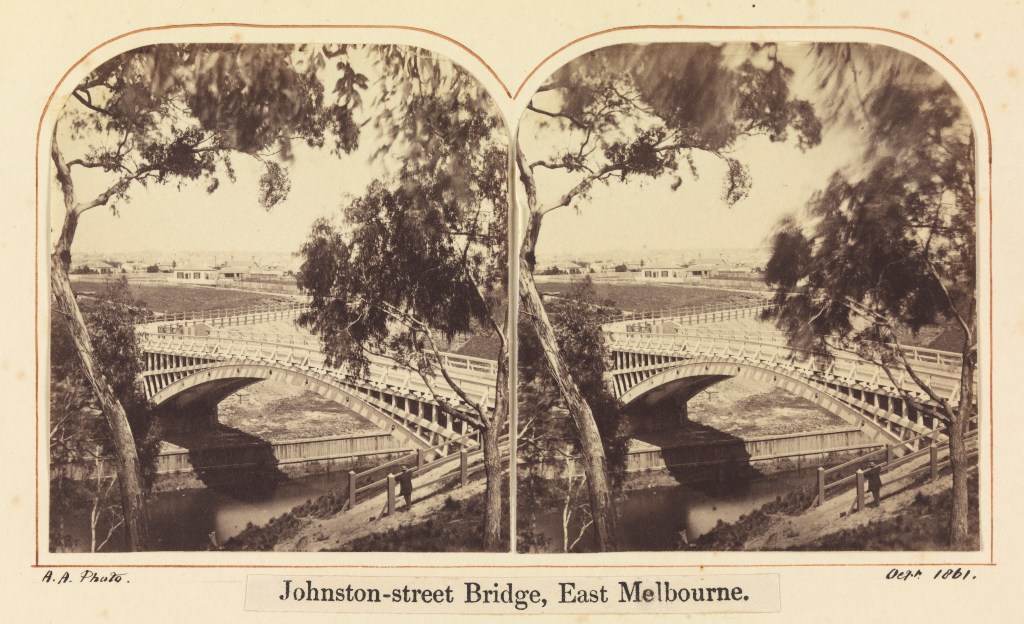
prince albert dies
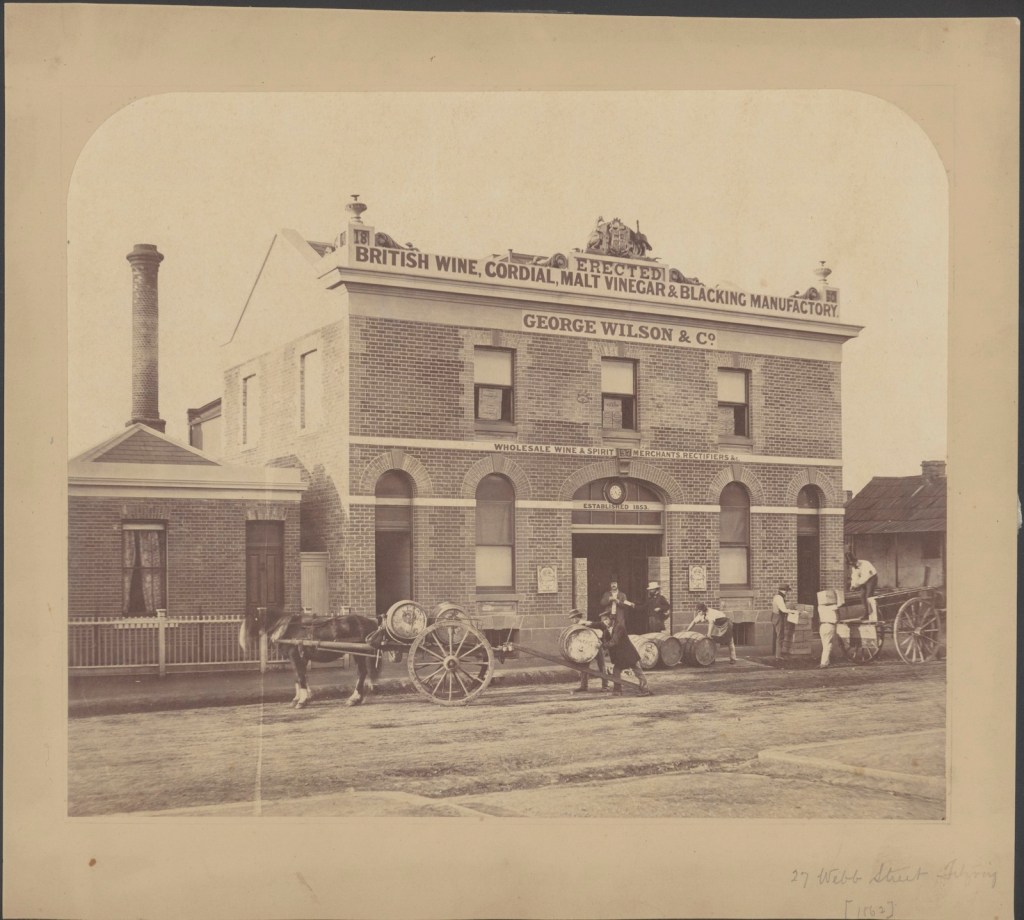
Across the road [from current 80 webb st]
George Wilson & Co., British Wine, Cordial, Malt Vinegar & Blacking Manufactory
PHOTO BY
Davies & Co. (Melbourne, Vic.), photographer.
[1861-1862] SOURCE state library https://viewer.slv.vic.gov.au/?entity=IE1889912&mode=browse
THE INDUSTRIAL EXHIBITION. (1861, October 3). The Herald (Melbourne, Vic. : 1861 – 1954), p. 5. Retrieved February 13, 2025, from http://nla.gov.au/nla.news-article244245553
is this from number 50
THE LACHLAN GOLDFIELDS. (1861, November 26). The Herald (Melbourne, Vic. : 1861 – 1954), p. 6. Retrieved February 13, 2025, from http://nla.gov.au/nla.news-article244180816
missing friends —–mrs bready!!!!!
Family Notices (1861, October 28). The Age (Melbourne, Vic. : 1854 – 1954), p. 1. Retrieved February 11, 2025, from http://nla.gov.au/nla.news-article154899602
EAST COLLINGWOOD IMPROVEMENT BILL. (1861, February 2). The Argus (Melbourne, Vic. : 1848 – 1957), p. 7. Retrieved February 11, 2025, from http://nla.gov.au/nla.news-article5697275
ABSTRACT OF SALES BY AUCTION THIS DAY. (1861, November 20). The Argus (Melbourne, Vic. : 1848 – 1957), p. 2. Retrieved February 11, 2025, from http://nla.gov.au/nla.news-article5706156
1862
—
OUR MANUFACTORIES. (1862, August 27). The Herald (Melbourne, Vic. : 1861 – 1954), p. 3. Retrieved February 11, 2025, from http://nla.gov.au/nla.news-article244228926
1863
—
ABSTRACT OF SALES BY AUCTION THIS DAY. (1863, November 2). The Argus (Melbourne, Vic. : 1848 – 1957), p. 2. Retrieved February 11, 2025, from http://nla.gov.au/nla.news-article5738331
Family Notices (1863, January 12). The Herald (Melbourne, Vic. : 1861 – 1954), p. 4. Retrieved February 11, 2025, from http://nla.gov.au/nla.news-article244408245
Collingwood rate books AVAIL!!!!!!!
- City of Collingwood rate books – 1864-1900
- Rate records, Collingwood (Town 1873-1876; City 1876-1994)
Previously Known as East Collingwood (Municipal District 1855-
1863; Borough 1863-1873; Town 1873) (VA439)
Available in the library via the Ancestry database
Records from 1864 – 1966 are held at PROV.
Records from 1864-1900 are available online.
https://access.prov.vic.gov.au/archive/VPRS377
ABSTBAOT OF SALES BY AUCTION THIS DAY. (1864, May 21). The Argus (Melbourne, Vic. : 1848 – 1957), p. 2. Retrieved February 11, 2025, from http://nla.gov.au/nla.news-article5749010
INQUESTS. (1864, December 5). The Herald (Melbourne, Vic. : 1861 – 1954), p. 3. Retrieved February 13, 2025, from http://nla.gov.au/nla.news-article245509915
1865
1865
House known as 50 Webb St until 1880 when there is a change to street numbering, it becomes 80 Webb St.
SOURCE Meg Lee, Citizen Historian Project 80 Webb Street Fitzroy, Fitzroy Historical Society Newsletter, 2022 issue 2 p4
Primary source re street numbering? what area did it affect. did the same thing happen in cbd?
dancing saloon
MUNICIPAL. (1865, October 5). The Herald (Melbourne, Vic. : 1861 – 1954), p. 3. Retrieved February 13, 2025, from http://nla.gov.au/nla.news-article244471113
BOROUGH COUNCIL. (1865, October 5). The Argus (Melbourne, Vic. : 1848 – 1957), p. 5. Retrieved February 11, 2025, from http://nla.gov.au/nla.news-article5776660
MUNICIPAL. (1865, October 6). The Age (Melbourne, Vic. : 1854 – 1954), p. 6. Retrieved February 13, 2025, from http://nla.gov.au/nla.news-article155041315
JEWELLERY ROBBERY
BEST ARTICLE HERE:::::::
AMERICA. (1865, December 10). Mount Alexander Mail (Vic. : 1854 – 1917), p. 2. Retrieved February 13, 2025, from http://nla.gov.au/nla.news-article197091015
and here
POLICE COURTS. (1865, November 16). The Herald (Melbourne, Vic. : 1861 – 1954), p. 4. Retrieved February 13, 2025, from http://nla.gov.au/nla.news-article244471585
Robbers name: ANTHONY WRENCH / ANTHONY ROBERTS / ANTHONY TRAFFORD
sisters Catherine Scott and Mary A Roberts
CURRENT TOPICS. (1865, December 8). Geelong Advertiser (Vic. : 1859 – 1929), p. 2. Retrieved February 13, 2025, from http://nla.gov.au/nla.news-article147564564
THE QUEENSLAND JEWELLERY ROBBERY. (1865, December 7). The Herald (Melbourne, Vic. : 1861 – 1954), p. 3. Retrieved February 11, 2025, from http://nla.gov.au/nla.news-article244468056
CITY POLICE COURT. (1865, December 7). The Age (Melbourne, Vic. : 1854 – 1954), p. 6. Retrieved February 13, 2025, from http://nla.gov.au/nla.news-article155039007
POLICE COURTS. (1865, July 13). The Herald (Melbourne, Vic. : 1861 – 1954), p. 4. Retrieved February 13, 2025, from http://nla.gov.au/nla.news-article244469688
CITY AND SUBURBAN POLICE. (1865, November 25). Leader (Melbourne, Vic. : 1862 – 1918, 1935), p. 3. Retrieved February 13, 2025, from http://nla.gov.au/nla.news-article197033767
POLICE. (1865, December 7). The Argus (Melbourne, Vic. : 1848 – 1957), p. 6. Retrieved February 13, 2025, from http://nla.gov.au/nla.news-article5770950
CITY AND SUBURBAN POLICE. (1865, August 26). Leader (Melbourne, Vic. : 1862 – 1918, 1935), p. 3. Retrieved February 13, 2025, from http://nla.gov.au/nla.news-article197035924
1866
vocab: manure is apparently more general term than i think of it. which includes animal matter, bones, night soil, and soot:
article about manures eludes to the fact that it’s not just night soil or animal matter, it includes “bones and soot.” and other animal matter
–my source: Manures. (1867, May 25). The Australasian (Melbourne, Vic. : 1864 – 1946), p. 25. Retrieved December 30, 2025, from http://nla.gov.au/nla.news-article138053957
—
Family Notices (1866, January 4). The Argus (Melbourne, Vic. : 1848 – 1957), p. 4. Retrieved February 11, 2025, from http://nla.gov.au/nla.news-article5783836
1867
—
1867 ‘THE EARTH CLOSET SYSTEM.’, The Age (Melbourne, Vic. : 1854 – 1954), 11 February, p. 5. , viewed 30 Dec 2025, http://nla.gov.au/nla.news-article155031371
SUBURBAN POLICE. (1867, November 1). The Age (Melbourne, Vic. : 1854 – 1954), p. 6. Retrieved February 11, 2025, from http://nla.gov.au/nla.news-article185509112
1868
5 july 1868
Charles and Lizzie Gray live at webb st and their only child dies, Jessie aged 3 months.
Death notice in The Argus.
SOURCE 8 July 1868
October 1868: chinese gambling houses busted in collingwood: see
LATEST NEWS. (1868, October 13). Gippsland Times (Vic. : 1861 – 1954), p. 2 (Morning.). Retrieved February 11, 2025, from http://nla.gov.au/nla.news-article61341898
1869
—
Family Notices (1869, June 19). Leader (Melbourne, Vic. : 1862 – 1918, 1935), p. 15. Retrieved February 11, 2025, from http://nla.gov.au/nla.news-article196482024
SUBURBAN POLICE. (1869, February 12). The Age (Melbourne, Vic. : 1854 – 1954), p. 1 (Supplement to The Age). Retrieved February 11, 2025, from http://nla.gov.au/nla.news-article177005086
EAST COLLINGWOOD COURT (THIS DAY.) (1869, August 6). The Herald (Melbourne, Vic. : 1861 – 1954), p. 3. Retrieved February 11, 2025, from http://nla.gov.au/nla.news-article244908014
FITZROY COURT (THIS DAY). (1869, February 18). The Herald (Melbourne, Vic. : 1861 – 1954), p. 3. Retrieved February 13, 2025, from http://nla.gov.au/nla.news-article244920268
IMMIGRATION. (1869, June 26). Ovens and Murray Advertiser (Beechworth, Vic. : 1855; 1857 – 1890; 1892 – 1955), p. 2. Retrieved February 13, 2025, from http://nla.gov.au/nla.news-article197567402
1869 cont
In this year, Thomas Jnr recollects signing paperwork involving monies involved with Thomas Rowe that Bridget used to make repairs to WEBB ST:
I Thomas Bready of Talbot in the colony of victoria Labourer vow of the above named deceased make oath and say
–That in or about the year one thousand eight hundred and sixty nine I together with my mother and sister Mary Jane Simons formerly Mary Jane Bready signed a document which I was informed by my mother was to secure the repayment of the sum of sixty pounds lent to her by one Thomas Rowe.
-That I was induced to sign the said document by my mother stating that she had proved a will left by my father the said Thomas Bready deceased and also that she required the money to repair the house erected on the land left by my father situate in Webb Street Fitzroy in the Colony of Victoria, and the said Thomas Rowe aforewards advanced a further sum of twenty five pounds to my mother to which I consented.
-That I have been informed and verily believe the said document is not registered and I called upon Mr Rowe in company with a clerk of Mr Thomas Miller’s solicitor and requested him to show me the deeds but he refused
-That the said Thomas Rowe informed me this morning that the sum of seventy six pounds seventeen shillings is still due to him and that he was recovering the rent of the property above mentioned to pay off that amount.
-Sworn at Melbourne in the colony of Victoria this second day of September in the year of our lord One Thousand Eight hundred and Seventy four before me.
SOURCE Affadavit of Thomas Bready. dated 2 Sept 1874 FILE 00028-p0000-000149-0480-00077
1870
—
1871
Victorian CENSUS check this out https://hccda.ada.edu.au/Collated_Census_Tables/VIC-1871-census.html
1872
26 Oct 1872
Alan C. L. De Lacy is living at Webb St and advises he is a claimant to the Russian De Lacey Estate.
-advises The Age, ” I am the great-grand nephew of the late Field Marshal Count De Lacy, of the Russian service…I will prosecute my claims as the only legitimate heir-at-law and next of kin of the late Field-Marshal Count de Lacy at once for the estates and personalty, as none but legitimate descendants can claim, and I must protest in the strongest manner against anyone taking and using my family surname without a legal right to do so by legitimate descent. — I have, &c..
ALAN C. L. DE LACY.
50 Webb-street, Fitzroy, 26th October.
SOURCE: Fri 26 Oct 1872, The Age.
also reproduced in Empire (Sydney, NSW : 1850 – 1875), Friday 8 November 1872, page 4 THE DE LACY RUSSIAN ESTATES
https://trove.nla.gov.au/newspaper/article/60867799#
22 November 1872
Alan De Lacy , commission agent/ powder manufacturer , charged with assault in Elizabeth St offices. His victim identifies him as ‘Edward Fitton’. Alan de Lacy advises Edward Fitton is his insane drunkard cousin.
SOURCE: Saturday 23 November 1872 x 2
1873 INDUSTRY. (1873, July 11). The Herald (Melbourne, Vic. : 1861 – 1954), p. 2. Retrieved April 14, 2025, from http://nla.gov.au/nla.news-article245305194
1873
27 Feb 1873
Alan De Lacey advises Argus he’s the individual mentioned in association with
new means to preserve wood for telegraph and he is in international negotiations ” I am, Sir, yours, etc , ALAN C.L.DE LACY. 50 Webb-street, Fitzroy.”
SOURCE Thu 27 Feb 1873 The Argus
1 March 1873
G.B.B. Elliot advises the Argus he was the person identified as being the discoverer of a means to preserve the wood of telegraph poles, not de Lacy.
SOURCE Argus Saturday 1 March 1873
9 April 1873.
De Lacy advises Editor of Mercury he is the victim of his patents being used illegally and that these patents are also a business opportunity. .. “I find that several companies are now floated there [Tara-naki and Otago, NZ] and they are using my patent invention illegally, for smelting the ore, as I am the only inventor who ever succeeded in smelting this fine iron sand in a blast furnace….I will be glad to arrange with a bona-fide respectable party or parties to secure those iron ores, and to float them… I have condensed the voluminous matter connected with this subject, to suit your space, but full particulars as to correspondence, &c. , can be given to any one requiring it
I am, Sir, &c.
ALAN C. L. DE LACY.
50, Webb-street, Fitzroy, Melbourne, Victoria,
April 9th, 1873.”
SOURCE The Mercury, Mon 21 Apr 1873
24 MAY 1873.
De Lacey advises The Brisbane Courier he posseses patents related to gold mining which are an opportunity for investment
TELEGRAPHIC. WE have received a letter from Mr Alan C.L. De Lacy, of 50 Webb-street, Fitzroy, Melbourne, to the effect that he is in possession of patent machinery which will save all the gold now lost in the tailings from ordinary crushing machines…Here is clearly a now opening for company promoters.
SOURCE Sat 24 May 1873 p4 The Brisbane Courier ‘TELEGRAPHIC’
https://trove.nla.gov.au/newspaper/article/1317841?searchTerm=50%20webb-street
1874
1875
1876 – fitz link
Extraordinary Divorce Suit. (1876, December 29). The Herald (Melbourne, Vic. : 1861 – 1954), p. 3. Retrieved June 25, 2025, from http://nla.gov.au/nla.news-article244266374
—
Found Drowned. (1876, August 28). The Herald (Melbourne, Vic. : 1861 – 1954), p. 3. Retrieved March 13, 2025, from http://nla.gov.au/nla.news-article244275564
1877
1877
Further subdivision of land, by Mary Jane Simons, wife of Nicholas Simons.
–one half sold to Williams James Parlett for L470 and the remainder (my part) sold to Joshua Greenwood. of 180 Gore St {who holds on to the house for a year before back on market}.
(which is the other half? Carnation canteen?)
SOURCE SOURCE Meg Lee, Citizen Historian Project 80 Webb Street Fitzroy, Fitz Historical Society Newsletter, 2022 issue 2 p4
Citizen Historian Project Meg Lee Draft One
need primary source for this info above.
greenwood:
Mr. J. L. Greenwood. (1911, July 29). Observer (Adelaide, SA : 1905 – 1931), p. 41. Retrieved March 18, 2025, from http://nla.gov.au/nla.news-article164729744
1878
By 1878, when Fitzroy became a city, the population and number of buildings had increased dramatically, but with no major alteration to the the street pattern for the last two decades. p26 fitz first sub
1878
Samuel Davis takes title of house.
Samuel Davis DOB?..died 10 Jan 1927 – SOURCE marion. There are a few Samuel Davises, so this is a good identifier.
The current Certificate of Title begins under the transfer of Land Act…names Samuel Davis, of 112 Gore St as the first proprieter of (80 Webb St). Samuel Davis 52 Rowe St North Fitzroy died in 1927 when he transferred his property to his wife Amelia. She died in 1928 ((presumably it was always a rental property???NO I DONT THINK SO, THIS WOULD BE THE FIRST TIME THE HOUSE GETS THE REAR EXTENSION etc SO I THINK THIS WAS THEIR ACTUAL HOME))
SOURCECitizen Historian Project Meg Lee Draft One
NB – it’s interesting that Samuel Davis rents southern fitz but lives in north fitz..
-nth fitz is the more suburban family friendly area
‘there were strong connections in terms of investers, property investers, and builders, whose activities gradually shifted from the one area to the other (ie southern to northern fitz) p.27 fit first subu
The critical difference between the layouts of southern and Northern Fitzroy was of course that the former resulted almost entirely from private subdivision, while the latter….was almost entirely planned by government, with larger allotments and with roads generally 1.5 chains (30 meters) wide. p27 fitz first subu
-The bulk of North Fitzroy thus passed into private hands between 1865 and 1875, and the hands into which it passed were suprisingly few. Great banks of allotments and even whole blocks went to individual buyers. p27 fit first sub
need primary source for this above. :::Question – did Samuel have a son, if so, a possible Samuel Davis jnr was busted for taking part in a two-up school in fitzroy on May 1921 source:
https://trove.nla.gov.au/newspaper/article/203971311?searchTerm=samuel%20davis%20fitzroy
1879
8 February 1879
Amelia Davis [now living at Webb St presumably?] vs Elizabeth Newton – assault
Davis rushed at Mrs. Newton, “open-mouthed, with extended fingers, and clawed” the plaintiff. Mrs. Newton pushed Davis off. This constituted another offence against Mrs. Newton. Amelia Davis was fined 10s with 21s costs. The case against Mrs. Newton was dismissed.
SOURCE Mercury and Weekly Courier 8 February 1879
interesting article about cesspits here: and how closet pan collection is much better (and should be collected and enforced like rates) and how cesspits should be outlawed
CESSPITS. (1879, February 1). The Telegraph, St Kilda, Prahran and South Yarra Guardian (Vic. : 1864 – 1888), p. 3. http://nla.gov.au/nla.news-article114578821
1880s AS A DECADE. The 1880s marked a turning-point for southern fizroy. The suburb was already built up and the building stock itself was aging. The infusion of life at the south-west corner caused by the exhibitions was only a temporary one, but the tendency (especially in Gertrude Street) was for larger buildings to be used as boarding houses, if not brothels. While industrial uses were increasing and the shopping streets boomed, the housing itself became less attractive to families, and the proportion of owner-occupiers, never large, seems to have dwindled further. p.26 fitz first sub.
1880
1880
House number changes from 50 to 80 Webb St.
Changes to house numbering systems in Fitzroy —did this happen in cbd too???
SOURCE Meg Lee, Citizen Historian Project 80 Webb Street Fitzroy, Fit Historical Society Newsletter, 2022 issue 2 p4
1881
—
1882
—
1883
1883
21 July 1883
Samuel and Amelia Davis -drunk and disorderly. Amelia cautioned, Samuel charged. Charles Meredith and Mary Revere were also cautioned. Not sure if they were all arrested together or not.
SOURCE Mercury and Weekly Courier 21 July 1883
THE UNIVERSAL SOFT GOODS COMPANY, FITZROY. (1883, December 21). Record (Emerald Hill, Vic. : 1881 – 1954), p. 3. Retrieved March 18, 2025, from http://nla.gov.au/nla.news-article120728666
1884
re cesspits
-article where journalist mentions he believes cesspits are not allowed in Melbourne, but they are permitted in the suburbs
–PRIVY CESSPITS. (1884, July 4). The Riverine Herald (Echuca, Vic. : Moama, NSW : 1869 – 1954; 1998 – 2002), p. 2. Retrieved November 7, 2024, from http://nla.gov.au/nla.news-article115073741
1885
—see Fitzroy Forties
FITZROY—THURSDAY. (1885, April 10). Mercury and Weekly Courier (Vic. : 1878 – 1903), p. 2. Retrieved March 18, 2025, from http://nla.gov.au/nla.news-article58432303
FITZROY.—THURSDAY, APRIL 9TH. (1885, April 11). Fitzroy City Press (Vic. : 1881 – 1920), p. 3. Retrieved March 18, 2025, from http://nla.gov.au/nla.news-article65647163
1886
Public transport
The first power driven public transport to be introduced to Fitzroy was the cable tram. One route through Fitzroy
ran along Nicholson Street from the city and divided into two routes: one ran along Gertrude Street to Smith
Street and the other continued northward along Nicholson Street. Another route ran down Brunswick Street.(127)
These routes were established in 1886 and 1887. Unlike the pattern of urban development in some of
Melbourne’s then outer suburbs, where the location of tram routes facilitated and stimulated the development of
those streets into major commercial strips, the tram routes in Fitzroy were located along streets which were
already consolidated commercial precincts.
FROM: https://vhd.heritagecouncil.vic.gov.au/places/97362/download-report
1887
COLUMN 2 PARA
1888
banks begin to tighten their lending policies. p28 fitz first sub
1889
POLICE INTELLIGENCE. (1889, January 8). The Argus (Melbourne, Vic. : 1848 – 1957), p. 8. Retrieved March 18, 2025, from http://nla.gov.au/nla.news-article6216722
1890
COLUMN 2 PARA
1891
COLUMN 2 PARA
1892
COLUMN 2 PARA
1893
1894
COLUMN 2 PARA
1895
COLUMN 2 PARA
1896
1896
5 August 1896
…on the night of the 5th of August Sydney Morris [‘from Webb Street Push’] and a number of other larrikins, entered the bar Council Club Hotel, [now Union Club Hotel] and demanded drinks. They were refused. Morris pulled the handles off the beer engine and used very bad language. He next knocked over the bar screen, and kicked it to pieces. The disturbance was so serious that the hotel had to be closed. This was not the first oc-casion that the accused had carried on In this way.
SOURCE Herald 26.11.1896
23 November 1896
Sydney Morris [‘from Webb Street Push’] arrested by Constable Hutchinson for 05.08.96 disturbance at Council Club Hotel, [now Union Club Hotel] Webb street. SOURCE Herald 26.11.1896
26 November 1896
Sydney Morris [‘from Webb Street Push’] charged with wilfully breaking a bar screen…property of Theresa Dwyer, of the Council Club Hotel, [now Union Club Hotel] Webb street at the Fitzroy Court. He had seven prior convictions. A fine of 40s, with 15s costs, was imposed, with the alternative of 21 days’ imprisonment.
SOURCE Herald 26 November 1896
3 December 1896
“Webb St push” members charged with loitering. Andrew Finlay, 18, and John Develin, 16, alais Woods, alais Wilson, were charged with loitering. “Both Develin and Finlay, with a number of other roughs gathered in Webb street at all hours of the day and night, and the language made use of was disgraceful.” SOURCE
Fitzroy City Press Thursday 3 December 1896
1897
1897
Sewage connected to the house from the laneway.
There was no articulated water or sewage until 1897 when the Melbourne Sewer works connected their homes to the system
SOURCE Meg Lee, Citizen Historian Project 80 Webb Street Fitzroy 2022 issue 2 p4
11 March 1897
Webb St Push member Sydney Morris charged for violence at Council Club Hotel (now Union Club Hotel)
Shortly after 11 o’clock on Tuesday night Sydney Morris, 19, one of the Webb Street Push, entered the bar of the Council Club Hotel at the corner of Napier and Webb streets and asked Miss Goodall, the barmaid for a shandy, at the same time placing on the counter a coin something like a two-shilling piece. Mrs. Annie James, the manageress of the hotel, knowing that the prisoner had created a great disturbance in the hotel and did considerable damage on a former occasion directed Miss Goodall not to serve the drink. The prisoner then made use of disgusting language. Mrs. James hurried out of the bar to call a constable and the prisoner followed her and struck her a blow on the right eye, at this juncture Constable O’Brien came on the scene and arrested Morris. When searched at the watch-house, the spurious coin was found in his pocket. For the assault the prisoner was fined £10, in default three months, and for the bad language £2 10s., in default one month. At the prisoner’s request he was remanded for a week on the third charge.
Fitzroy City Press Thursday 11 March 1897
2 June 1897
Members of Webb Street Push arrested for violence at Council Club Hotel (now Union Club Hotel)
Arthur Murray, Robert Dunbar, Thomas Bloss, James McNamara and John Finnegan, said to be members of the notorious Webb-street gang of larrikins, were yesterday charged at Fitzroy court, before Mr Keogh, P.M., on a charge of assaulting and robbing James Burns on the evening of 24th May called at the Council Club Hotel, Napier-street, Fitzroy
SOURCE
Age Wednesday 2 June 1897
1898
COLUMN 2 PARA
1899
Melbourne and Metropolitan Board of Works detail plan, 1202, City of Fitzroy [cartographic material]
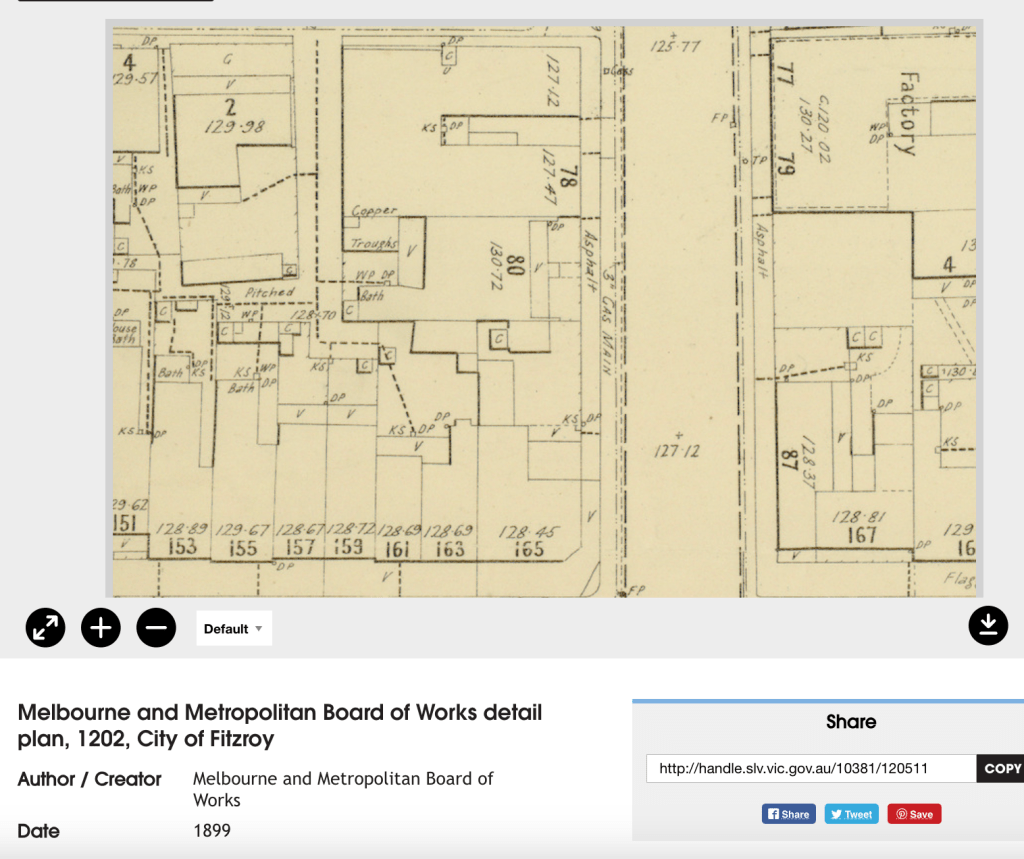
Melbourne and Metropolitan Board of Works
[Melbourne] : MMBW 1899
SOURCE: http://handle.slv.vic.gov.au/10381/120511
1901 – – -see here—-https://www.abc.net.au/news/2018-07-10/the-aboriginal-names-for-ten-melbourne-suburbs/9960092
1904
Samuel Davis renting out Webb St and ??living at??? 46 Michael St North Fitzroy, does work on drainage at 80 Webb St.
SOURCE
PLAN OF DRAINAGE document
Litho No 1202 Detail Plan 1202 Drainage Plan 31740
FOR Mr S. Davis, 46 Michael St North Fitzroy, owner (for property 80 Webb St)
“C (Closet) top enclosed in brickwork cemeted and tap fixed over. Owner to relay all paving and repair troughs.” – – this would be for water closet ie toilet.
works carried out to plan 10.12.04
1919
17th April 1919
Raid on 27 Webb street, [NB old street numbering]
Police in search of Slater, who was wanted in connection with the shooting of Constable Cooper.
-At Whiting’s residence 27 Webb St they found Slater, Rankin, and Thorpe, a convicted thief and coiner, from next door.
-Under Whitings mattress they found an automatic revolver, fitted with a Maxim silencer.
-Rankin was a convicted man and under suspicion
-Witness had also seen at the house a man named Conquest, a reputed pickpocket and thief. (either before this raid or the second raid 8 May 1919)
-Whiting was a reputed receiver of stolen goods.
SOURCE Age 22 May 1919
8 May 1919
Raid on two houses in Webb Street inc. Whiting’s address 27 Webb street, [NB old street numbering]
In the early morning of 8th inst. a strong force of detectives and police, in charge of Detective-Sergeant T. Coonan, raided two houses in Webb street, and arrested a number of men on various charges.
-Detective-Sergeant Coonan: that the purpose of the raid was, in the first place, to arrest the man Fitzharding alias Slater, (wanted in connection with the shooting of Constable Cooper) and
-to arrest two other men, who were wanted on charges of wounding with intent to murder.
-Among the men taken into custody was
-Slater, alias Fitzharding, who was “wanted” in connection with the shooting of Constable Cooper in Gertrude street one morning in January last. Slater taken under custody to Melbourne Hospital, suffering from revolver wounds alleged to have been inflicted by Henry Stokes, in Swanston street, last week, in sensational circumstances, already published.
{Men charged following raid:}
-Edward Whiting, 37, dealer, charged with being the occupier of a house frequented by reputed thieves.
-William Rankin, 38, war pensioner, vagrancy.
-Patrick M’Mahon, 38, clerk, vagrancy.
-M’Mahon was a suspected person, a known thief, and was known in other States as a pickpocket.
-Arthur de Lacey, 32, dealer, vagrancy. De Lacey was a reputed thief and a suspected person.
-Walter Randall, 30, laborer, vagrancy. Randall was continually in the company of assault and robbery men and other thieves.
-Upon going to Whiting’s house, 27 Webb street, [NB old street numbering] they were admitted by accused Whiting.
-They found Fitzharding, Rankin and M’Mahon occupying beds there. Women were also in the house. All the men in the house were arrested. The house had for some time been visited and frequented by convicted and reputed thieves.
-police found alongside Slater’s bed in the front room a double-barrelled gun, loaded in both chambers
-under Whiting’s mattress was a fully loaded revolver.
-Rankin was a convicted man, and M’Mahon was a reputed thief. Witness had also seen at the house a man named Conquest, a reputed pickpocket and thief. Whiting was a reputed receiver of stolen goods.
-Randall was continually in the company of assault and robbery men and other thieves.
De Lacey was a reputed thief and a suspected person.
-Later in court Whiting, who has been one of the “targets” in the vendetta drama, said his “missus” took the house in Webb street, and he had never paid a week’s rent. M’Mahon and Rankin had been boarding there. Randall was not at his place at all. Conquest had not been at his place since 1st April. Conquest left a fortnight after he (Whiting) was shot. Slater had come to the house to stay with him on account of the men coming to the house with the intention of shooting him (Whiting). Slater had been at the house since he had been arrested.
SOURCE Age 22 May 1919
22 May 1919
Fitzroy Court: Whiting is sentenced to nine months’ imprisonment; De Lacey, Randal and M’Mahon to six months’ imprisonment each and Rankin to three months’ imprisonment. Notice of appeal was given in each case.
Arising out of the raid [8 May] the following men were before Messrs. Kelley, P.M., Fraser and M’Mahon, J’s.P., at Fitzroy court yesterday: -Edward Whiting, 37, dealer, charged with being the occupier of a house frequented by reputed thieves. Williarn Rankin, 38, war pensioner, vagrancy. Patrick M’Mahon, 38, clerk, vagrancy. Arthur de Lacey, 32, dealer, vagrancy. Walter Randall, 30, laborer, vagrancy. Inspector Arthur prosecuted; Mr. Sonenberg appeared for Whiting, Rankin, M’Mahon and Randall; Mr. Clark for De Lacey.
-The bench decided to convict in each case. Whiting was sentenced to nine months’ imprisonment; De Lacey, Randal and M’Mahon to six months’ imprisonment each and Rankin to three months’ imprisonment. Notice of appeal was given in each case.
SOURCE Age 22 May 1919
1927
10 JANUARY 1927
Samuel Davis dies.
SOURCE marion. –there’s several Samuel Davis’ around at the time, she’s identified this Samuel Davis.
1927
Age (Melbourne, Vic. : 1854 – 1954), Saturday 19 March 1927, page 18
WILLS AND ESTATES
SAMUEL DAVIS, formerly of Michael-Street, North Fitzroy, but late of Rowe-street, North Fitzroy, who died on 10th January, left by will dated 17th October 1928, real estate valued at L2877 and personal property valued at L2410 to his widow.
SOURCE https://trove.nla.gov.au/newspaper/article/204199963?searchTerm=samuel%20davis%20fitzroy#
Question: Why isnt he late of 80 webb street? was he and his wife living there at the time or were they renting the house out? I’m assuming this is the right samuel davis because this is the death date Marion has.
Amelia Davis takes on title. SOURCE marion.
1928
1928 Amelia Davis dies SOURCE marion.
New title:
Rosina Spencer, 93 Barkley St Carlton and Stella Long, 24 Pole St Seddon, married women become owners in partnership (source draft 1 meg lee sun 16 feb 2022)
1949
Cnr Webb and Gore St Fitzroy 1949
I cannot find the original source for this photo.
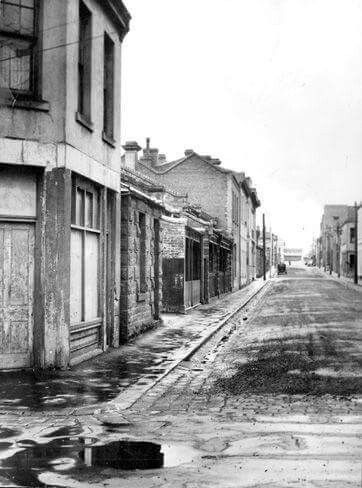
1967
Stella Long, becomes sole owner of 80 webb
listed as ‘widow, 16 McGregor St Middle Park’
(source draft 1 meg lee sun 16 feb 2022)
1969
80 Webb St becomes student housing
House sold to Christos Pandelis Atlis, Gentleman and Stephanie Chris, clerk of 94 Bruce St, Preston
During this ownership the house was rented through Student Housing for 28 pounds per week, for the renters this was 7 pounds each.
(source draft 1 meg lee sun 16 feb 2022)
1970
New owner: Emily Gwendoline Kyng, musician of 382 Victoria Pde, East Melbourne
—Emily Gwendoline ‘Gwendo’ Paul DOB 23.10.1906 in Cobar NSW
-recital pianist
-married 1927 to Herold/ Harold/ Herald Kyng
-professional name Miss Gwendo Paul
-one son, Peter Harold Frederick Kyng
erfqerferfe
COLUMN 1 PARA
COLUMN 2 PARA
////////////////////////////////////
house titles cont.
1928 Rosina Spencer (died 1967) and Stella Long hold title
1967 Stella Long
1969 Chistos Altis and Stephanie Chris
1970 Emily Kyng
1972 Warwick du Ve and Ethel du Ve – mortgage to Gladys Bourke and K Bourke
1975 mortgage to Katherine Bourke
1978
The house had been rendered with ‘upgraded’ window frames and was sold in April 1978 for $25,000 ((to roger? double check)
SOURCE Meg Lee, Citizen Historian Project 80 Webb Street Fitzroy, Fit Historical Society Newsletter, 2022 issue 2 p4
1978 title: Roger Peppard
SOURCE Marion
——At some point in 1978 the ceiling collapses and central skylight installed… SOURCE Meg Lee, Citizen Historian Project 80 Webb Street Fitzroy, Fit Historical Society Newsletter, 2022 issue 2 p4
—-Roger is the one who did all the renos, did this happen under his ownership or by previous owner?
…following the renovation sold again in September 1978 for $42,400
I think the house LOSES it’s rendering on the front at this time. (source Meg Lee) ((Roger Peppard would have been the one to take off the rendering from the inside too)).
SOURCE Meg Lee, Citizen Historian Project 80 Webb Street Fitzroy, Fit Historical Society Newsletter, 2022 issue 2 p4
1978 title: Margaret Darcy SOURCE Marion
1987-2024 title: Marion Glanville
—————————————————-
other things:
state lib blog on researching your house: Researching your home in Collections, Family matters, Research guides, Research tips & tricks
https://blogs.slv.vic.gov.au/family-matters/collections/researching-your-home August 28, 2024 at 08:00 by Carmen Quick
ARTICLES TO CHECK OUT – up to here……..
http://
library.yarracity.vic.gov.au/research/local-history/the-history-of-your-house
below – do searches for fitz and collingwood.
——
the house
https://fitzroymelb.com/80-webb-street-fitzroy/
————————————–
erfqerferfe
layout experiment
COLUMN 1 PARA
COLUMN 2 PARA
uuuuuuuiooooooooooooo
COLUMN 1 PARA
COLUMN 2 PARA
uuuuuuuiooooooooooooo
table::
TWO COLUMN PARA WITH ADDITIONAL 2 COLUMNS NESTED INSIDE
33 TESFDSKEFA;KERFNAEKRN
66 PARA
AKRWJFNNQEKRFEJFNAEJRGAJERGBJARGBJRGBAJREGBJERHGJJOJOK[OJ[OJ[OJ[OI[OO
33 LEWHFBWEBFWFEBWFB
66
AJWEFHDAWOUEFAOUWFAWUEFBAWJEFBAWJEFBAWJEFBAJLBFAJEFBEJBFALEJRBFAEJRBFAELAJERHBF
33
FWEFWEFEWFEQF
66
AWRJFNQLJRBFLJEQRFBLJAEBRFLAJERBFLAJERFBALJERFBALJERGBALJERGBAJLERGBAJLERBG
TWO COLUMN PARA WITH ADDITIONAL 2 COLUMNS NESTED INSIDE
THE YEAR
ENTRY
AKRWJFNNQEKRFEJFNAEJRGAJERGBJARGBJRGBAJREGBJERHGJJOJOK[OJ[OJ[OJ[OI[OO
SOURCE
THE NEWSPAPERWRJWEIFEWFNWEFNEFEFNFEJBEFHEFEF
>>
EXTERNAL LINKRFJQERJFHBQJEHRBFAJERBFRHJAHBER
??
MY RESEARCH QUESTIONS HEREAEWRFQERKFJQERFBQELJFBLJEQBRFLJQEBRFLQJERGBLER
TABLE 10 COLUMNS THESE COULD all be links makes a whole lot of sense maybe.
| 1231 | 1232 | 1234 | 1235 | 1236 | 1237 | 1238 | 1239 | 1240 | 1241 |
table
arf;lafakmrf 6 columns
SOURCE
| YEAR | AUTHOR | TITLE | PUBLISHER | PAGES | LINK |
| 1822 | KKEMP | THE AREFKJERFERFAJERGERJGJ | FIRST COLUMN HALF WAY DOWN PAGE | ||
| ewfewfwef | |||||
| wEFQWEFEWFAERWFERF | |||||
amazing articles I need to go thru
“Boot scrapers were born at the same time as footpaths. This mundane contraption from daily life is a key to urban history,” ULB history professor Christian Loir said. “It is part of the history of walking in our cities.”
Set in semi-circular niches beside the front doors of most homes, the ground-level scrapers have long fascinated the tens of thousands of expatriates sent to Brussels each year to work at the many EU-linked institutions and diplomatic missions.
“I like to tell children they are the front doors of the house gnomes,” a blogger said.
“I’ve become a little obsessed with these contraptions, pointing out the prettiest whenever I’m strolling along the cobblestone footpaths of Brussels,” another wrote.
Brussels’ biggest university recently focused on the early version of today’s doormat at a world forum on the history of walking and urban space, and a central city exhibition is highlighting the almost 1,000 different models found on city streets today.
TESTIMONIALS
Professor Laurence Rosier, who teaches at the ULB and curated the show, said the scrapers were a testimonial to the stonemasons and ironworkers of yesteryear, as well as to the invention of the contemporary footpath.
Though the ancient Romans built footpaths, only the poor walked Europe’s cities until the late 18th century, when the upper classes of the time hopped off their carriages to amble the streets.
“Walking suddenly became fashionable,” Loir said. “This was a key moment in urban history, when the elite discovered the city. The impact was enormous.”
The sudden popularity of walking the streets helped shape today’s cities, with footpaths, tree-lined boulevards, public parks and covered arcades built during the 19th century.
“Suddenly there was a new quality to public space,” Loir said.
CHANGING TIMES
The new taste for strolling also saw shoes morph from heavy high-heeled designs for indoors to softer, low-heeled, foot-fitting gear, as scientists engrossed themselves in the study of motor skills and local authorities turned to public hygiene, improving sewerage and offering public toilets.
In the first decades of the 19th century, footpaths were lined with scrapers to wipe off the mud and excrement before going indoors. As more and more people adopted the walking habit, it became vital to clear a special space for the new pedestrian class, safe from the flying mud and bolting horses. In the 1840s, scrapers were ordered off the street as authorities in Belgium removed all obstructions in the interests of public safety.
Instead, the ubiquitous decrottoir was now fixed to houses, by the front door, leading to a change in social habits such as removing one’s shoes on going inside.
“There were manuals published on how to enter a home, how to be civil by not taking off one’s shoes, and huge catalogs on manufacturers” of boot scrapers, said Rosier, who with photographer Christophe Holemans spent several years researching the subject before the summer show.
—https://www.taipeitimes.com/News/world/archives/2011/08/21/2003511305
| TLDR | ‘Dating Melbourne’s cesspits: digging through the archives’ |
| Author: | Barbara Minchinton & Sarah Hayes |
| Title of source: | ‘Dating Melbourne’s cesspits: digging through the archives’, |
| Title of container: | Provenance: The Journal of Public Record Office Victoria |
| Version: | Last updated: November 22, 2019 |
| Number: | Issue no. 16 |
| Publisher: | Public Record Office Victoria |
| Publication date: | 2018 |
| Location: | no page number, online publication? |
| ONLINE HERE: | https://prov.vic.gov.au/explore-collection/provenance-journal/provenance-2018/dating-melbournes-cesspits |
| in full here: | Abstract From the late 1980s to the early 2000s, a number of archaeological digs were conducted at what was known as ‘Little Lon’ in Melbourne’s central business district. Public Record Office Victoria holds extensive archival records that supported these archaeological investigations; however, records specifying the dates when cesspits were closed were not identified until late 2013. The discovery of these records opens the possibility of correlating artefacts recovered from Little Lon’s cesspits with the people who might have discarded them. For the archaeologists working on material from Little Lon and other nineteenth-century sites in Melbourne, the records are an extraordinary boon. This paper places the creation of these records within the context of Melbourne’s waste management history, considering in particular the construction and closure of its cesspits. Today, flush toilets are taken for granted in Melbourne. Few people will remember nightmen trundling up the back lane to collect their household’s night soil each week. These days, only campers in out-of-the-way places encounter cesspits and nightpans, those foul-smelling precursors to sewerage pipes. However, for historical archaeologists, old cesspits can be goldmines of information. From 1835 (when Europeans invaded from across Bass Strait) until the 1870s, Melbourne relied entirely on what we might regard today as camp-style toileting and rubbish arrangements. When cesspits were no longer needed for their original purpose, they were often used for getting rid of excess household refuse. Rubbish discarded by householders of the nineteenth century can provide all kinds of information about the people who owned it and the lives they lived, but it is necessary to establish when the cesspit was closed to accurately date the contents. Since 1988, there have been numerous archaeological investigations conducted in the area of Melbourne known as ‘Little Lon’ (see Figure 1); however, historical archaeologists were often unable to date their finds with any degree of certainty because not enough was known about the process of cesspit closures in Melbourne. In 2013, by following the general history of Melbourne’s waste disposal and the ways in which the Melbourne City Council (MCC) administered and recorded it, research at Public Record Office Victoria (PROV) revealed a series of records that provided specific dates for the closure of many of the cesspits in the Little Lon area. This article explains who created the records and for what purpose. Readers who are interested in urban archaeologists’ use of these records can also consult ‘Cesspit formation processes and waste management history in Melbourne: evidence from Little Lon’ in Australian Archaeology (2016).[1] The research presented in this article forms part of an Australian Research Council funded project: A Historical Archaeology of the Commonwealth Block 1850–1950 (LP 0989224). The ‘Commonwealth Block’ refers to the block of land owned by the Commonwealth of Australia bounded by Little Lonsdale Street, Lonsdale Street, Exhibition Street and Spring Street in Melbourne’s north-east corner (Figure 1), commonly known as ‘Little Lon’. There were numerous archaeological research reports published about the area prior to the discovery of the MCC records.[2] Figure 1: Location of Little Lon. Source: Ming Wei. Originally published in T Murray & A Mayne, ‘Imaginary landscapes: reading Melbourne’s “Little Lon”’, in A Mayne & T Murray (eds), The archaeology of urban landscapes: explorations in slumland, New Directions in Archaeology Series, University of Cambridge, 2001, p. 91. Cesspit construction, the boards of health and the inspector of nuisances Every city’s waste management history is different. For example, much of Sydney moved directly from cesspits to sewers.[3] By contrast, after cesspits were abandoned in Melbourne, nightsoil was collected from above-ground nightpans at the rear of each property for some time before sewerage pipes were installed. Consequently, answering the critical question of when a cesspit was closed in the Melbourne area requires an understanding of the broader waste management context. In the case of Little Lon, that context was controlled by the MCC. The archaeological record shows that the construction of cesspits in Little Lon can be characterised in three stages.[4] The earliest pits were unlined—simple holes in the ground. Pits from the second stage were lined but still leaky. In the third stage, pits were sealed, having been lined with waterproof casks and/or puddled clay to prevent seepage. These stages can be clearly identified in the historical record, beginning with negative public comments about cesspits in newspapers in the 1850s.[5] In widely spread settlements, unlined pits allowed fluids to be gradually absorbed by the surrounding ground; however, in densely populated areas, there was too much fluid to be safely absorbed. By the late 1850s, seepage was a problem and responsible owners began lining their cesspits in an effort to reduce it. Conversely, when mains water became available from the Yan Yean Reservoir in 1857,[6] some owners began running water continuously into their cesspits (‘water-closets’), allowing the liquid overflow to run into the street channels through grates that held back solids. The increase in ‘offensive fluids’—as the MCC called them—caused the public to become even more concerned.[7] Yet, by 1860, very few cesspits in poorer neighbourhoods such as Little Lon had been lined.[8] It was at this point that the MCC began to take responsibility for the public health aspects of Melbourne’s cesspits—hence, the story continues through the MCC archives. Administratively, the MCC was designated as a Local Board of Health (LBH)—an offshoot of the Central Board of Health (CBH) in the Chief Secretary’s Department—so that the MCC could enact its own by-laws relating to public health.[9] In October 1860, the MCC introduced by-law 42 for the annual licensing of nightmen; however, their work continued to be contracted and paid for by individual property owners. In 1864, there were only 10 nightmen licensed by the MCC for emptying ‘privy cesspits’ for a population of about 86,000 occupying about 9,300 buildings.[10] This indicates that most property owners still allowed their underground cesspits to overflow into the drains. The MCC could prosecute property owners for causing a nuisance under the Town and Country Police Act 1854, but privies had to be overflowing at the time of inspection to secure a conviction. No papers have been found in the archives relating to such prosecutions. In any case, preventing cesspits from overflowing did not solve the seepage problem. Seeking to address this issue, in 1861 the CBH distributed a circular to all local boards of health[11] setting out plans for the construction of two different types of lined cesspools (cesspits) (Figure 2). The MCC archives at PROV include a rare copy of this circular, which is a critical piece of evidence for dating the cesspits of Little Lon because it provides archaeologists with specific measurements and construction techniques for cesspits.[12] Figure 2: Diagram from the 1861 Central Board of Health circular showing plans for approved cesspits. Source: VPRS 3181/P0, Unit 364 Central Board of Health Circular, p. 2. This and all subsequent images of Melbourne City Council records are held at PROV and reproduced with the permission of Melbourne City Council. However, cesspits were going out of favour. Earth closets—above-ground pans with dry powdered earth to cover excrement—were coming in. The MCC’s licensed nightmen could collect and empty them, so the MCC began issuing notices to the owners of leaking cesspits requiring them to ‘remedy’ the problem, with earth closets being one of the possible remedies.[13] These notices have not been found in the MCC archives either; however, since the law did not provide for compulsory closure of the old pits, cesspit closures could not have been reliably deduced from them. LBH reports and MCC by-laws can be found in the MCC archives at PROV. In addition, the MCC had its own Health Committee and employed inspectors to implement the council’s regulations. In early 1867, Sergeant John Fullerton was appointed as the MCC inspector of nuisances.[14] Later that year, when An Act to Amend the Laws Relating to or Affecting Public Health came into force, every leaking cesspit was deemed an illegal health hazard. As an LBH, the MCC, through its inspector of nuisances, could issue an ‘Order to Amend Cesspools’ and specify the form of proper cesspits to be constructed by property owners or occupiers. It could also demand that overflowing or leaking cesspits be filled in and replaced by above-ground receptacles (or earth closets)—provided the inspector’s orders were formally approved at a meeting of the MCC. Fullerton’s orders usually included instructions to replace cesspits according to the CBH circular, and owners or occupiers were given either seven or 30 days to comply (Figures 3 and 4). Figure 3: Order to Amend Cesspools &c. Source: Health Committee Report 29, 7 December 1868, PROV VPRS 3103/P0, MCC Committee Reports, Unit 10, 1868–1869. Figure 4: Order to Amend Cesspools &c. Source: Health Committee Report 75, 1 February 1869, PROV VPRS 3103/P0, MCC Committee Reports, Unit 10, 1868–1869. Fullerton’s recommendations were always accepted by the MCC and his orders are all neatly filed in the archives held by PROV. However, they are not contained in the Minute Books of Council (VPRS 8910) or among the Proceedings of Council (VPRS 54); nor are they in the Committee Minutes (VPRS 8945) or the Health Committee Minutes (VPRS 4038). Instead, they are housed in a completely separate series: VPRS 3103/P0 Committee Reports. In the period covering the cesspit closures, each year of this series comprises two volumes of reports compiled from all of the standing committees of council, the largest usually being the Public Works Committee. Fullerton did his best to ‘abate the nuisances’ as outlined in the 1867 Act, but owners were inclined to make use of the lengthy council procedures involved in acting on notices to avoid the expense of closure. Probably as a result, the inspector of nuisances issued very few ‘Orders to Amend Cesspools, &c.’ in 1868. However, by the end of that year, Fullerton had a system of lists in place for dealing with ‘leaky cesspools’, ‘defective drains’, ‘low lying land’ and other ‘offensive fluids’. He issued a few notices to remove cesspool drains within seven days (Figure 5), but most of the notices from this period specify that cesspits should be rebuilt according to the CBH’s specifications within 30 days (as in Figure 3). Figure 5: Order to Amend Cesspool &c. Source: Health Committee Report 38, 14 December 1868, VPRS 3103/P0, MCC Committee Reports, Unit 10, 1868–1869. By mid-1869, Fullerton’s leaky cesspool reports had virtually ceased, probably because prosecution was proving difficult and the MCC had started planning their municipal nightpan collection service. On 12 July 1869, the Health Committee forwarded draft specifications to the MCC for the emptying of nightpans from all premises within the city.[15] The collection service commenced on 17 January 1870.[16] Once the MCC nightsoil collections began, Fullerton’s work as inspector of nuisances focused solely on cesspit closures. With enormous and growing public pressure for all cesspits to be filled in, Fullerton issued the first closure order on 31 January 1870[17] (Figure 6). Figure 6: The first order to fill in a cesspool. Source: Health Committee Report 65, 31 January 1870, PROV VPRS 3103/P0, MCC Committee Reports, Unit 12, 1869–1870. Fullerton quickly developed a reporting style that allowed him to recommend closures in bulk (Figure 7) and, in the first month after nightpan collections began, he recommended the closure of over three hundred leaky cesspits.[18] He continued at that pace throughout 1870. Each order required that the owners or occupiers of the premises fill up the leaking cesspit and install a watertight receptacle (nightpan) above the surface of the ground. From 4 April 1870, the notices gave owners/occupiers only seven days to effect the change.[19] Figure 7: Order to Amend Cesspools &c. Source: Health Committee Report 2, 28 November 1870, PROV VPRS 3103/P0, MCC Committee Reports, Unit 14, 1870–1871. As valuable to Melbourne’s historical archaeologists as these fortnightly Health Committee reports recommending cesspit closures and drain removals are, they do not provide sufficient detail to immediately identify the property involved—they list owners and/or tenants for each cesspit, but not their specific addresses. Fortunately, the MCC Rate Books (VPRS 5708 P9) record the names of owners and tenants for each allotment with great accuracy. By correlating these two sets of records and testing the result against the archaeological evidence obtained from the cesspit, cesspit closures can often be precisely dated. Unfortunately, not all cesspits were closed by council notice and many cesspits were used by more than one house. At the end of 1870, the Argus noted that the inspector of nuisances had caused the closure of: ‘Single cesspools … 1,029 ; double do., 539; cesspools used by from three to seven houses, 84; total, 1,622, representing 2,527 houses’.[20] With access to Fullerton’s lists recommending these closures, often cesspits serving more than one property can be identified in the records. Other cesspits were closed by building processes. In 1872, the MCC health officer noted that ‘all the houses built during the same period [1870–71] have, I believe, with hardly an exception, been constructed without the addition of these disgraceful pits’.[21] This comment makes the records in VPRS 9288/P1, MCC Intention to Build Notices, essential reading for archaeologists working with cesspits from this period. A cesspit located below a building that was constructed after notice to the MCC may thus be precisely dated.[22] Late in 1874, the Argus reported that ‘the cesspits in Melbourne proper have been filled up’.[23] Although MCC records show that this was not entirely correct, the MCC could do nothing about cesspits that were not causing a nuisance. However, a tragedy the following year changed everything. Two nightmen, father and son, were cleaning out a cesspit when they were overcome by ‘foul air’ (carbolic acid gas) and suffocated at the bottom of the pit. At the inquest into their deaths, the city coroner, Dr Youl, made his views clear. ‘The true evil’, he raged, ‘was the cesspits’. The Argus reported that: [Youl] had held inquests in West Melbourne on the bodies of two children who had been drowned in them, and he had also held two inquests, one in East Melbourne and one in Fitzroy, in which similar accidents to children had occurred. In all these cases he had pointed out the evil of allowing such pits to exist, and the answer—the true answer too—was always the same, that unless a cesspit overflowed neither the corporation nor any one [sic] else had any power to have the pit filled up.[24] After this latest horror, the coroner, ‘at the request of the jury, promised to bring this matter before the Government through the Central Board of Health, so as to attempt to obtain the abolition of cesspits’.[25] The following month, the Argus ran a substantial series on ‘The Sanatory [sic] Condition of Melbourne’, reporting that there were about 2,000 cesspits remaining in the city.[26] The majority of people had changed over to ‘above-ground receptacles’; however, because it cost people money to do so—and because there was no coercive power in the Act—there were still cesspits fouling the city. As a result of public pressure, The Public Health Amendment Act 1876 legislated the capacity for local health boards (including the MCC) to forcibly close cesspits and prohibit the building of new ones. The inspector of nuisances was given authority to issue closure certificates directly to owners/occupiers without requiring council approval; however, in the first six months of 1877, he only needed to issue notices on about 200 of these[27] before shifting his attention to the provision of a proper number of privies per group of houses, and ensuring that they had proper doors and coverings.[28] Again, VPRS 3103 contains all of these reports. Very few leaky cesspits were recommended for closure in 1878[29] and none thereafter. Conclusion This article has shown how the process of cesspit closures in Melbourne can be traced by correlating several sets of MCC records held at PROV. The changeover from cesspits to nightpans was a gradual one throughout Melbourne and, while the process was similar from one municipality to another, the timeframe for the introduction of nightpans varied because each LBH responded differently to orders from the colony’s CBH. For example, Emerald Hill (modern-day South Melbourne), Fitzroy, Prahran and St Kilda all had their own local boards of health and health committees; therefore, dating cesspit closures outside the MCC area would require research in the archives of those relevant council areas. Nevertheless, the records held at PROV provide a complex, rich and irreplaceable resource supporting the endeavours of urban archaeologists working within the early boundaries of the MCC. Acknowledgments This paper is based on research for the Australian Research Council–funded project A Historical Archaeology of the Commonwealth Block 1850–1950 undertaken by La Trobe University and Museum Victoria (LP 0989224; chief investigators are Professor Tim Murray and Dr Charlotte Smith). Endnotes [1] S Hayes & B Minchinton, ‘Cesspit formation processes and waste management history in Melbourne: evidence from Little Lon’, Australian Archaeology, vol. 82, no.1, 2016, pp. 12–24. [2] See, for example, J McCarthy, ‘Archaeological investigation: Commonwealth offices and Telecom corporate building sites, the Commonwealth Block, Melbourne, Victoria’, Volume 1: Historical and Archaeological Report, Department of Administrative Services and Telecom Australia, Melbourne, 1989; Godden Mackay Logan, Austral Archaeology and La Trobe University, ‘Casselden Place, 50 Lonsdale Street, Melbourne, archaeological excavations research archive report’, Volume 1: Introduction and Background, ISPT and Heritage Victoria, Melbourne, 2004; S Hayes, ‘Amalgamation of archaeological assemblages: experiences from the Commonwealth Block project, Melbourne’, Australian Archaeology, no. 73, 2011, pp. 13–24. [3] P Crook & T Murray, ‘The analysis of cesspit deposits from the Rocks, Sydney’, Australasian Historical Archaeology, vol. 22, 2004, pp. 44–56. [4] For more detail see Hayes & Minchinton, ‘Cesspit formation processes’, p. 14. [5] For example, ‘Public health and public works’, Argus, 6 April 1858, p. 6. [6] AE Dingle & H Doyle, Yan Yean: a history of Melbourne’s early water supply, Public Record Office, Melbourne, 2003, p. 35. [7] For example, ‘A nuisance’, Argus, 4 August 1859, p. 6 and ‘City Council. Correspondence’, 20 September 1859, p. 5. [8] ‘Fitzroy Municipal Council’, Argus, 6 September 1860, p. 5. [9] Records relating to by-laws are held in PROV VA 511 Melbourne (Town 1842–1847; City 1847–ct) (hereafter ‘Melbourne’), VPRS 16940 By-Laws. [10] JN Hassall, ‘Superintending inspector’s report’, Argus, 13 September 1864, p. 7. [11] ‘Fitzroy Municipal Council’, Argus, 14 February 1861, p. 5. [12] Central Board of Health Circular, 1 January 1861, PROV, VA 511 ‘Melbourne’, VPRS 3181/P0, MCC Town Clerk’s Correspondence Files Series 1, Unit 364. [13] Hassall, ‘Sanitary condition of Melbourne’, Argus, 13 September 1864. [14] ‘City Council. Weekly meeting’, Argus, 29 January 1867, p. 6. [15] Health Committee Report 224, 12 July 1869, PROV VA 511 ‘Melbourne’, VPRS 3103/P0, MCC Committee Reports, Unit 10, 1868–1869. [16] Meeting 6 December 1869, p. 20, no.15, Health Committee Report 20, PROV VA 511 ‘Melbourne’, VPRS 8911/P1 MCC Proceedings of Council Meetings (MCC 2/1), Unit 1, 1869–1870; ‘Cesspools cleansing’, Argus, 17 January 1870, p. 7. [17] Health Committee Report 65, 31 January 1870, PROV VA 511 ‘Melbourne’, VPRS 3103/P0, MCC Committee Reports, Unit 12, 1869–1870. [18] Health Committee Report 73, 9 February 1870, and Health Committee Report 90, 28 February 1870, PROV VA 511 ‘Melbourne’, VPRS 3103/P0 MCC Committee Reports, Unit 12, 1869–1870. [19] Health Committee Report 132, 4 April 1870, PROV VA 511 ‘Melbourne’, VPRS 3103/P0, MCC Committee Reports, Unit 12, 1869–1870. [20] J Fullerton, ‘MCC Health Committee’, Argus, 13 December 1870, p. 6. [21] TM Girdlestone, Report to the Health Committee, 9 May 1872, PROV VA 511 ‘Melbourne’, VPRS 54/P0, MCC Notice Papers and Proceedings of the Council, Unit 19, 1871–1872, p. 1. [22] MCC Notices of Intention to Build, PROV VA 511 ‘Melbourne’, VPRS 9288/P1; Hayes & Minchinton, ‘Cesspit formation processes’, p. 17. [23] Argus,17 October 1874, p. 6. [24] ‘Two men smothered in a cesspit’, Argus, 16 October 1875, p. 9. [25] Ibid. [26] ‘The sanatory [sic] condition of Melbourne’, Argus, 24 November, 1875, p. 6. [27] Health Committee Report 99, 11 June 1877, VA 511 ‘Melbourne’, VPRS 3103/P0, MCC Committee Reports, Unit 26, 1876–1877. [28] Health Committee Report 141, 24 September 1877, VA 511 ‘Melbourne’, VPRS 3103/P0, MCC Committee Reports, Unit 26, 1876–1877. [29] Health Committee Report 35, 22 February 1878, VA 511 ‘Melbourne’, VPRS 3103/P0, MCC Committee Reports, Unit 28, 1877–1878. |
| quick citation: | ‘Dating Melbourne’s cesspits: digging through the archives’, Provenance: The Journal of Public Record Office Victoria, issue no. 16, 2018. ISSN 1832-2522. Copyright © Barbara Minchinton & Sarah Hayes |
| further questions / discrepancies | FURTHER QUESTIONS |
Robyn’s book Corners of Melbourne: The great orange-peel panic and other stories from the streets brings to life tales about the kids in the back streets of Fitzroy who became the original ‘larrikins’, babies named for the street corners on which they were abandoned, and the proliferation of leaking cesspits that gave Melbourne a stinky reputation. Robyn Annear’s previous books include Bearbrass: Imagining Early Melbourne, Nothing but Gold: The Diggers of 1852, Nothing New: A History of Second-hand and Adrift in Melbourne. Her podcast ‘Nothing on TV’ presents stories from Trove historical newspapers. Robyn also appeared in the popular 2022 documentary, The Lost City of Melbourne.
TO DO IN TROVE
“THE EARTH-CLOSET.” The Argus (Melbourne, Vic. : 1848 – 1957) 21 May 1866: 5. Web. 30 Dec 2025 <http://nla.gov.au/nla.news-article5763052>.
CLOSET EMPTYING. (1876, January 29). The Telegraph, St Kilda, Prahran and South Yarra Guardian (Vic. : 1864 – 1888), p. 2. Retrieved December 30, 2025, from http://nla.gov.au/nla.news-article109632304
CLEANSING EARTH CLOSETS. (1881, April 2). The Telegraph, St Kilda, Prahran and South Yarra Guardian (Vic. : 1864 – 1888), p. 3. Retrieved December 30, 2025, from http://nla.gov.au/nla.news-article107119602
EARTH CLOSETS. (1866, January 6). Leader (Melbourne, Vic. : 1862 – 1918, 1935), p. 13. Retrieved December 30, 2025, from http://nla.gov.au/nla.news-article196561359
EARTH CLOSETS. (1866, April 3). The Argus (Melbourne, Vic. : 1848 – 1957), p. 6. Retrieved December 30, 2025, from http://nla.gov.au/nla.news-article5777768
EARTH CLOSETS. (1866, April 18). The Banner of Belfast (Vic. : 1855; 1857 – 1864; 1866; 1868 – 1869; 1871 – 1876), p. 3. Retrieved December 30, 2025, from http://nla.gov.au/nla.news-article281521705
EARTH CLOSETS. (1866, June 12). The Argus (Melbourne, Vic. : 1848 – 1957), p. 7. Retrieved December 30, 2025, from http://nla.gov.au/nla.news-article5765072
EARTH CLOSETS. (1866, January 5). The Age (Melbourne, Vic. : 1854 – 1954), p. 5. Retrieved December 30, 2025, from http://nla.gov.au/nla.news-article155047653
Earth Closets. (1867, August 17). The Australasian (Melbourne, Vic. : 1864 – 1946), p. 25. Retrieved December 30, 2025, from http://nla.gov.au/nla.news-article138055711
EARTH-CLOSETS. (1866, May 22). The Argus (Melbourne, Vic. : 1848 – 1957), p. 7. Retrieved December 30, 2025, from http://nla.gov.au/nla.news-article5763137
1864 ‘FRIDAY, FEBRUARY 5, 1864.’, The Argus (Melbourne, Vic. : 1848 – 1957), 5 February, p. 4. , viewed 30 Dec 2025, http://nla.gov.au/nla.news-article5743672
EARTH CLOSETS. (1865, August 17). The Argus (Melbourne, Vic. : 1848 – 1957), p. 6. Retrieved December 30, 2025, from http://nla.gov.au/nla.news-article5767316
PATENTS. (1869, November 20). Leader (Melbourne, Vic. : 1862 – 1918, 1935), p. 5. Retrieved December 30, 2025, from http://nla.gov.au/nla.news-article196479837
THE DRY EARTH PATENT CLOSETS. (1867, July 4). The Age (Melbourne, Vic. : 1854 – 1954), p. 7. Retrieved December 30, 2025, from http://nla.gov.au/nla.news-article185508122
CLOSET DEODORISERS. (1875, December 17). The Argus (Melbourne, Vic. : 1848 – 1957), p. 6. Retrieved December 30, 2025, from http://nla.gov.au/nla.news-article7427528
EARTH CLOSETS WITHOUT EARTH. (1875, December 13). The Argus (Melbourne, Vic. : 1848 – 1957), p. 9. Retrieved December 30, 2025, from http://nla.gov.au/nla.news-article7427145
EARTH CLOSETS WITHOUT ANY EARTH. (1875, December 11). The Argus (Melbourne, Vic. : 1848 – 1957), p. 5. Retrieved December 30, 2025, from http://nla.gov.au/nla.news-article7427029
EARTH CLOSETS WITHOUT EARTH. (1875, December 10). The Argus (Melbourne, Vic. : 1848 – 1957), p. 7. Retrieved December 30, 2025, from http://nla.gov.au/nla.news-article7426997
EARTH CLOSETS AND DEODORISATION. (1866, May 25). The Ballarat Star (Vic. : 1865 – 1924), p. 3. Retrieved December 30, 2025, from http://nla.gov.au/nla.news-article112862422
EARTH CLOSETS WITHOUT EARTH. (1875, December 8). The Argus (Melbourne, Vic. : 1848 – 1957), p. 6. Retrieved December 30, 2025, from http://nla.gov.au/nla.news-article7426765
EARTH CLOSETS. (1866, February 17). The Age (Melbourne, Vic. : 1854 – 1954), p. 6. Retrieved December 30, 2025, from http://nla.gov.au/nla.news-article155046630
EARTH CLOSETS. (1866, June 11). The Argus (Melbourne, Vic. : 1848 – 1957), p. 6. Retrieved December 30, 2025, from http://nla.gov.au/nla.news-article5764916
THE CITY COUNCIL AND THE CLOSET SYSTEM. (1879, May 1). The Argus (Melbourne, Vic. : 1848 – 1957), p. 7. Retrieved December 30, 2025, from http://nla.gov.au/nla.news-article5941501
THE EARTH-CLOSETS. (1867, January 10). The Herald (Melbourne, Vic. : 1861 – 1954), p. 3. Retrieved December 30, 2025, from http://nla.gov.au/nla.news-article244422560
EARTH CLOSETS. (1866, June 6). The Argus (Melbourne, Vic. : 1848 – 1957), p. 7. Retrieved December 30, 2025, from http://nla.gov.au/nla.news-article5764515
CORRESPONDENCE. (1875, October 28). The Age (Melbourne, Vic. : 1854 – 1954), p. 3. Retrieved December 30, 2025, from http://nla.gov.au/nla.news-article202167226
LAW COURTS. (1876, August 19). Leader (Melbourne, Vic. : 1862 – 1918, 1935), p. 22. Retrieved December 30, 2025, from http://nla.gov.au/nla.news-article196559224
EARTH CLOSETS. (1866, June 8). The Argus (Melbourne, Vic. : 1848 – 1957), p. 6. Retrieved December 30, 2025, from http://nla.gov.au/nla.news-article5764673
Deodorising Stables, Etc. (1893, June 24). Weekly Times (Melbourne, Vic. : 1869 – 1954), p. 25. Retrieved December 30, 2025, from http://nla.gov.au/nla.news-article221783597
EARTH CLOSETS. (1866, June 25). The Age (Melbourne, Vic. : 1854 – 1954), p. 7. Retrieved December 30, 2025, from http://nla.gov.au/nla.news-article155047833
EARTH CLOSETS. (1866, December 27). The Herald (Melbourne, Vic. : 1861 – 1954), p. 3. Retrieved December 30, 2025, from http://nla.gov.au/nla.news-article244425381
THE CHOLERA AND EARTH CLOSETS. (1866, October 3). The Age (Melbourne, Vic. : 1854 – 1954), p. 7. Retrieved December 30, 2025, from http://nla.gov.au/nla.news-article160217103
PUBLICATIONS RECEIVED. (1881, February 12). The Australasian (Melbourne, Vic. : 1864 – 1946), p. 16. Retrieved December 30, 2025, from http://nla.gov.au/nla.news-article137812510
THE PUBLIC HEALTH BILL. (1866, May 15). The Age (Melbourne, Vic. : 1854 – 1954), p. 5. Retrieved December 30, 2025, from http://nla.gov.au/nla.news-article155046156
DRAPER’S EARTH CLOLETS. (1866, December 20). The Herald (Melbourne, Vic. : 1861 – 1954), p. 4. Retrieved December 30, 2025, from http://nla.gov.au/nla.news-article244421211
IMPROVEMENT OF EARTH CLOSETS. (1875, October 26). The Argus (Melbourne, Vic. : 1848 – 1957), p. 9. Retrieved December 30, 2025, from http://nla.gov.au/nla.news-article7423305
MR WOODWARD AND THE EARTH CLOSETS. (1867, January 9). The Age (Melbourne, Vic. : 1854 – 1954), p. 5. Retrieved December 30, 2025, from http://nla.gov.au/nla.news-article155035170
ANSWERS TO CORRESPONDENTS. (1866, June 9). Leader (Melbourne, Vic. : 1862 – 1918, 1935), p. 12. Retrieved December 30, 2025, from http://nla.gov.au/nla.news-article196559780
THE PUBLIC HEALTH BILL. (1866, May 4). The Age (Melbourne, Vic. : 1854 – 1954), p. 6. Retrieved December 30, 2025, from http://nla.gov.au/nla.news-article155043693
1867 ‘THE PROPOSED NEW HEALTH BILL.’, Leader (Melbourne, Vic. : 1862 – 1918, 1935), 2 February, p. 25. , viewed 30 Dec 2025, http://nla.gov.au/nla.news-article196637288
THE PUBLIC HEALTH BILL. (1866, April 28). The Australasian (Melbourne, Vic. : 1864 – 1946), p. 16. Retrieved December 30, 2025, from http://nla.gov.au/nla.news-article138046419
COLLINGWOOD—TUESDAY, FEB. 26. (1878, March 2). Mercury and Weekly Courier (Vic. : 1878 – 1903), p. 2. Retrieved December 30, 2025, from http://nla.gov.au/nla.news-article59574431
CITY COUNCIL. (1887, May 24). The Argus (Melbourne, Vic. : 1848 – 1957), p. 9. Retrieved December 30, 2025, from http://nla.gov.au/nla.news-article7925754
GOVERNMENT GAZETTE. (1866, May 9). The Age (Melbourne, Vic. : 1854 – 1954), p. 5. Retrieved December 30, 2025, from http://nla.gov.au/nla.news-article155043635
1866 ‘THE GAZETTE.’, The Argus (Melbourne, Vic. : 1848 – 1957), 9 May, p. 5. , viewed 30 Dec 2025, http://nla.gov.au/nla.news-article5782642
House Fly Peril (1929, November 8). Countryman (Melbourne, Vic. : 1924 – 1929), p. 10. Retrieved December 30, 2025, from http://nla.gov.au/nla.news-article223638735
-this is interesting cause house fly would be good search
TYPHOID FEVER. (1886, March 9). The Age (Melbourne, Vic. : 1854 – 1954), p. 6. Retrieved December 30, 2025, from http://nla.gov.au/nla.news-article199448887
Manuring Fruit-Trees. (1867, February 9). The Australasian (Melbourne, Vic. : 1864 – 1946), p. 25. Retrieved December 30, 2025, from http://nla.gov.au/nla.news-article138051942
YEOMAN MISCELLANY. (1867, April 20). The Australasian (Melbourne, Vic. : 1864 – 1946), p. 26. Retrieved December 30, 2025, from http://nla.gov.au/nla.news-article138053300
TYPHOID RAMPANT. (1888, April 7). The Telegraph, St Kilda, Prahran and South Yarra Guardian (Vic. : 1864 – 1888), p. 5. Retrieved December 30, 2025, from http://nla.gov.au/nla.news-article107814402
THE PUBLIC HEALTH BILL. (1867, January 29). The Herald (Melbourne, Vic. : 1861 – 1954), p. 3. Retrieved December 30, 2025, from http://nla.gov.au/nla.news-article244418830
FILL UP YOUR CESS-PITS.–USE YOUR WOOD ASH. (1866, October 6). Mount Alexander Mail (Vic. : 1854 – 1917), p. 2. Retrieved December 30, 2025, from http://nla.gov.au/nla.news-article198205562
BROWNS AND SCARSDALE BOROUGH COUNCIL. (1872, April 25). The Ballarat Star (Vic. : 1865 – 1924), p. 3. Retrieved December 30, 2025, from http://nla.gov.au/nla.news-article197628305
MORE CONCERNING DIRT. (1868, May 1). The Argus (Melbourne, Vic. : 1848 – 1957), p. 7. Retrieved December 30, 2025, from http://nla.gov.au/nla.news-article5815110
PUBLIC NUISANCES. (1874, May 23). The Ballarat Courier (Vic. : 1869 – 1900; 1914 – 1918), p. 4. Retrieved December 30, 2025, from http://nla.gov.au/nla.news-article192286868
FAIR PLAY. (1873, December 6). The Herald (Melbourne, Vic. : 1861 – 1954), p. 4. Retrieved December 30, 2025, from http://nla.gov.au/nla.news-article245307619
INSPECTOR’S REPORT. Inspector’s Office. (1876, June 9). The Herald (Melbourne, Vic. : 1861 – 1954), p. 4. Retrieved December 30, 2025, from http://nla.gov.au/nla.news-article244276442
FIRE AT THE PALACE HOTEL. (1896, January 7). The Argus (Melbourne, Vic. : 1848 – 1957), p. 6. Retrieved December 30, 2025, from http://nla.gov.au/nla.news-article8886809
THE PROPOSED NEW HEALTH BILL. (1867, January 29). The Age (Melbourne, Vic. : 1854 – 1954), p. 6. Retrieved December 30, 2025, from http://nla.gov.au/nla.news-article155034064
WHY TYPHOID IS SO PREVALENT IN VICTORIA. (1890, April 24). The Argus (Melbourne, Vic. : 1848 – 1957), p. 5. Retrieved December 30, 2025, from http://nla.gov.au/nla.news-article8602435
PROSECUTIONS UNDER THE HEALTH ACT. (1892, March 22). The Argus (Melbourne, Vic. : 1848 – 1957), p. 3. Retrieved December 30, 2025, from http://nla.gov.au/nla.news-article8408040
EXTRAORDINARY CASE AT SORRENTO. (1877, January 20). The Australasian Sketcher with Pen and Pencil (Melbourne, Vic. : 1873 – 1889), p. 174. Retrieved December 30, 2025, from http://nla.gov.au/nla.news-article60607313
DRAINAGE OF MELBOURNE. (1881, July 15). The Record (Emerald Hill, Vic. : 1881 – 1957), p. 3. Retrieved December 30, 2025, from http://nla.gov.au/nla.news-article108472080
INSANITARY DAIRIES. (1889, December 24). The Argus (Melbourne, Vic. : 1848 – 1957), p. 4. Retrieved December 30, 2025, from http://nla.gov.au/nla.news-article8580425
SEWAGE MATTERS. (1868, July 25). The Australasian (Melbourne, Vic. : 1864 – 1946), p. 8. Retrieved December 30, 2025, from http://nla.gov.au/nla.news-article138057262
THE SANITARY CONDITION OF MELBOURNE. (1866, February 10). The Age (Melbourne, Vic. : 1854 – 1954), p. 5. Retrieved December 30, 2025, from http://nla.gov.au/nla.news-article155047914
To the Editor of “The Herald.” (1897, November 8). The Herald (Melbourne, Vic. : 1861 – 1954), p. 3. Retrieved December 30, 2025, from http://nla.gov.au/nla.news-article241598542
THE ST. ARNAUD INFANTICIDE CASE. (1883, January 4). Bendigo Advertiser (Vic. : 1855 – 1918), p. 3. Retrieved December 30, 2025, from http://nla.gov.au/nla.news-article88579987
MEDICAL SOCIETY OF VICTORIA. (1866, July 5). The Argus (Melbourne, Vic. : 1848 – 1957), p. 6. Retrieved December 30, 2025, from http://nla.gov.au/nla.news-article5766979
THE MELBOURNE CITY COUNCIL. (1887, May 24). The Age (Melbourne, Vic. : 1854 – 1954), p. 7. Retrieved December 30, 2025, from http://nla.gov.au/nla.news-article190638872
TYPHOID AT RICHMOND. (1876, June 3). The Argus (Melbourne, Vic. : 1848 – 1957), p. 5. Retrieved December 30, 2025, from http://nla.gov.au/nla.news-article5890371
THE SANITARY MEASURES OF THE CORPORATION. (1868, April 24). The Argus (Melbourne, Vic. : 1848 – 1957), p. 7. Retrieved December 30, 2025, from http://nla.gov.au/nla.news-article5814381
Public Meeting to Consider the New Health Bill. (1867, February 2). The Australasian (Melbourne, Vic. : 1864 – 1946), p. 21. Retrieved December 30, 2025, from http://nla.gov.au/nla.news-article138051736
DISPOSAL OF REFUSE AT SOUTH YARRA. (1893, October 28). The Age (Melbourne, Vic. : 1854 – 1954), p. 10. Retrieved December 30, 2025, from http://nla.gov.au/nla.news-article197193093
POLLUTING THE YARRA. (1870, September 17). Weekly Times (Melbourne, Vic. : 1869 – 1954), p. 11. Retrieved December 30, 2025, from http://nla.gov.au/nla.news-article219365215
THAT AWFUL CANTERBURY CHAIR. (1873, October 2). Melbourne Punch (Vic. : 1855 – 1900), p. 7. Retrieved December 30, 2025, from http://nla.gov.au/nla.news-article174546469
METROPOLITAN SEWAGE (1869, January 25). The Age (Melbourne, Vic. : 1854 – 1954), p. 3. Retrieved December 30, 2025, from http://nla.gov.au/nla.news-article177004368
THE DRAINAGE OF MELBOURNE. (1890, June 3). The Age (Melbourne, Vic. : 1854 – 1954), p. 6. Retrieved December 30, 2025, from http://nla.gov.au/nla.news-article196970830
ROYAL COMMISSION ON NOXIOUS TRADES. (1870, December 17). Leader (Melbourne, Vic. : 1862 – 1918, 1935), p. 21. Retrieved December 30, 2025, from http://nla.gov.au/nla.news-article196689439
ACCIDENTALLY POISONED. (1878, April 6). The Australasian (Melbourne, Vic. : 1864 – 1946), p. 21. Retrieved December 30, 2025, from http://nla.gov.au/nla.news-article143310216
Parliamentary Paper. (1866, May 19). The Australasian (Melbourne, Vic. : 1864 – 1946), p. 14. Retrieved December 30, 2025, from http://nla.gov.au/nla.news-article138046798
REPORT ON NIGHTSOIL. (1866, May 12). The Herald (Melbourne, Vic. : 1861 – 1954), p. 3. Retrieved December 30, 2025, from http://nla.gov.au/nla.news-article244421878
PARLIAMENTARY PAPER. (1866, May 15). The Argus (Melbourne, Vic. : 1848 – 1957), p. 1 (Supplement to the Argus). Retrieved December 30, 2025, from http://nla.gov.au/nla.news-article5785148
SANITARY STATE OP MELBOURNE. (1866, May 26). The Age (Melbourne, Vic. : 1854 – 1954), p. 6. Retrieved December 30, 2025, from http://nla.gov.au/nla.news-article155045544
TYPHOID FEVER AT RICHMOND. (1876, June 10). The Age (Melbourne, Vic. : 1854 – 1954), p. 6. Retrieved December 30, 2025, from http://nla.gov.au/nla.news-article202162311
SANITARY STATE OF MELBOURNE. (1866, May 12). The Age (Melbourne, Vic. : 1854 – 1954), p. 6. Retrieved December 30, 2025, from http://nla.gov.au/nla.news-article155046706
HOW TYPHOID IS CAUSED. (1887, February 11). Mount Alexander Mail (Vic. : 1854 – 1917), p. 4. Retrieved December 30, 2025, from http://nla.gov.au/nla.news-article198278575
Privies, Cesspools, Drains, etc (1869, November 27). Williamstown Chronicle (Vic. : 1856 – 1954), p. 3. Retrieved December 30, 2025, from http://nla.gov.au/nla.news-article68579728
LAW COURTS. (1876, August 16). The Herald (Melbourne, Vic. : 1861 – 1954), p. 3. Retrieved December 30, 2025, from http://nla.gov.au/nla.news-article244281506
SANITARY STATE OP MELBOURNE. (1866, May 19). The Australian News for Home Readers (Vic. : 1864 – 1867), p. 14. Retrieved December 30, 2025, from http://nla.gov.au/nla.news-article63171489
DISPOSAL OF NIGHT-SOIL. (1866, February 9). The Argus (Melbourne, Vic. : 1848 – 1957), p. 5. Retrieved December 30, 2025, from http://nla.gov.au/nla.news-article5773879
BOROUGH COUNCILS. (1866, June 21). The Herald (Melbourne, Vic. : 1861 – 1954), p. 3. Retrieved December 30, 2025, from http://nla.gov.au/nla.news-article244422453
A SANITARY SYSTEM FOR MELBOURNE. (1888, January 17). The Argus (Melbourne, Vic. : 1848 – 1957), p. 4. Retrieved December 30, 2025, from http://nla.gov.au/nla.news-article6101424
THE APPLICATION OF MANURE. (1871, December 16). Leader (Melbourne, Vic. : 1862 – 1918, 1935), p. 7. Retrieved December 30, 2025, from http://nla.gov.au/nla.news-article196833642
THE CLEANSING OF MELBOURNE. (1871, January 13). The Age (Melbourne, Vic. : 1854 – 1954), p. 3. Retrieved December 30, 2025, from http://nla.gov.au/nla.news-article203015107
HOW TYPHOID IS GENERATED. (1890, January 23). The Age (Melbourne, Vic. : 1854 – 1954), p. 5. Retrieved December 30, 2025, from http://nla.gov.au/nla.news-article197015284
No title (1866, May 28). The Herald (Melbourne, Vic. : 1861 – 1954), p. 2. Retrieved December 30, 2025, from http://nla.gov.au/nla.news-article244420941
Original Correspondence. (1880, March 27). Williamstown Chronicle (Vic. : 1856 – 1954), p. 3. Retrieved December 30, 2025, from http://nla.gov.au/nla.news-article68592445
IS THE CHOLERA COMING? (1866, July 21). Leader (Melbourne, Vic. : 1862 – 1918, 1935), p. 13. Retrieved December 30, 2025, from http://nla.gov.au/nla.news-article196560880
SCARLET FEVER. (1875, October 23). The Kyneton Observer (Vic. : 1856 – 1900), p. 2. Retrieved December 30, 2025, from http://nla.gov.au/nla.news-article240921157
AN OUTRAGEOUS NUISANCE. (1888, July 16). The Herald (Melbourne, Vic. : 1861 – 1954), p. 3. Retrieved December 30, 2025, from http://nla.gov.au/nla.news-article241433610
INQUESTS. (1882, May 19). The Argus (Melbourne, Vic. : 1848 – 1957), p. 10. Retrieved December 30, 2025, from http://nla.gov.au/nla.news-article11541220
MELBOURNE DRAINAGE. (1881, October 13). The Age (Melbourne, Vic. : 1854 – 1954), p. 1 (Supplement to The Age). Retrieved December 30, 2025, from http://nla.gov.au/nla.news-article201984656
THE MEDICAL SOCIETY OF VICTORIA. (1866, July 5). The Herald (Melbourne, Vic. : 1861 – 1954), p. 2. Retrieved December 30, 2025, from http://nla.gov.au/nla.news-article244424363
TYPHOID FEVER: (1875, May 29). The Australasian (Melbourne, Vic. : 1864 – 1946), p. 21. Retrieved December 30, 2025, from http://nla.gov.au/nla.news-article143015069
THE SEWERAGE OF MELBOURNE. (1866, July 5). The Age (Melbourne, Vic. : 1854 – 1954), p. 6. Retrieved December 30, 2025, from http://nla.gov.au/nla.news-article160215091
SEWAGE OF [?]HE CITY. (1869, January 23). The Herald (Melbourne, Vic. : 1861 – 1954), p. 2. Retrieved December 30, 2025, from http://nla.gov.au/nla.news-article244920784
MUSEUM OF INDUSTRY AND ART. (1867, March 5). The Argus (Melbourne, Vic. : 1848 – 1957), p. 6. Retrieved December 30, 2025, from http://nla.gov.au/nla.news-article5787623
THE SEWAGE DIFFICULTY. (1875, April 27). The Argus (Melbourne, Vic. : 1848 – 1957), p. 6. Retrieved December 30, 2025, from http://nla.gov.au/nla.news-article11516005
HOME USE OF SEWAGE. (1869, September 18). The Australasian (Melbourne, Vic. : 1864 – 1946), p. 24. Retrieved December 30, 2025, from http://nla.gov.au/nla.news-article137567419
TOWN COUNCIL. (1875, April 3). Mercury (Fitzroy, Vic. : 1875 – 1877), p. 3. Retrieved December 30, 2025, from http://nla.gov.au/nla.news-article58152324
 burrows & co