| 1850s AS A DECADE |
| 1850s as a decade Minor Building Boom result of Melbourne Building Act Fear of conflagrations in areas of densely packed timber houses [[specifically in Fitzroy]] led to the enactment of the Melbourne Building Act, which came into effect in January 1850. It stipulated that all new buildings had to have a masonry party wall (which extended above the roofline in the case of terrace houses) and be constructed of fireproof materials. The Act was applied to the central city, East Melbourne and Jolimont, West Melbourne and a small part of North Melbourne (south of Victoria Parade). Concurrent with the gazettal of the Act was a minor building boom with a resultant rise in quality from the previous rough cottages to more pretentious, speculatively built, two-storey brick houses. SOURCE Context Pty Ltd 2012, Thematic History: A History of the City of Melbourne’s Urban Environment, prepared for the City of Melbourne. Inferior quality bricks were often rendered to protect them from weathering, and the rendering ruled and often coloured to resemble the more prestigious ashlar stone. Most houses did not have parapets concealing their roof, and not all had verandahs. Verandah roofs were clad in corrugated iron, usually with a delicate concave profile. SOURCE Context Pty Ltd 2012, Thematic History: A History of the City of Melbourne’s Urban Environment, prepared for the City of Melbourne. ****when was corrugated iron introduced as a technology for building and when was it introduced for roofing??? While the majority of houses were of [a] simple, vernacular type, the Gothic Revival was also present in the 1850s and 1860s SOURCE Context Pty Ltd 2012, Thematic History: A History of the City of Melbourne’s Urban Environment, prepared for the City of Melbourne. |
| 1850s as a decade Bluestone Quarrymasters By 1850 the number of licensed quarry masters had risen to nineteen, each one employing between 6 and 8 men as labourers on the stone. Nearly thirty individuals and partnerships had opened quarries in and around Melbourne during this 2 year period. They were: Brown & Ramsden, Alex Carnie, Robert Clowe, William Cogan, Michael Darcy, John Dodd, Drysdale & Groom, Dunstone & Roberts, Ham & Mitchell, William Harper, John Hunt, W.B. Kampf, Robert Lancaster, Jonathan Lilley, William Lilley, James Linacre, Morgan & Milne, Morrissy & Hoker, Mortimer, Christopher Mulhall, Pearce & Smith, Thomas Quin, Sharwick & Morgan, Benjamin Standering, L.J. Stephens, Alexander Sutherland, Thomas & Rosson, Trudgeon & Marshall, and Edward Wells. These men were largely responsible for the building of early Melbourne. The work was dirty and heavy, conditions primitive and the equipment dangerous. Men worked a twelve to fourteen hour day, six days per week, in all weather. SOURCE: Bluestone Quarrying in Melbourne – September 20, 2011 by blessedbluestone https://blessedbluestone.wordpress.com/2011/09/20/bluestone-quarrying-in-melbourne/—- |
| Police Barracks based at far western end of bourke st (where exactly) In the 1850s there were rudimentary police barracks at the far western end of Bourke Street, not far from the original site of government administration (established in 1837). A large new barracks was erected here in 1888. -p43 SOURCE Context Pty Ltd 2012, Thematic History: A History of the City of Melbourne’s Urban Environment, prepared for the City of Melbourne. |
1850s government assisted migration from britain to melb:
government assisted migration as necessary for the sex ratio of men to women in colony, but also see types of workers and how they adapted/did not adapt to the colony. p53 The Golden Age: A History of the Colony of Victoria 1851-1861 by Geoffrey Serle, 1977 Melbourne University Press.
the sense of industrial advances and technology, the idea that with prosperity comes greater opportunity
‘Bless yourself, wrote Cobden, that you live in times when reform bills, steamboats, railroads, penny postage, and free trade, to say nothing of the ratification of civil and religious liberties, have been possible facts’. And he might have added the telegraph, gas-lighting, main-drainage, anaesthetics and photography. The feeling of power over environment stemming from these inventions and the use of machinery, a thrilling feeling of modernity and of new and exciting vistas about to be revealed, roused men’s minds. With industrialisation and prosperity came greater opportunity. Patronage was no longer the road to fortune; with luck the ladder could be climbed by any enterprising, intelligent, thrifty, hard-working man.’ -p60 The Golden Age: A History of the Colony of Victoria 1851-1861 by Geoffrey Serle, 1977 Melbourne University Press.
| Leading city of the British Empire 1850s as a decade By the mid 1850s, the city of Melbourne had the largest population in Australia and this remained the case for 40 years. Rapid development of the city in the early 1850s, as a result of the gold rush, transformed Melbourne from provincial colonial outpost to a leading city of the British Empire. Yet while the northern side of the river developed rapidly and speculatively, the southern side, known as ‘Canvas Town’, continued to be occupied by tents and stock, and had the beginnings of an industrial zone. SOURCE Context Pty Ltd 2012, Thematic History: A History of the City of Melbourne’s Urban Environment, prepared for the City of Melbourne. |
| BURIED BLOCKS – houses are buried by 2m in part of CBD to stop chronic flooding in lower ground levels in part of CBD inc Bennets Lane. 1850s as a decade see a-z |
| Lodging Houses 1850s as a decade After 1851, and the discovery of gold, the numbers of new immigrants increased dramatically. Immigrants were housed initially in hotels, lodging houses and in private lodgings. There was an Immigrants’ Depot in King Street (from 1840), a site later occupied by the Model Lodging House by the 1850s. [WHERE exactly]. There was also an Immigrants’ Home on St Kilda Road near Princes Bridge. SOURCE Context Pty Ltd 2012, Thematic History: A History of the City of Melbourne’s Urban Environment, prepared for the City of Melbourne. |
| impact of gold to society: It Is Our Turn To Be Masters Now / IN GOLD WE TRUST 1850s as a decade ‘People with cultivated tastes are generally amused by the antics of noveaux riches. In this case, however, there was some cause for alarm rather than amusement, for the upstarts were not only numerous but mostly drawn from the lowest ranks of society. ‘It is our turn to be masters now’, was the common taunt, ‘you will have to be our servants yet’. It was hardship enough, but for those who had been accustomed to having servants all their lives, to be left to fend for themselves. In social relations though not in politics, a ‘French Revolution’ had indeed occurred. Some of the ruling class honestly feared that the guillotine might follow, and at the least, believed the colony was ruined ‘as a habitable place for civilized man’. Their fears are more easily understood when it is realized that at this time there seems to be no limit on the amount of gold that could be easily gathered.’ p.30 The Golden Age: A History of the Colony of Victoria 1851-1861 by Geoffrey Serle, 1977 Melbourne University Press. impact of gold in undermining aristocratic status of squatters 1850s as a decade ‘The squatters, almost to a man, were gravely alarmed. A few panicked and sold out cheaply, all recognised that their dominant status was seriously threatened’ p32 The Golden Age:A History of the Colony of Victoria 1851-1861 by Geoffrey Serle, 1977 Melbourne University Press. -an example of this is back on p29 The Golden Age: A History of the Colony of Victoria 1851-1861 by Geoffrey Serle, 1977 Melbourne University Press. when diggers are being solicited for labouring work by squatters and the diggers are trolling them acting interested and then offering them labouring work for them when they buy their own runs of land because now they are on equal socio economic status thanks to discovery of gold. |
| gold as God’s mammon or gold as Devil’s work / the curse of gold or divine design 1850s as a decade ‘In an age when men still saw in every historical event a manifestation of God’s will, many conscientiously struggled to deduce the Creator’s intentions in revealing the colony’s store of gold.’ (ie, the revelation of gold was in the guise of the devil /it was part of a divine judgment and terrible results would follow/ or it was alternatively described as evidence of the goodness of god/ gold as mammon/ but definitely spiritually divisive in how it’s manifestation was showing man’s greed and lust for materialism) p.31 The Golden Age: A History of the Colony of Victoria 1851-1861 by Geoffrey Serle, 1977 Melbourne University Press. ‘every man adjusted his theology to his circumstances’ p.32 The Golden Age:A History of the Colony of Victoria 1851-1861 by Geoffrey Serle, 1977 Melbourne University Press. great 1852 quote from J.D.Lang in Britain at the time: “Let us hear no more…of the mawkish, whining cant about gold being the ruin and the curse of every country in which it has hitherto been discovered, – as if there were anything either wrong or sinful in drawing money out of God’s bank, the bowels of mother earth…’ p39 The Golden Age:A History of the Colony of Victoria 1851-1861 by Geoffrey Serle, 1977 Melbourne University Press. Divine design: that ‘the treasures of Australia have been opened under the special Providence of God, it has not been done to damage the interests of society, but to advance them…’ p39 The Golden Age:A History of the Colony of Victoria 1851-1861 by Geoffrey Serle, 1977 Melbourne University Press. |
A total absence of small change: penny tokens
[[as recollected by Mr George McArthur, of Maldon, Victoria when donating his collection of penny tokens in 1895:]]
…we had suffered great inconvenience as well as loss from the total absence of small change, sixpence being the smallest coin of the realm then in circulation in Victoria, and the change usually given by tradesmen to their customers was a box of matches, a reel of cotton, or other small article of trifling value, or possibly of no actual value to the recipient; such a custom materially increased the profits of the vendor at the expense of the purchaser, who was quite helpless in the matter. But this state of things was eventually remedied by the leading tradesmen themselves, who, finding that there was no law to prevent them, took upon themselves the right to coin, and issue for general circulation, the tokens in unlimited quantities. The immediate gain to the tradesmen who coined tokens is said to have amounted to 100 per cent, besides the great advertising privileges of this medium. But, on the other hand, the pressing want of small change was fully met, resulting in mutual benefit and convenience all round. However, in course of time the Government and the banks imported a sufficient supply of the ordinary bronze coinage from England to replace the tokens, and in 1860 the further issues of them were prohibited, and they were withdrawn from circulation as a legal currency. The number of tradesmen issuing the tokens in Victoria reached 64 and in Queensland 12, in New South Wales 23, South Australia 7, and in West Australia 2; while in New Zealand there were 49, and in Tasmania 20, making in all 177 who issued coin tokens. The above number comprises the distinct coiners, although in the several issues from those, occasional variations occurred in some of the designs, so that some complete collections are said to contain nearly 400 varieties of tokens.
SOURCE
Daily Telegraph (Launceston, Tas. : 1883 – 1928), Friday 22 February 1895, page 1 COLONIAL PENNY TOKENS https://trove.nla.gov.au/newspaper/article/153473239#
| demand for the first royal mint outside of London to be built in Melbourne and how Australian mined gold impacts europe more than american mined gold which remains within the USA economy. 1850s as a decade The discovery of gold in Victoria in 1851 occurred at a time when the colony used British Imperial coins. Prime among these coins was the gold sovereign, a coin of international repute whose gold content fixed the value of the pound. These gold coins were made at the Royal Mint in London – gold taken to the mint would be returned without charge in gold coins which were legal tender without limit. The gold being discovered in Australia could therefore be turned into money once it got to London. This was a problem for the diggers – they wanted to dig for more gold, not spend a year travelling to and from London by sailing ship. [[me: well obviously going to a bank to have them buy the gold off you is the alternative – is that how it worked]] SOURCE ‘Establishment of Melbourne Mint, 1872’ https://collections.museumsvictoria.com.au/ articles/3776 -also note that petitioning for a mint outside of London was a big deal since none exist outside England. The first one outside England becomes Sydney, then 2 years later finally Melbourne ‘The 1850s were by far the greatest period of gold production that the world had seen… …Australia produced only 38% of the total (Victoria 33%) -less than the United States (41%) – but it was Australian gold that made the main impact on Europe, for almost all (apart from that used at the Sydney Mint from 1855) was exported, whereas most of the production of the United States was kept at home’ SOURCE -p42 The Golden Age: A History of the Colony of Victoria 1851-1861 by Geoffrey Serle, 1977 Melbourne University Press. ‘Modern opinion agrees that the imports of gold added to the economic stability of all Europe. Marx and Engels, waiting for the economic crisis which would bring on a fresh wave of revolutions, attributed the delay to the confusion introduced by California and Australia.’ – p43 The Golden Age: A History of the Colony of Victoria 1851-1861 by Geoffrey Serle, 1977 Melbourne University Press. |
financial district develops
The discovery of gold in the early 1850s was the catalyst that propelled Melbourne-based institutions to national prominence. Many types of financial institutions emerged to serve the needs of a rapidly growing Victorian and national economy. In the process the city developed a financial district centred on Collins Street west of Elizabeth Street. …
the decade of the 1850s saw the number and character of Melbourne’s banks transformed. Bankers and financiers quickly came to occupy a place of prominence. A booming economy needed credit, specialist payment services and a place for savings. The opportunities for business occasioned by the impact of gold attracted new banks. The exception was the Bank of New South Wales which opened its branch on the corner of Collins and William streets on 15 April 1851, two months before the discovery of gold in Victoria. While the Commercial Banking Co. of Sydney returned to open a branch on 17 January 1853, it had closed again within the year. This bank was not to have representation again in Melbourne until 1927.
The rest of the newcomers chose Melbourne as their principal place of business. They differed from their predecessors who, with the exception of the Union Bank, were branches of existing banks whose headquarters were in Sydney or Tasmania. The new arrivals included three British banks, the Oriental Bank Corporation, the English, Scottish & Australian Chartered Bank (ES&A) and the London Chartered Bank of Australia who set up their branches in 1852 and 1853. Despite the doubling in the number of banks between 1851 and 1853 there was room for more. Local business people opened three new banks, the Bank of Victoria (1853), the Colonial Bank of Australia (1856) and the National Bank of Australasia (1858). In a portent of the future, the Bank of Australasia transferred its head office from Sydney to Melbourne in 1860. By that year eight of Australia’s 15 trading banks were headquartered in Melbourne. Of the rest three were in Sydney, two in Tasmania, and one each in Adelaide and Perth.
-‘Banking and Finance’, https://www.emelbourne.net.au/biogs/EM00155b.htm
1850s parliament
The first sessions of the new parliament of Victoria were held at St Patrick’s Hall in Bourke Street from 1851-56. A lavish new Parliament House, designed by Peter Kerr, was first used in 1856 but continued to be built in stages, although its intended dome was never completed. Towering above the Spring Street hill, it presided over the east end of town and beyond.
SOURCE Context Pty Ltd 2012, Thematic History: A History of the City of Melbourne’s Urban Environment, prepared for the City of Melbourne.
| 1850 as a year |
| Separation At Last! Melbourne as separate colony to New South Wales NOV 1850 11.11.1850 Separation Announced ‘On Monday 11 November 1850 a Port Melbourne publican galloped his coach over Princes’ Bridge and up Swanston Street – blowing a trumpet, waving the Union Jack, and shouting ‘Hooray! We’ve got separation at last!’ -The Separation Bill is passed by the imperial government, not formally proclaimed for another seven months. Five days of celebrations follow. >>see FLAGSTAFF HILL See more: p1, The Golden Age:A History of the Colony of Victoria 1851-1861 by Geoffrey Serle, 1977 Melbourne University Press. |
| 1851 |
| Victorian Parliament meets at St Patricks Hall for the first time 1851 ST PATRICKS HALL current site BLOCK 27 468-470 Bourke Street is historically significant as the original location of St Patrick’s Hall of 1849, which was built on land purchased by the St Patrick’s Society in 1846. In 1851 the hall was the first meeting place of the Victorian Parliament. Further info SEE BLOCK 27 also The first sessions of the new parliament of Victoria were held at St Patrick’s Hall in Bourke Street from 1851-56. SOURCE Context Pty Ltd 2012, Thematic History: A History of the City of Melbourne’s Urban Environment, prepared for the City of Melbourne. |
| England: The Great Exhibition of 1851 1851 May 1st ‘…but what best symbolised the idea of progress and moved men most deeply was the Great Exhibition of 1851. Six million visitors were exposed to the moral guidance which the Prince Consort was so anxious that the Exhibition impart. Peace on earth, international goodwill, the gospel of work and, of course, the virtues of free trade and the superiority of British achievement…Extraordinary as they were, the eighteen-acre ‘Crystal Palace’ and its contents are insufficient to explain the emotional imapact made by the festival: men were moved to see in the Exhibition the end of a long period of economic struggle and civic dischord, and the opening of a glorious age.’ p60 The Golden Age: A History of the Colony of Victoria 1851-1861 by Geoffrey Serle, 1977 Melbourne University Press. |
| New South Wales goldrush news reignites prospecting frenzy in Victoria 1851 Late MAY News of the gold rush over the Blue Mountains in NSW reaches Port Philip, creating a local prospecting frenzy as well: ‘Old stories of discoveries assumed fresh meaning, and rumours of new finds were ‘thick as blackberries’. By late August 1851 significant rushes of gold are discovered in Ballarat. By late September more gold finds emerge and the exodus to Ballarat begins See more pp9-12, The Golden Age: A History of the Colony of Victoria 1851-1861 by Geoffrey Serle, 1977 Melbourne University Press. |
| You can’t just walk off the job to go to the goldfields [but people are] 1851 Sep ‘(gold) licences would be issued only to those who could produce a certificate of discharge from their last employment or ‘prove to the satisfaction of the Commissioner’ that they were not ‘improperly absent from hired service’ p19 The Golden Age: A History of the Colony of Victoria 1851-1861 by Geoffrey Serle, 1977 Melbourne University Press. |
| When are you off? early OCT 1851 ‘ ‘When are you off? was the usual greeting; few stood on the order of their going but went at once…There was a run on the bank as savings were withdrawn to buy food and equipment; property values actually fell; many businesses closed down or were kept going by women; employees deserted en masse. The upper classes, left without servants, had to fend for themselves. Prisoners in the gaols had a holiday as there were no quarrymen or draymen to provide stone for breaking.’ p 21 The Golden Age: A History of the Colony of Victoria 1851-1861 by Geoffrey Serle, 1977 Melbourne University Press. construction industry around this time 1851>1854 All available skilled labour and materials were rushed to the goldfields, leaving the many newcomers to Melbourne camped in tents on Emerald Hill and Canvas Town. The population boom and concurrent rise in the price of labour and materials led to the construction of many hastily built timber structures outside the area controlled by the Melbourne Building Act, and the importation of timber and metal prefabricated structures like the corrugated ironclad, iron-framed Walmsley House in Parkville. [The construction industry had normalised by 1854]. SOURCE Context Pty Ltd 2012, Thematic History: A History of the City of Melbourne’s Urban Environment, prepared for the City of Melbourne. |
| Not a man is left Latrobe dispatch 10 October 1851: Not only have the idlers to be found in every community, and day labourers in town and the adjacent country, shopmen, artisans, and mechanics of every description thrown up their employments, and in most cases, leaving their employers and their wives and families to take care of themselves, run off to the workings, but responsible tradesmen, farmers, clerks of every grade, and not a few of the superior classes have followed: some, unable to withstand the mania and force of the stream, but others, because they were, as employers of labour, left in the lurch and had no other alternative. Cottages are deserted, houses to let, business is at a stand-still, and even schools are closed. In some of the suburbs not a man is left.’ p22 The Golden Age: A History of the Colony of Victoria 1851-1861 by Geoffrey Serle, 1977 Melbourne University Press. nb this dispatch doesn’t arrive until 5 april 1852 in england. the december dispatch arrives a day later. -p40 The Golden Age: A History of the Colony of Victoria 1851-1861 by Geoffrey Serle, 1977 Melbourne University Press. |
Second exodus of Melbourne men from to newest goldfields in Castlemaine
NOV 1851
At the very end of October a rush began which dwarfed that to Ballarat two months earlier….For six months the Castlemaine area proper was to hold the great majority of diggers…Melbourne and Geelong were again almost entirely emptied of their male population in November, many leaving for a second time’
-p23 The Golden Age: A History of the Colony of Victoria 1851-1861 by Geoffrey Serle, 1977 Melbourne University Press.
Government in chaos: not enough soldiers or police in the colony.
1851 Dec
‘By December government had almost completely broken down and signs of panic were apparent in both La Trobe’s dispatches and his measures…There were only forty-four soldiers in the colony (soon to be reinforced by thirty from NSW) who were guarding the gold escorts and the powder magazine [powder magazine at Batman’s Hill] and gaol in Melbourne, and it was impossible to recruit police’ . p24 The Golden Age: A History of the Colony of Victoria 1851-1861 by Geoffrey Serle, 1977 Melbourne University Press.
| 1852 as a year |
1852 Map of the City of Melbourne and its Extension released. A 1901 duplicate digitised online at slv. more info: maps
| Supreme Court of Victoria sits for the first time 1852 at courthouse on the corner of La Trobe and Russell Streets next to the new gaol. ‘In 1851, the District of Port Phillip separated from New South Wales and the Colony of Victoria was established. One of the colony’s earliest legislative acts was to establish the Supreme Court with William a’Beckett becoming the first Chief Justice. He and the other judge appointed to the Court, Redmond Barry, took their seats on the Bench for the first time on 10 February 1852. |
| 1852 government gaol cell block watch-house, police barracks and station: SOURCE: BOURKE ST WEST POLICE STATION SALLY RULJANCICH https://www.emelbourne.net.au /biogs/EM00222b.htm this is site of old Bourke St West Police Station BLOCK 33 i think it was one of maybe a second watch house in the city also being used as a gaol |
| Best of gold production has peaked but people still coming 1852 SEPT ‘The best of the digging was over by September 1852 when Bendigo passed its peak, and production declined till the end of the year despite the thousands who were pouring in….Melbourne was swamped with unemployed and destitute migrants returning from the diggings at the close of 1852. source: p87 The Golden Age: A History of the Colony of Victoria 1851-1861 by Geoffrey Serle, 1977 Melbourne University Press. |
| Diggers Weddings in Swanston St. 1851> 1852 xmas and new year period in the city see chapter: ‘Immediate effects of the rushes and developments in 1852’ for Christmas and new years period in the CBD as diggers come into the city for celebrations. including ‘diggers weddings’ p29 The Golden Age: A History of the Colony of Victoria 1851-1861 by Geoffrey Serle, 1977 Melbourne University Press. ‘the classic and oft-repeated story of the period…is of the squatter who, having asked a group of diggers whether they would accept employment as shearers, was ‘strung along’ with questions about the wages he was offering and the number of sheep to be shorn, until the offer was finally rejected with the alternative suggestion that he sell his run to them and stay on as manager; and as he walked away in disgust, came the final insult: ‘Yer wouldn’t like to come and cook for us, would yer?’ – pp29-30 The Golden Age: A History of the Colony of Victoria 1851-1861 by Geoffrey Serle, 1977 Melbourne University Press. |
| JAN 1, 1852 Gold-mining Licence Fee to be doubled from 1 Jan 1852 onwards: attempt to de-incentivise number of people mining and get them back into supporting the economy: ‘a blunder which appalled [the government’s] few friends, laid it open to derision both at home and abroad, and goes far to explain the urgency of LaTrobe’s pleas for military reinforcement’ -p25 The Golden Age: A History of the Colony of Victoria 1851-1861 by Geoffrey Serle, 1977 Melbourne University Press. agricultural labour concerns: -will there be enough farmers for harvest: Attempts are made to reduce the numbers on the goldfields by increasing mining fees; ‘It was widely accepted at the time that the main motive was to safeguard the harvest’ p27 The Golden Age: A History of the Colony of Victoria 1851-1861 by Geoffrey Serle, 1977 Melbourne University Press. |
| Families are relocating from Melb to join the husband/father setting up on goldfields 1852: jan and Feb. the numbers of diggers rise steadily…Men are sending for their wives to join them on the goldfields -p34 The Golden Age: A History of the Colony of Victoria 1851-1861 by Geoffrey Serle, 1977 Melbourne University Press. |
| Bank of Victoria is dreamed up 1852 MAR (and then July) ‘Early in March 1852, at a meeting or merchants to discuss the rumour that the banks were to start purchasing gold, Henry Miller objected to ‘foreign’ banks profiting so much from the gold discoveries, and advocated forming a local bank. The existing banks, although their ultimate profits were certain, were gravely embarrassed by a shortage of coin, and were charging about 10 per cent on bills on London drawn against gold exported from the colony and on private bills drawn on England. Miller and Westgarth were prominent at a meeting held in July 1852 to establish the Bank of Victoria. ‘We must meet our destiny’ said Westgarth, and others hoping from easier accommodation from their own bank also thumped the drum of local patriotism’. SOURCE p.124 The Golden Age: A History of the Colony of Victoria 1851-1861 by Geoffrey Serle, 1977 Melbourne University Press. |
| police resources fully stretched and opening for corruption 1852 MAR ‘…by early March the Melbourne police were at full strength. In the emergency [[ of inability to attract labour force]] almost any applicant for the police was accepted, and many were criminal villains who were to make large incomes from blackmail.’ -p33 The Golden Age: A History of the Colony of Victoria 1851-1861 by Geoffrey Serle, 1977 Melbourne University Press. |
| Victorian gold found to be the highest quality 1852 JUL Late in July 1852 the news was received that the gold [mined in Victoria] was of the best quality. The banks soon started gold-buying, and quickly drove the private gold-buyers from the field. It is hardly surprising that a strong demand for a local mint and assay office had developed. Note Lord Robert Cecil’s opinion…that the gold buyers were ‘making a great deal more than they have, commercially speaking, any right to. They are shrewd, and the diggers simple and rich’ –p23 The Golden Age: A History of the Colony of Victoria 1851-1861 by Geoffrey Serle, 1977 Melbourne University Press. |
| Daylight robbery mid 1852 ‘parties of bushrangers swooped on travellers on the roads to the diggings, tent robbing and ‘claim-jumping’ became common, and in Melbourne itself, for a short time, ‘robbert, outrage and murder prevailed by day and night’. On Brighton Road, one day, five robbers held up every passer by for some hours, tied them to trees, and eventually departed safely.’ p.36 The Golden Age: A History of the Colony of Victoria 1851-1861 by Geoffrey Serle, 1977 Melbourne University Press. Includes excellent footnote of authors interpretation of crime at the time and biases in sources inc gov reports and newspapers |
| economic boom begins mid 1852 The boom developed swiftly from mid-1852. By July no houses or shops remained empty and builders worked feverishly to meet demand which would not be satisfied for years to come. SOURCE p120 The Golden Age: A History of the Colony of Victoria 1851-1861 by Geoffrey Serle, 1977 Melbourne University Press. |
| First wave of British migrants begin to reach the colony in response to gold rush 1852 AUG -p23 The Golden Age: A History of the Colony of Victoria 1851-1861 by Geoffrey Serle, 1977 Melbourne University Press also see p50, 51 for more detail |
| descriptive summary of melbourne 4 nov 1852 Sydney Morning Herald correspondent: “I must say that a worse regulated, worse governed, worse drained, worse lightened, worse watered town of note is not on the face of the globe; and that a population more thoroughly disposed, in every grade to cheating and robbery, open and covert, does not exist;….that in no other place are the administrative functions of the Government so ineffectually managed; that in a word, nowhere in the southern hemisphere does chaos reign so triumphant as in Melbourne’ -p67 The Golden Age: A History of the Colony of Victoria 1851-1861 by Geoffrey Serle, 1977 Melbourne University Press. |
| Accommodation crisis> Immigrants Housing November 1852- accommodation is created to meet housing demand for new immigrants: ‘By the end of the year the acommodation problem was solved – after a fashion. The apparently scandalous lack of anticipation by La Trobe’s government may in part be explained by the hesitation to invade a field commonly left to churches and the voluntary effort. By the end of November, however, the Government had established two ‘Immigrants Houses’, one a building in the town, another a group of shacks on the south side of the river. -p68 The Golden Age: A History of the Colony of Victoria 1851-1861 by Geoffrey Serle, 1977 Melbourne University Press. |
| Accommodation crisis> CANVAS TOWN DEC 1852 –a large block of land on the west side of St Kilda Rd allocated by La Trobe for those who had brought tents. note, he also authorised the hiring of two ships, to house people. what ships? ‘…Many of the residents were from poverty-stricken families of those trying their luck on the fields, ‘forlorn, wretched, outcast’. Many had pitched their tents on swampy ground and paid the penalty, for in the summer the encampments was swept with low fever, ague and children’s diseases….By winter many had managed to move across to the new houses built in Emerald Hill (South Melbourne). Late in 1853, when ‘Canvas Town’ had become the refuge of the shiftless, the criminal and the sly-grogger, it was closed down.’ pp68-69 The Golden Age: A History of the Colony of Victoria 1851-1861 by Geoffrey Serle, 1977 Melbourne University Press. |
| Impact of gold back in England in 1852: England: 1852 after nearly three months of a gap in the mails, news arrives and is followed by six ships carrying 8 tones of gold. the ‘Australian madness’ starts as all classes of society in England are inspired to leave for goldfields: ‘Hundreds of thousands would have sailed immediately, had there been shipping available, confident that they had only to make the voyage to win a fortune’ p38 The Golden Age: A History of the Colony of Victoria 1851-1861 by Geoffrey Serle, 1977 Melbourne University Press. England: 1852: ‘convicts in the hulks at Wollwich under sentence of transportation had mutinied, and had imprudently asserted that the government had ‘broken faith’ with them by not carrying out their sentences’ [[bound for Van Diemans Land…my bold.]] SOURCE p41 The Golden Age: A History of the Colony of Victoria 1851-1861 by Geoffrey Serle, 1977 Melbourne University Press. England: 1852 scams: ‘Australian gold made an immediate economic impact on Britain in a variety of ways. First of all, the most gullible of the investing class threw their money away in mining companies for the immediate benefit of the financial underworld…The majority were probably swindles from start to finish’ SOURCE p41 The Golden Age: A History of the Colony of Victoria 1851-1861 by Geoffrey Serle, 1977 Melbourne University Press. |
| 1853 as a year |
| construction boom 1853 JAN to JUL ‘In the first half of 1853 over one thousand buildings, many of stone, were constructed in the city alone. Thousands more in the suburbs were thrown together of any and every material – rough planks or corrugated iron- for bricks and stone could not be supplied fast enough….quarries, brickyards and sawmills made up well over half the colony’s urban industrial enterprises. Masons, carpenters and bricklayers remained in short supply…’ SOURCE p120 The Golden Age: A History of the Colony of Victoria 1851-1861 by Geoffrey Serle, 1977 Melbourne University Press. |
| Bank of Victoria Opens 1853 JAN {private bank backed by state legislation} The Bank of Victoria, promoted by Henry ‘Money’ Miller opened in January of 1853, issuing notes, accepting deposits and conducting general banking business, although its activities were restricted to Victoria. After collapsing in May of 1893, it underwent reconstruction, reopening in Jun 1893. -SOURCE ‘Melbourne Banks’ https://www.egold.net.au/biogs/ EG00066b.htm also: The Bank of Victoria was founded by Dr Thomas Black, a physician from the Richmond area of Melbourne. The bank was registered in Victoria in 1852 by an Act of the Legislative Council, commencing operations in January 1853 as the Bank of Victoria Limited. By 1887 the bank had 65 branches, all in Victoria. The Bank of Victoria Ltd lives on through its subsequent mergers. The bank merged with the Commercial Banking Company of Sydney Limited in 1927 and eventually became part of the National Bank of Australia in 1981. SOURCE https://coinworks.com.au/Bank-of-Victoria-Ltd-One-Pound-Circa-1900~5302 |
| surplus of domestic goods flood the market after long demand 1853 {{excess of imported domestic goods arrive in Melbourne, meet the heady demand, and now prove to have been overly optimistic and become surplus goods and drop dramatically in value}} ‘….throughout 1853, as supply quickly caught up with demand, prices fell rapidly. As competition grew hotter, auctioneers’ bells rang daily in the streets to summon the colonists to sales of goods at ‘awlful sacrifices’. The independent consignments of English exporters lay unclaimed on the wharves and were auctioned off by the Customs or lay open to pilfering. The scarcity and expense of storage space caused more emergency sales, many migrants thus losing heavily on the goods they had brought. Towards the end of 1853 the colonists were revelling in the cheapness of imported goods and the unusual courtesy of shopkeepers.’ SOURCE p121 The Golden Age: A History of the Colony of Victoria 1851-1861 by Geoffrey Serle, 1977 Melbourne University Press. and ‘In the face of the glut of cheap imports, there was little scope for ambitious manufacturers except in fields where ‘natural protection’ applied {ie protected by tarifs?}. Thus the building industry, a few coachmakers, and brewers and other beverage-makers prospered. Cheap tallow made profitable manufacture of soap and candles possible; a few saddlers and tanners did well; so did Henry Langland’s and Thomas Fulton’s two iron foundaries whose products – casting for buildings, ornamental iron-work, agricultural implements and mining machinery – sold well despite competing imports and the lack of local raw material.’ SOURCE p.125 The Golden Age: A History of the Colony of Victoria 1851-1861 by Geoffrey Serle, 1977 Melbourne University Press. |
| Supreme Court of Victoria gets a wooden courthouse extension added to cope with demand cnr russell and latrobe NORTH 14 current site: 325–343 Russell Street Melbourne 3000 {{In 1842-3 a modest two-storey brick building was erected to house the Supreme Court of Victoria on the corner of Russell and La Trobe streets, Melbourne.}} A wooden extension was added in 1853 to cope with the sudden increase of cases associated with the gold rush. current site: 325–343 Russell Street Melbourne 3000 SOURCE: History https://www.rmit.edu.au/maps/melbourne-city-campus/building-20 |
| Victorian Police Force Created and operate out of new police barracks in GOVERNMENT PADDOCK current Yarra Park 1853 The Victorian police force was created in 1853, with the Melbourne force modeled on that of the London Metropolitan Police. A new police barracks was built in the north-east corner of the Government Paddock, (SEE GOVERNMENT PADDOCK A-Z)at the south-west corner of Hoddle Street and Wellington Street. A police prison was built at the police barracks in 1854, which comprised ‘10 separate cells built of iron on stone foundations and roofed with iron’ and was designed ‘for police members who offend’. A police hospital erected at the police reserve was not only the first police hospital in Victoria, but is claimed to be the first in the world. The Mounted Police Barracks and depot continued to operate on this site in the 1880s,75 but part of this site was excised and re-reserved for the Yarra Park State School in the 1870s. SOURCE p43 Context Pty Ltd 2012, Thematic History: A History of the City of Melbourne’s Urban Environment, prepared for the City of Melbourne. |
| the north bank of the yarra (cbd side) is gross: MAY 1853 ‘William Kelly writes that at the time of his arrival in May 1853, ‘The north bank of the Yarra….was a slough of dark mud in a state of liquidity, only a very few degrees removed from that of the river, and along it…was a line of lighters and intercolonial vessels, four deep, discharging promiscuously into the mire bales of soft goods…and a hundred-and-one other and sundry articles, piled up in mountains in the muck…’ SOURCE p123 The Golden Age: A History of the Colony of Victoria 1851-1861 by Geoffrey Serle, 1977 Melbourne University Press. |
| mid 1853 new wharf made with fill from Batman’s Hill ‘The government was delaying {{addressing the crappy condition of the two private and one government wharves on the yarra}} until the arrival from England of the long-sought Colonial Engineer. In mid-1853…it acted at last, and for some weeks a thousand cart-loads a day of stone and gravel were removed from Batman’s Hill and used as the basis for a long macadamized wharf, to the great benefit of the merchants. SOURCE p123 The Golden Age: A History of the Colony of Victoria 1851-1861 by Geoffrey Serle, 1977 Melbourne University Press. NB what is macademized: macadam, form of pavement invented by John McAdam of Scotland in the 18th century. McAdam’s road cross section was composed of a compacted subgrade of crushed granite or greenstone designed to support the load, covered by a surface of light stone to absorb wear and tear and shed water to the drainage ditches. Macadam | Paving, Asphalt & Gravel – Britannica |
| Melbourne General Cemetary opens as Old Melbourne Cemetary (QV Market) fills up JUNE 1 1853 The Old Melbourne Cemetery (QV Market) was closed in 1854 as it was full, then re-opened in 1864 for the sale of new plots, re-closed in 1867, with the final burial taking place in 1917…. Melbourne General Cemetery in Carlton was opened on 1st June 1853 to meet demand. SOURCE https://melbournewalks.com.au/the-old-melbourne-cemetery-queen-victoria-market-tour/ |
| tensions on goldfield continue to fester 1853 …Poor La Trobe was certainly in difficulties when he came to write his despatches. He had himself always looked on the licence-system as transitory, for it was ‘open to very grave objections’ and could only be continued so long as it was supported by public opinion. Yet the assumption implicit in his report was that the diggers had no good grounds for protest….One is never sure whether La Trobe, or Hotham fifteen months later, had revolutionary Americans and Irish in mind, or only continential revolutionaries and ‘physical force’ chartists. Wright similarily believed that the object of the movement was to overthrow the government, though he had found no evidence of a secret society. These were men who had trembled from afar at the events of 1848 {european uprisings and revolutions}, and had not the slightest knowledge of the procedures and motivations of popular political movements. Like many modern conservatives, they could explain radical demands only in terms of subversive activity. There was hardly a hint, in fact, of any revolutionary element in the movement. The ultimate resort to ‘physical force’ that was envisaged would have been no more than a wild demonstration with no intention of replacing the government. The leaders had begun to think in political terms, and fully realised that the vote was the only satisfactory long term solution for their grievances. Their followers, although all their assumptions were democratic, had barely begun to acquire political consciousness. They learned much from their political agitation, but for the moment their protest was almost entirely against the amount of taxation, the method of its collection, and the arbitary nature of goldfields government’. SOURCE p112/113 The Golden Age: A History of the Colony of Victoria 1851-1861 by Geoffrey Serle, 1977 Melbourne University Press. |
| 1854 |
| Economy retracts 1854 ‘In short, just when Hotham arrived, {{new governor}} the crazy commercial structure of the colony was tottering over. Goods from overseas were still pouring in and could not be sold. Imports in 1854 were even greater than 1853…Early in 1854 land speculation had fallen right away, and speculative building almost ceased a few months later. Many traders who had suffered losses from the from the glut of goods now gambled on further orders in the belief their rivals would be discouraged. Declining gold production aggrevated the situation. Eventually the banks were forced for safety’s sake to clamp down on credit because of dwindling reserves. Hundreds of shaky import firms went down like nine-pins..Prices and wages fell sharply and continued to fall for several years SOURCE p160 The Golden Age: A History of the Colony of Victoria 1851-1861 by Geoffrey Serle, 1977 Melbourne University Press. |
| Tensions on goldfield on simmer: ‘The diggers leaders were inexperienced, divided in counsel, and confused by the apparent impossibility of gaining the franchise by any other means than the annual licence. Hence, early in 1854 the government was fearful of operating laws in which it had lost faith; the diggers remained resentful but peaceful so long as not provoked; and only those who obeyed the law were taxed.’ SOURCE p118 The Golden Age: A History of the Colony of Victoria 1851-1861 by Geoffrey Serle, 1977 Melbourne University Press. |
| 1854 Bluestone becomes popular construction material as construction industry normalises in this year after initial goldrush labour and material shortage ‘The construction industry had normalised by 1854. In this period bluestone (basalt) became a popular material for commercial buildings (particularly for warehouses in the west end of the central city) and dwellings, as local supply was unlimited and the quality far better than most bricks made locally’. SOURCE Context Pty Ltd 2012, Thematic History: A History of the City of Melbourne’s Urban Environment, prepared for the City of Melbourne. |
| Prison for bad cops 1854 A police prison was built at the police barracks in 1854, which comprised ‘10 separate cells built of iron on stone foundations and roofed with iron’ and was designed ‘for police members who offend’. SOURCE p43 Context Pty Ltd 2012, Thematic History: A History of the City of Melbourne’s Urban Environment, prepared for the City of Melbourne. |
| EUREKA STOCKADE TRIAL 1854 see p161 The Golden Age: A History of the Colony of Victoria 1851-1861 by Geoffrey Serle, 1977 Melbourne University Press. ‘Over the week-end Melbourne had been alive with rumours that the diggers were rising with arms – even that they would march on the city and pillage it. When news of Eureka arrived, the leading citizens rushed to pledge support to the Governor. Some of the shopkeepers called a meeting on Monday 4 December to organise a rifle brigade to defend the city in the absence of the troops’. source p169 The Golden Age: A History of the Colony of Victoria 1851-1861 by Geoffrey Serle, 1977 Melbourne University Press. |
| 1855 |
| winter unemployment 1855 June ‘Hotham’s suspension of public works in June brought serious unemployment just when it seemed that Victoria was climbing out of the slump. Unemployment in the summer has not been serious because of the demand for seasonal labour but, in the absence of any unions strong enough to resist, employers were cutting wages back hard….Prices fell more steadily, but wages fell more quickly….Hotham actually acknowledged that it was part of the duty of government to see that no man should go hungry…By September things were on the mend. source p191 The Golden Age: A History of the Colony of Victoria 1851-1861 by Geoffrey Serle, 1977 Melbourne University Press. |
| 1855 IMAGE 1855: panoramic photo for multiple sites 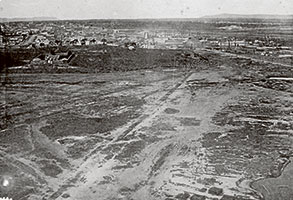 PHOTO photo taken late 1855 by Walter Woodbury showing Batman’s Hill taken from what is the present Collins St extension of docklands from then west melb gasworks chimney. …this grainy image showing the corner of Spencer and Flinders streets. VIEW FROM BLOCK 57 If one squints, you not only see the first Princes Bridge SOUTH 13, but also Queens Wharf SOUTH 1 (which stretched between Spencer St and the current Aquarium site). Further to the right are the abattoirs that lined the Yarra, WEST-SOUTH 1 slowly polluting it with foul animal remains and noxious chemicals. At the bottom of the photo is the muddy flat of the nearby Melbourne Swamp, which was located north-west of Melbourne until drainage started in the 1870s. Then, in-between all of this, is Batman’s Hill. It is hard to believe for many Melburnians today, but the west side of Spencer St was originally an 18-metre hillock covered in she-oak, that sloped towards the Yarra. It was there that the city’s founder, John Batman, had his house. If one focuses right of centre of the hill, you can see the house standing on top, barricaded by a picket fence. When Batman died in 1839, it became a Government Office, and was later used as a hospital… On the far left of Woodbury’s photo WEST 7 is a boxy building surrounded by a square wall known as the Powder Magazine(see POWDER MAGAZINE), which stored the city’s supply of gunpowder. |
| Sydney’s royal mint enters operation and is the first branch of the royal mint outside London 1855 SOURCE Celebrating 150 Years of the Melbourne Mint May 30, 2022 https://www.hellenic.org.au/post/ celebrating-150-years-of-the-melbourne-mint |
| 1856 |
| 1857 |
| 1857 economic crisis and deepening unemployment …economic developments after the early fifties – a steadily declining gold industry, a stable pastoral industry, quickly developing agriculture and slowly developing manufacturing, and sustained building and public works construction – has not yet drawn attention to the crisis which became evident in 1857. In terms of available capital and resources, Victoria was over-populated…meanwhile there was extensive unemployment and distress. The years 1854 to 1861 were a time of rapid deflation. As imported goods were continually in a state of over-supply, as local produce became freely available and conditions of transport steadily improved, prices fell steadily to somewhere near the pre-gold level, while wages on the whole followed close behind, especially when unemployment became serious in 1857. source p239 The Golden Age: A History of the Colony of Victoria 1851-1861 by Geoffrey Serle, 1977 Melbourne University Press. also more immigration from britain in same year…’public protest at continuing immigration in a period of high unemployment’….Assisted immigration was widely regarded as the equivalent of of legislating for a reduction in wages’ p241 The Golden Age: A History of the Colony of Victoria 1851-1861 by Geoffrey Serle, 1977 Melbourne University Press. -begging becomes part of the scene in melbourne |
| 1858 |
WILLIAMS MELBOURNE ALMANAC
link online here
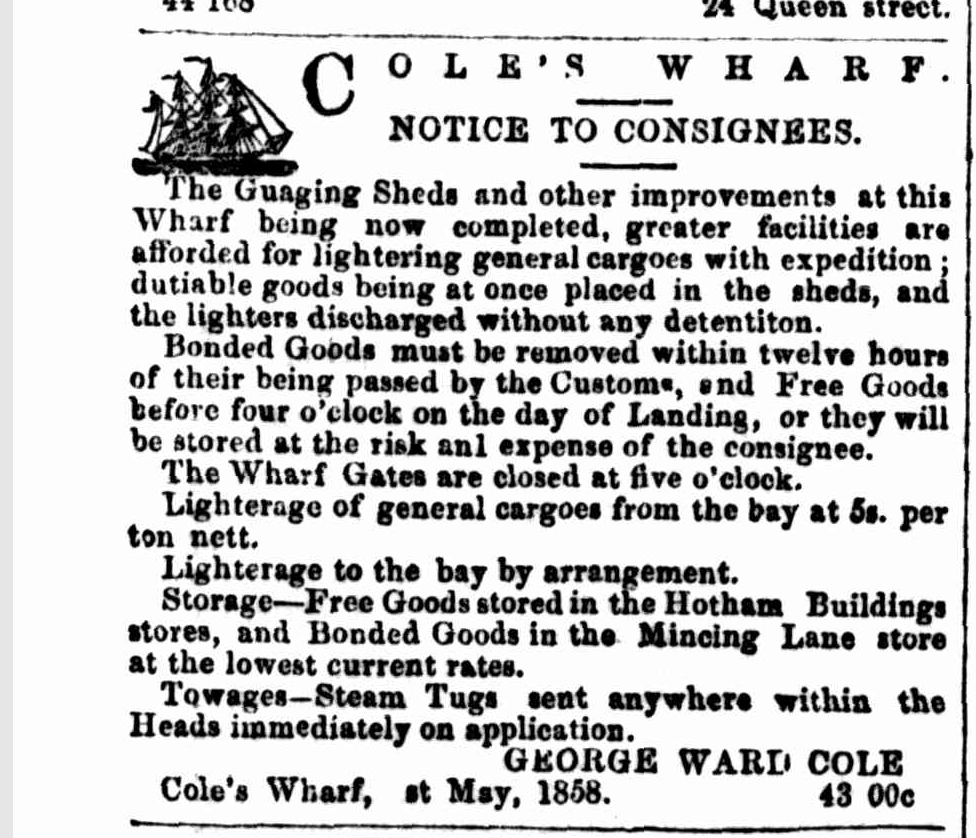
C O L E ‘ S W H A R F . NOTICE TO CONSIGNEES. The Ganging Sheds and other improvements at this Wharf being now completed, greater facilities afforded for lightering general cargoes with expedition ; dutiable goods being at once placed in the sheds, and the the lighters discharged without any detention. Bonded Goods must be removed within twelve hours of their being passed by the Customs, and Free Goods before four o’clock on the day of Landing, or they will be stored at the risk and expense of the consignee. The Wharf Gates are closed at five o’clook. Lighterage of general cargoes from the bay at 5s. per 5 ton nett. Lighterage to the bay by arrangement. Storage — Free Goods stored in the Hotham Buildings stores, and Bonded Goods in tho Mincing Lane store at the lowest current rates. PT Towages— Steam Tugs sent anywhere within the Heads immediately on application. GEORGE WARD COLE Cole’s Wharf, st May, 1858.
SOURCE: Advertising (1858, May 22). The Age (Melbourne, Vic. : 1854 – 1954), p. 1. Retrieved November 19, 2024, from http://nla.gov.au/nla.news-article154857758
IMAGE:
great description of melbourne without any baths or fountains and how hot it gets in summer:
HEALTH AND RECREATION—MELBOURNE IMPROVEMENT. (1858, May 21). The Age (Melbourne, Vic. : 1854 – 1954), p. 3. Retrieved November 26, 2024, from http://nla.gov.au/nla.news-article154857571
| 1859 |
Calverts illustrated almanac here online
| bubble economy 1859 general movement towards backing public companies, shares, speculation, investment, conmen, ponzi schemes etc. p225 The Golden Age: A History of the Colony of Victoria 1851-1861 by Geoffrey Serle, 1977 Melbourne University Press. |
| 1859 elections as outputs of the gold rush only increased, the desire for a Melbourne mint was revived by the time of 1859 elections. The Victorian Parliament renewed its petitions and finally, on 7 August 1869, the British acquiesced. The volume of gold that could be minted locally was unable to be ignored. SOURCE Celebrating 150 Years of the Melbourne Mint May 30, 2022 https://www.hellenic.org.au/post/ celebrating-150-years-of-the-melbourne-mint |
 burrows & co