| 1840s AS A DECADE |
residential water:
By the 1840s water pumps were installed on the north bank [of the yarra river] and men with carts sold the water, door to door. Residents also sank wells and used tanks and barrels to collect rainwater.
SOURCE https://www.oldtreasurybuilding.org.au/yarra/using-the-yarra/
| Late 1840s Bluestone Quarrying in Collingwood supplies Melbourne builds In 1848 nine local stone quarries held annual licences in the County of Bourke. The durable dark blue-grey basalt or ‘bluestone’ as it was referred to, was resistant to weathering by water and made an ideal building material for the better warehouses and homes. Most of the material quarried in the late 1840s came from Collingwood, between Merri Creek and the Reilly Street sanitation drain ( known today as Queen’s Parade). The area then was described as bare, barren and stony, with a network of quarry holes to be found everywhere. SOURCE: Bluestone Quarrying in Melbourne – September 20, 2011 by blessedbluestone https://blessedbluestone.wordpress.com/2011/09/20/bluestone-quarrying-in-melbourne/ |
| Late 1840s Scarcity of cointage ‘The first copper tokens were introduced in Melbourne in 1849 and tokens circulated freely in colonial Australia until 1868 (when they became illegal in New South Wales) and reflect pressures on coinage in the period following the Australian gold rush when tokens filled the role of an unofficial coinage. An advertisement in the Melbourne Argus (20 October 1849) cited the reason for introducing copper tokens: “To obviate the extreme inconvenience occasioned by the scarcity of coppers, particularly by grocers, who have not unfrequently to pay a premium of from sixpence to a shilling a pound for their Saturday night’s supply [of coins], Mr. Councillor Annand has had coined at Birmingham, a large supply of penny pieces, having on one side the figure of Britannia, and one the obverse the inscription, ANNAND, SMITH & Co family grocers Melbourne”. They were manufactured both locally and overseas and served both as low denomination coins (typically pennies and halfpennies), and advertising for merchants in the various colonies of Australia. As the shortage of official copper coins diminished in the second half of the nineteenth century, tokens became a nuisance and they were collected and sold for their scrap metal value. Birmingham makers of tokens were Allen and Moore; Heaton and Sons; Pope & Co; and Smith and Kemp. London token makers were WJTaylor; and Coard. In Sydney tokens were made by JC Thornthwaite; Hogarth and Erichsen; and Whitty and Brown. In Melbourne – Thomas Stokes; Stokes and Martin; and WJ Taylor.’ -SOURCE John Martin, grocer and tea dealer, 29 Rundle Street, Adelaide > History https://collections.sea.museum/en/objects/179990/john-martin-grocer-and-tea-dealer-29-rundle-street-adelai |
| Maritime Trade, 1840s and commercial bond stores Melbourne’s maritime trade expanded rapidly through the 1840s. Manufactured goods for the expanding town and surrounding farming districts came through Melbourne’s port. Large amounts of imported spirits and tobacco generated much customs revenue. Even stock and wool that was loaded at Geelong had to be cleared through customs at Melbourne, an arrangement that infuriated Geelong merchants. In 1840 Melbourne was declared a free warehousing port, which meant that merchants could hold their imported goods in bonded warehouses, and only pay customs duty once they sold the goods. Commercial bond stores sprung up around the port in the vicinity of the customs house. SOURCE https://museumsvictoria.com.au /immigrationmuseum/resources/customs-house/ |
| 1840 as a year |
| LETTSOM RAID BLOCK 50 1840 In 1840, there was a mass arrest and jailing of Aboriginal people in and around Melbourne. The so-called Lettsom Raid resulted in between 200 and 400 Aboriginal people being detained in barracks near the Birrarung (Yarra River). During the raid Winberri, a Wurundjeri Woi Wurrung man, was shot dead. Although only 23 years old, he was considered a remarkable young man ‘famous, respected and admired … Winberri was by family connection able to pass safely through distant remote tribes, a man with a “noble spirit” according to [William] Thomas, who wrote a three-page description of the unusual mourning ritual for Winberri carried out morning and evening by his aged father and his only sister‘ (Fels, 2011, p. 114). Supposedly carried out in retaliation for frontier violence, the Lettsom Raid has been characterised as part of coercive actions, aimed to control Aboriginal people and exclude them from Melbourne (Standfield, 2011, p. 179). SOURCE https://aboriginal-map.melbourne.vic.gov.au/112 Lettsom Raid The Lettsom Raid occurred at dawn on Sunday 11 October 1840, when Major Samuel Lettsom, accompanied by 58 soldiers and police, rounded up 400 Aboriginal people who were camped near Melbourne and marched them to town, ‘pricking them with their bayonets and beating them with the butt end of their muskets’. Two men were killed and others wounded. Major Lettsom had been dispatched from Sydney to apprehend Aboriginal leaders responsible for attacks against settlers on the Goulburn River, but followed them to Melbourne after learning that they had gone there for a ceremonial gathering. Lettsom demanded that Protector William Thomas hand over the Goulburn ‘troublemakers’ but he refused, arguing that there were no warrants for their arrest. Lettsom then gained permission from Superintendent La Trobe to make the raid. Edward S. Parker, Protector for the Goulburn region, managed to free all but 30 of the Goulburn men, ten of whom were put on trial on 6 December 1840. They were tried without the benefit of a defence lawyer or interpreter and nine were sentenced to ten years transportation for theft. The raid and its aftermath illustrate that Aboriginal people were not treated as equals under British law, despite the legal fiction that said they were. SOURCE Lettsom Raid MICHAEL F. CHRISTIE https://www.emelbourne.net.au/ biogs/EM00849b.htm |
| 1841 |
what clifton hill area looked like as located by city of melbourne aboriginal land website

[1845?]
Artist John Cotton (1801/02-1849) from slv here
After the formation of Melbourne City Council in 1841, one of the most pressing tasks was improving
Elizabeth Street, which in its short existence had become the most troublesome street in Melbourne.
“[William Westgarth in 1888] The bane and bottomless deep for the corporation’s narrow budget was
Elizabeth-street, where a little “casual” called “The Williams,” of a mile’s length, from the hardly
perceptible hollows of the present Royal Park, played sad havoc at times with the unmade street. It
had scooped out a course throughout, almost warranting the title of a gully, and at Townend’s corner
[southwest corner of Collins and Elizabeth Streets] we needed a good long plank by way of a bridge.
At the upper end of the street was a nest of deep channels which damaged daily for years the springs
and vehicles of the citizens.” (Westgarth, 1888)
As well as forming the spine of the city, Elizabeth Street also followed the approximate alignment of a
drainage line running into the Yarra, an inconvenient piece of topography that was to characterise the
street throughout the nineteenth century.
-SOURCE pp5,6 Elizabeth Street
Historical Character Study, Green Heritage Compliance and Research pdf
Melbourne is still a wild terrain
Despite four years of back-breaking labour {clearing the land-still being down since 1937 by convict labour-and maintaining streets}, the streets of Melbourne could not hold their own
against Mother Nature.
“[Anon in 1841] What between stumps and gullies, rivulets, lakes and bogs, it is rather a Herculean
task to wade the streets of Melbourne in wet weather.” (Brown-May, 1998)
-SOURCE p5 Elizabeth Street
Historical Character Study, Green Heritage Compliance and Research pdf
| first stone building in Melbourne is Customs House BLOCK 59 1841 -bluestone Customs House with a slate roof was completed on this site in 1841. -Designed by the Government architect in Sydney, it was Melbourne’s first stone building. -It sat by the Turning Basin, a natural pool on the Yarra River that was the highest point to which ships could navigate up the river. -Convicts were used to row the customs officers out to ships moored in the bay. Although the settlement was not a penal colony, several hundred convicts worked as servants or on government duties. -by the 1850s critics called it one of the ‘ugliest and most inconvenient of all our public buildings’. SOURCE https://museumsvictoria.com.au /immigrationmuseum/resources/customs-house/ |
| 1842 |
| FIRST PUBLIC HANGING 1842 Tunnerminnerwait and Maulboyheenner -These men were born in Tasmania and brought to Melbourne in 1839 by George Augustus Robinson, ‘Protector of Aborigines’. -In 1842, they became the first people to be hanged in Melbourne after they were convicted for the murder of two whale-hunters in the Western Port area. -Their execution took place before the existence of Old Melbourne Gaol on Russell Street, which was being constructed at the time. -They were publicly hanged on Franklin Street behind the [ current day ]City Baths They are now understood to be buried on the site of the Queen Victoria Market. ie they would have been buried within or on boundary of Melbourne Cemetary which is currently Queen Victoria Market SOURCE https://www.melbourne.vic.gov.au/ about-melbourne/melbourne-profile/ aboriginal-culture/Pages/tunnerminnerwait -and-maulboyheener.aspx#:~:text=Their%20 execution%20was%20the%20biggest, Street%20behind%20the%20City%20Baths. |
| Supreme Court of Victoria is built cnr russell and latrobe NORTH 14 current site: 325–343 Russell Street Melbourne 3000 In 1842-3 a modest two-storey brick building was erected to house the Supreme Court of Victoria on the corner of Russell and La Trobe streets, Melbourne. A wooden extension was added in 1853 to cope with the sudden increase of cases associated with the gold rush. current site: 325–343 Russell Street Melbourne 3000 SOURCE: History https://www.rmit.edu.au/maps/melbourne-city-campus/building-20 |
https://www.cbdnews.com.au/old-melbourne-law-court
Old Melbourne Law Court
This unpretentious wooden building with veranda nestled in among much taller, more impressive edifices was one of the earliest public buildings in Melbourne. Located on the north-west corner of Russell and La Trobe streets, its foundation stone was laid in 1842 and the building was completed in 1843. Its style speaks to its age.
To begin with, it was used for Supreme Court sittings until a new courthouse was constructed in 1853.
That building is to the left of the Old Law Court in this image. Eventually, the Supreme Court relocated to William St in 1884. The Old Court later served as the Petty Sessions Courthouse and on the windows on the La Trobe St frontage are the remnants of a sign identifying it as the Civil Sessions and Debts Court (identified in an 1895 MMBW plan as the Summons and Debt Court). It served in this capacity until 1910 when the buildings were demolished and replaced with the City Court.
A complex of other law and order related buildings grew up around this old courthouse and the Melbourne Gaol (now the Old Melbourne Gaol) was next door on Russell St. The precinct was the scene of many trials, but two stand out in the public imagination.
The Eureka Stockade trials were held in the courthouse in February and March 1855, Chief Justice Sir William a’Beckett presiding. The charge was high treason. The 13 men on trial had been held at the Melbourne Gaol since December 7, 1854, four days after the rebellion. The drama of the evidence was equalled by the drama in the courtroom. In the end, they were all acquitted.
Bushranger Ned Kelly has always played a huge part in the Australian public’s imagination and the story of the Kelly Gang has been told, retold and reimagined many times. It seems unlikely that such a larger-than-life figure should be tried in such an unpretentious setting, but it was here that his trial was held at the end of October 1880. Here the dramatic witness statements were heard. Here the jury took just 25 minutes to deliver its verdict. Here Judge Redmond Barry brought down the sentence of death. And, on November 11, 1880, just down the road at the Melbourne Gaol, he was executed.
In contrast to such dramatic scenes, the streetscape you see here (from the Royal Historical Society’s images collection) is formal and lifeless. Along Russell St, which dominates the foreground of the image, can be seen iron rails embedded into the road surface and horse droppings, a reminder that the St Kilda Beach and North Carlton horse tram used to travel this route. Heading west along La Trobe St takes you past the Police Office to the Working Men’s College (now RMIT University). On the other side of the street the National Art Gallery, with its Russell St frontage, gave way to the Melbourne Public Library and Museum (now the State Library of Victoria). An impressive neighbourhood of public buildings.
The massive embankment at the front of this building is taller than the boy pictured walking in the direction of the Museum, now part of the State Library of Victoria, and is held back by bluestone pitchers, a ubiquitous material used in buildings and road making during the goldrush era. The gutters are made of bluestone, too, a material that can still be seen in some lanes in the CBD and in inner suburbs like Carlton and Brunswick.
This embankment, and a substantial ramp on the La Trobe St frontage, remind us that from the first, white settlers manipulated the landscape to suit their needs and that the streetscapes we see today do not necessarily reflect the topography of the area in the thousands of years that preceded the colonisers.
History
Building dates
A wooden extension was added in 1853 to cope with the sudden increase of cases associated with the gold rush…. In 1884 the Supreme Court moved to more suitable accommodation in the new Law Courts in William Street. The Russell Street buildings were then used for the Court of Petty Sessions. The buildings were demolished in 1910 and the current courthouse was erected in their place.
Source: https://www.rmit.edu.au/maps/melbourne-city-campus/building-20
| 1843 |
On Elizabeth St:
“[Anon in 1843] It was no uncommon thing to see a loaded dray bogged in the principal street, the
wheels being sunk into holes, two or three feet deep, from which the strength of ten or twelve bullocks
is required to extricate it.” (Brown-May, 1998)
-SOURCE p7 Elizabeth Street
Historical Character Study, Green Heritage Compliance and Research pdf
rural depression
Fulton developed a technique for boiling down sheep for tallow around 1843–44 when squatters slaughtered their otherwise worthless sheep in the thousands due to a rural depression..Fulton was located at 131 Flinders St West in about 1844. (different street numbers now but see also LANGFORD FOUNDARY) source: https://en.wikipedia.org/wiki/Thomas_Fulton_(ironmaster)
| 1844 |
| THE DOG ACT 1844 While there are few references to the Aboriginal people in official notices of motion, by-laws were created that directly affected Aboriginal people. The Dog Act of 1844, for example, which ‘ensured that the “hoards” of diseased dogs, if unregistered, were routinely killed in the streets’. Assistant Protector William Thomas stated that the women in camps “cried for their dogs”.[ii] A week later, this Aboriginal group that included these women left the settlement “on account of their dogs being killed”.’[iii] SOURCE 12. ESTABLISHMENT OF MUNICIPAL GOVT. & THE IMPACT ON THE WURUNDJERI https://aboriginalhistoryofyarra.com.au/12-establishment-of-municipal-government-and-the-impact-on-the-wurundjeri/ this has been sourced from—Penelope Edmonds, ‘The Intimate, Urbanising Frontier: Native Camps and Settler Colonialism’s Violent Array of Spaces around Early Melbourne’ in Tracey Banivanua Mar and Penelope Edmonds (eds), Making Settler Colonial Space: Perspectives on Race, Place and Identity, Palgrave Macmillan, 2010, 136 |
| 1846 |
| LaTrobe sends letter to Colonial Secretary in Sydney a report prosecuting Aboriginals 1846 July= In July 1846 the Superintendent of Port Phillip, Charles Joseph La Trobe, sent the Colonial Secretary in Sydney an extensive report about a matter of great importance to him – the effective prosecution of criminal cases involving Aboriginal people. By the mid-1840s the continual problems that beset prosecutions of this nature frustrated La Trobe to the extent that he decided to restate the issues clearly in a long letter, outlining the considerable confusion that existed about the legal status of Aboriginal people, evidentiary law and the role of magistrates in criminal cases. La Trobe expected that his presentation of ‘plain facts and past experience’ of the matter would enable the New South Wales Governor to ‘bring the subject more distinctly under the attention of the Home Government’. This was not the first time La Trobe had brought the problematic character of judicial proceedings to the attention of colonial authorities. As superintendent, he attempted to highlight what he thought were defects in the criminal justice system. Ultimately his efforts did little to change legal practice but are a valuable insight into his approach to Aboriginal issues and the difficulties he faced while attempting to fulfil one of his most important duties – the improvement of conditions for Aboriginal people and the resolution of conflict in a rapidly expanding white society. SOURCE: Abstract ‘Superintendent La Trobe and the amenability of Aboriginal people to British law 1839-1846’, Provenance: The Journal of Public Record Office Victoria, issue no. 8, 2009. ISSN 1832-2522. Copyright © Frances Thiele. This is a peer reviewed article. https://prov.vic.gov.au/explore-collection/provenance-journal/provenance-2009/superintendent-la-trobe-and-amenability |
The first hospital in Melbourne opened in 1848.
–
1849
‘The first copper tokens were introduced in Melbourne in 1849 and tokens circulated freely in colonial Australia until 1868 (when they became illegal in New South Wales) and reflect pressures on coinage in the period following the Australian gold rush when tokens filled the role of an unofficial coinage. An advertisement in the Melbourne Argus (20 October 1849) cited the reason for introducing copper tokens: “To obviate the extreme inconvenience occasioned by the scarcity of coppers, particularly by grocers, who have not unfrequently to pay a premium of from sixpence to a shilling a pound for their Saturday night’s supply [of coins], Mr. Councillor Annand has had coined at Birmingham, a large supply of penny pieces, having on one side the figure of Britannia, and one the obverse the inscription, ANNAND, SMITH & Co family grocers Melbourne”. They were manufactured both locally and overseas and served both as low denomination coins (typically pennies and halfpennies), and advertising for merchants in the various colonies of Australia. As the shortage of official copper coins diminished in the second half of the nineteenth century, tokens became a nuisance and they were collected and sold for their scrap metal value. Birmingham makers of tokens were Allen and Moore; Heaton and Sons; Pope & Co; and Smith and Kemp. London token makers were WJTaylor; and Coard. In Sydney tokens were made by JC Thornthwaite; Hogarth and Erichsen; and Whitty and Brown. In Melbourne – Thomas Stokes; Stokes and Martin; and WJ Taylor.’
-SOURCE
John Martin, grocer and tea dealer, 29 Rundle Street, Adelaide > History
https://collections.sea.museum/en/objects/179990/john-martin-grocer-and-tea-dealer-29-rundle-street-adelai
FIRST TRADER TOKEN ISSUED 1849 Melb
The first Australian trader token was a penny, issued by Melbourne grocer Annand, Smith & Co. in 1849. As
was the cases in most other countries, token issues were predominantly in response to a shortage of pennies
and halfpennies. It didn’t hurt that these pieces nicely doubled as an advertisement for one’s business when
they were given out as change…..At first, companies would import tokens from British manufacturers, such as the Soho Mint and Heaton & Sons
of Birmingham. But as the colony’s manufacturing capacity grew, local makers provided their own services in
this lucrative business. It was lucrative because each token cost less to produce than the value it traded for,
even when shipping costs were factored in. Initially, the Victorian government turned a blind eye to these
tokens, as private enterprise had solved an immediate problem to most people’s satisfaction. It was also
saving the Victorian government money, as it cost the government a penny per penny to buy coins from the
Royal Mint in England.2
Stokes capitalised on this and issued a large number of tokens of differing types for his own business and for
others. SOURCE City of Melbourne Numismatic Collection
By Darren Burgess P2
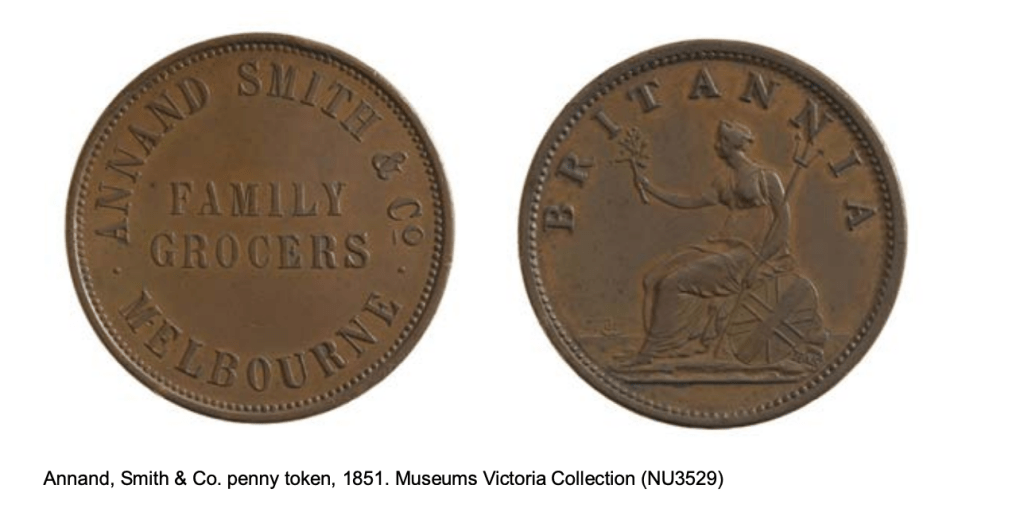
SOURCE City of Melbourne Numismatic Collection
By Darren Burgess P2
While Aboriginal people could be admitted to hospital, they were often refused visitors and treated poorly, as in the case of William Barak, Wurundjeri Woi Wurrung head (ngurungaeta), and his son David.
David was admitted to hospital in 1881; his father was refused entry to see or visit his son. When David died a short time later, his body was never returned to his family. David was 10 years old.
go back to context melbourne document
history of supreme court website
history of gaols
history of first gaol escape
history of blds/grid
the golden age book
 burrows & co