| 1830s AS A DECADE |
quickly just about currency:
1800
Copper ‘Cartwheel Penny’ King George III 1797 aka Proclamation Penny
description
obverse
The obverse design bears the robed and laureate bust of King George III with long hair. The Latin reads ‘GEORGIUS III. D: G. REX’, which translates as ‘George III by the grace of God King’. 1
reverse
The reverse quotes ‘BRITANNIA’, that is ‘Britain’, with the date below, 1797.
-Britannia, holds an olive branch and a trident, with a shield resting beside and a small ship in the left.
-“this was a new maritime interpretation of the female personification of Britain. Britannia now sits on an island surrounded by water to convey Britain’s supremacy of the seas.
To reinforce the maritime theme, Küchler (coin designer) removed the spear that Britannia had carried since her first appearance on coins struck during the reign of the Emperor Hadrian during the Roman occupation of Britain in the second century. In its place, he gave her a trident, like the one wielded by Neptune, the god of the sea. In her other hand, she holds out an olive branch as a symbol of peace. To complete the design, a ship sails by on the horizon to symbolise Britain’s naval dominance. The ship is believed to represent a warship, with its gun ports visible”.
source: here2
The inscription is incuse (impressed with a stamp) and on the rim on both sides. The rim was to help avoid wear on the coin and also helped give it nickname of the cartwheel penny.3
value: set as twice their value at two pence when introduced to Australia, a higher value than in England as a disincentive for the currency to return off shore.4
in circulation until 1860 when it was replaced with a new, smaller more sturdy bronze penny. 5
British context:
Created to combat counterfeiting, these coins were the first in England to be minted on a steam powered press. The steam coining press was developed by James Watt and the manufacturer Mathew Boulton at the Soho foundry in 1788. In 1797, the government agreed to let Boulton coin a penny and a two pence. Each denomination is perfectly round and the excellent craftsmanship eliminated counterfeiting. The wide raised rim led to the term ‘cartwheel’. The copper penny was minted for two or three years, but continued to carry the date 1797.6
Australian context:
First coinage from Britain into Australia introduced in 1800 and proclaimed as official currency for the colony.7
-a cartwheel penny was found by archeologists beneath the floors of the convict sleeping wards of the Hyde Park Barracks. 8
| first nations v colonisers 1830s as a decade When white settlers invaded the country around Port Phillip in the mid 1830s they encountered a people who had already had some contact and familiarity with Europeans. David Collins’ party of marines and convicts had been stationed briefly at Sullivan’s Cove (Sorrento) in 1802–03 and had sent an exploratory party to Port Phillip — and the future site of Melbourne — where contact with the Boon wurrung was made. Aboriginal people would have also heard stories of the sealers and whalers who worked seasonally at various places along the coast, and would have sighted ships at sea. There was also some contact between the Boon wurrung and sealers at Western port in the 1820s and the 1830s, but the extent of this is not well understood. SOURCE p5 Context Pty Ltd 2012, Thematic History: A History of the City of Melbourne’s Urban Environment, prepared for the City of Melbourne. their source: Thematic history: A history of the City of Melbourne’s urban environment also see: Richard Broome, Aboriginal Victorians: A history since 1800, Allen & Unwin, Sydney, 2005, pp. 5–6, 9, 14. |
| 1835 as a year |
| Batman Treaty 1835 MAY first nations leaders approached by Batman with farmers syndicate party (and interpreters?) and engage in an agreement of what Batman intends to be a purchase of land versus what is most likely to have been understood as a permission to pass through Permission to pass v land ownership Batman’s treaty 1835 – MAY Batman & treaty @ merri creek Note that Batman was the first carrier of Syphilis to victoria. If he had ANY sexual contact with first nations he would have been the first importer. Not the first coloniser to introduce from accross the seas. whole history of syphilis. And it would have been pretty advanced at this point. AND his wife would have had it. -A treaty between the Port Phillip Association represented by John Batman, and the Wurundjeri, SOURCE p7 Context Pty Ltd 2012, Thematic History: A History of the City of Melbourne’s Urban Environment, prepared for the City of Melbourne. -What Batman understood to be a transaction of land ownership was actually intended as permission to pass through but not remain. -This treaty was refused by the colonial government as it would question the legality of the claim of Australia as Terra Nullius. SOURCE: https://museumsvictoria.com.au/ melbournemuseum/resources/marvellous-melbourne/ [but it would also legitimise private associations purchasing land without government jurisdiction] ‘I would recommend Rex Harcourt’s enormously interesting book “Southern Invasion, Northern Conquest” (Golden Point Press, 2001). It contains what I think is the clearest account in print of the circumstances surrounding the Treaty and the events leading up to it. The rejection of the Treaty by Governor Richard Bourke implemented the doctrine of Terra nullius upon which British possession of Australia until Mabo became based’. SOURCE https://yallambie.wordpress.com /2015/01/23/the-terra-nullius-dream/ Does party arrive with sheep etc and where do they set up. Tullamareena (or Tullamarine, Dullamarin) was a senior man of the Wurundjeri, a Koori, (Aboriginal) people of the Melbourne area, at the time of the British settlement in Victoria, Australia, in 1835. He is believed to have been present at the signing of John Batman‘s land deal in 1835. -SOURCE https://en.wikipedia.org/wiki/Tullamareena In 1835 two sons of British convicts transported to Australia, John Batman and John Pascoe Fawkner, initiated a process that would result in the creation of the city of Melbourne. In May of that year, John Batman as the expedition leader for the Tasmanian based Port Phillip Association, signed the infamous treaty with the Kulin people, allowing British settlement on 600,000 acres of their land around Port Phillip Bay in return for an annual tribute. -SOURCE p2 Elizabeth Street Historical Character Study, Green Heritage Compliance and Research pdf |
| Fawkner & his rival farmer syndicate arrive via Enterprize after delays with money problems 1835 – AUG SOUTH 2, SOUTH 3 modern day Enterprize Park -John Pascoe Fawkner with new farmers syndicate enters the Yarra River aboard the sailing ship Enterprize, establishing the first permanent settlement SOURCE: https://museumsvictoria.com.au/ melbournemuseum/resources/marvellous-melbourne/ Does Fawkner arrive with sheep etc and where does he and party set up. …Launceston publican John Pascoe Fawkner financed his own expedition to Port Phillip Bay and instructed his men to establish the first permanent non-Aboriginal settlement on the banks of the Yarra River. Others soon followed from Tasmania, however their arrival was neither compliant with Aboriginal law nor with Elizabeth Street Historical Character Study 3 British law. The illegal township of Tasmanian squatters was known to them {who, the colonisers or indig people} as Bearhurp, a corruption of Birrarung, to outsiders it was simply known as the Settlement. -SOURCE p2 Elizabeth Street Historical Character Study, Green Heritage Compliance and Research pdf |
| Bourke’s Proclamation from Sydney identifies Melbourne settlement as illegal but there’s no law enforcement to remove settlement so its presence/growth is effectively condoned by lack of enforcement. 1835 – OCT ‘New South Wales Governor, Sir Richard Bourke, effectively quashed the treaty with this Proclamation issued by the Colonial Office and sent to the Governor with Dispatch 99 of 10 October 1835. Its publication in the Colony meant that from then, all people found occupying land without the authority of the government would be considered illegal trespassers. The Proclamation of Governor Bourke implemented the doctrine of terra nullius upon which British settlement was based, reinforcing the notion that the land belonged to no one prior to the British Crown taking possession of it. Aboriginal people therefore could not sell or assign the land, nor could an individual person acquire it, other than through distribution by the Crown’. SOURCE ‘Objects Through Time: Governor Bourke’s 1835 Proclamation of Terra Nullius’ https://www.migrationheritage.nsw.gov.au/ exhibition/objectsthroughtime/bourketerra/ index.html#:~:text=The%20Proclamation %20of%20Governor%20Bourke%2C%2010 %20October%201835%20is%20historically, Crown%20taking%20possession %20of%20it see also Proclamation of Governor Bourke, 10 October 1835. Image courtesy of www.foundingdocs.gov.au |
| 1836 as a year |
| Batman builds house at base of BATMAN’S HILL (see a-z) 1836 APR ‘In April 1836, Batman and his family settled on the hill and built a house at the base, where Batman lived until his early death from syphilis in 1839. The Batmans’ house was one of the largest and grandest in the settlement, frequently featured in art of early settlement Melbourne’. -SOURCE Unveiling the Layers of Batman’s Hill and Melbourne’s Urban History by Luci Nicholson https://farragomagazine.com/article /farrago/Unveiling-the-Layers-of-Batmans-Hill-and-Melbournes-Urban-History/ |
| Melbourne’s illegal settlement is sanctioned as an extension of New South Wales 1836 just out of interest what happened to the tracts of land Batman wanted to get his mitts onto and had anyone settled on them at this time Melbourne is named Melbourne 1836 The township had originally been known as Dutigalla (or Douta Galla) and Bearbrass and various other names, but in 1836 Gov Bourke declared the name of Melbourne — after Lord Melbourne, the then prime minister of Britain. -SOURCE p23 Context Pty Ltd 2012, Thematic History: A History of the City of Melbourne’s Urban Environment, prepared for the City of Melbourne. Governor Bourke is ‘forced to condone the fast-growing settlement as an extended district of the Colony of New South Wales’. SOURCE p26 Context Pty Ltd 2012, Thematic History: A History of the City of Melbourne’s Urban Environment, prepared for the City of Melbourne. Melbourne’s first administrative centre (the so-called ‘Government Block’ bounded by Collins, Bourke, King and Spencer Streets) BLOCK 33 AND 41 SOURCE p26 Context Pty Ltd 2012, Thematic History: A History of the City of Melbourne’s Urban Environment, prepared for the City of Melbourne. William Lonsdale, who arrived in October 1836 as the first police magistrate and general administrator, briefly occupied the Commandant’s House located in the government block at the western end of town BLOCK 33. SOURCE p26 Context Pty Ltd 2012, Thematic History: A History of the City of Melbourne’s Urban Environment, prepared for the City of Melbourne. -also 1837 sir richard bourke map which shows the government block, Batman’s site, and commandant’s residence. |
| The first Customs officer arrives and sets up the Custom Tent along Yarra BLOCK 59 or SOUTH 3 1836 ‘Governor Bourke in Sydney had to accept the illegal settlement at Port Phillip by John Batman and his fellow entrepreneurs. There was little he could do to prevent it. But Bourke could at least ensure that smuggling was prevented and that customs duties were paid on all goods brought into Melbourne. The Customs Tent Robert Webb established his customs house in a round white tent pitched beside the Yarra River, close to where the boats unloaded their stock and supplies. The customs service immediately paid its way. In (the next year) 1837 Webb collected duties of 3000 from 140 ships, far more than his annual salary of 200. …later on this decade the tent becomes a weatherboard cabin: Customs House upgrades from tent in 1835 to a crappy weatherboard cabin BLOCK 51 The first iteration of Customs House was a white tent pitched on the banks of the Yarra, soon to be replaced with a structure described as a ‘shabby, leaky, comfortless, weatherboard cabin’ which shipped in pieces from Sydney and erected here during the 1830s. SOURCE https://museumsvictoria.com.au /immigrationmuseum/resources/customs-house/ i think it’s block 51 close to block 59 rather than closer to the river because there’s a structure marked as Webb on 1837 russell map |
| FLAGSTAFF CEMETERY 1836-7. Willie, the child of James Goodman was the first person to buried in Melbourne, Port Phillip District. He was buried on 13th May 1836 at the very first cemetery at Burial Hill which is today’s Flagstaff Gardens west of the market. Flagstaff was only used for about 8 burials. There is a memorial on the hill. SOURCE THE CEMETERY AT QUEEN VICTORIA MARKET https://melbournewalks.com.au/the-old-melbourne-cemetery-queen-victoria-market-tour/ -see also there was a write up in the argus, https://tomelbourne.com.au/flagstaff-gardens/ |
RUSSELL plays around with model colonial town layout sourced from sydney
The street plan which became known as the Hoddle Grid was initially drawn up by the surveyor, architect and artist Robert Russel while delayed at Melbourne in 1836.
“While waiting, it occurred to me that we might as well fill in time by making a survey of the future settlement … Out of mischief I made a survey of the site of Melbourne, without official instructions.” (Maxwell, 2003)
The plan was not original and followed an officially developed model of how a colonial town should
be laid out. As Russell admitted, it was based on –“… a plan in the Sydney office generally approved as suitable for laying out a new township, and I had a copy of it… [it was] scarcely a design, simply 24 ten acre squares’.” (Maxwell, 2003)
-SOURCE p2 Elizabeth Street
Historical Character Study, Green Heritage Compliance and Research pdf
| 1837 as a year |
| Governor Bourke visits Melbourne in person, proclaims the town as part of NSW and confirms the site of the town survey. SOURCE p11 Context Pty Ltd 2012, Thematic History: A History of the City of Melbourne’s Urban Environment, prepared for the City of Melbourne. – Although Port Phillip was an appanage of New South Wales, it was at that time being settled by Tasmanians, who, during 1836 and 1837, were pouring into it with stock. Mr. Russell states that ‘it was partly in consequence of a rumour that Tasmania was going to claim Port Phillip that the Governor of New South Wales decided to pay the place a visit. -being quoted here is a member of Bourke’s retinue in March 1837, Thomas Russell SOURCE THE NAMING OF MELBOURNE.—AN ITEM OF VICTORIAN HISTORY. (1886, September 21). The Australasian Sketcher with Pen and Pencil (Melbourne, Vic. : 1873 – 1889), p. 158. Retrieved February 20, 2024, from http://nla.gov.au/nla.news-article63225316 Article identifier http://nla.gov.au/nla.news-article63225316 On the night of their arrival at Melbourne, Mr. Russell and five other of the servants, having discovered that drinks were obtainable at a wattle and dab hut in the vicinity of the tents, went there, and were ushered by the host, Mr. J. P. Fawkner, into the parlour, which the party filled. “Brandies round” were ordered, and Mr. Russell tendered a £1. Sydney note. Mr. Fawkner counted the party, pocketed the note, and said, “Six threes is 18/ , and 2/ discount for a Sydney note; that is right, gentlemen.” …Another member of the party bought a bottle of brandy from Mr. Fawkner for 15/, and, tendering a sovereign, got 5/ back as change. About 2 o’clock, on the fifth morning, after their arrival a severe shock of earthquake was felt. Most of the party had never had such an experience before, and ran out of their tents. Russell remembers seeing the Governor peep out from his tent, and hearing him say it was an earthquake. (On Mar 26 the party starts for a trip to Geelong and are led by William Buckley) SOURCE THE NAMING OF MELBOURNE.—AN ITEM OF VICTORIAN HISTORY. (1886, September 21). The Australasian Sketcher with Pen and Pencil (Melbourne, Vic. : 1873 – 1889), p. 158. Retrieved February 20, 2024, from http://nla.gov.au/nla.news-article63225316 Article identifier http://nla.gov.au/nla.news-article63225316 BLANKETS, CLOTHING, DISTRIBUTED & 4 BRASS PLATES AWARDED On March 8, 1837, Bourke distributed blankets and clothing to about 120 natives, and exhorted them to good conduct and attention to the missionary. He also gave four brass plates as honorary distinctions for good conduct to natives recommended by Captain Lonsdale. -SOURCE Argus (Melbourne, Vic. : 1848 – 1957), Saturday 8 December 1934, page 6 GOVERNOR BOURKE’S DIARY-II THE TOWNSHIP ON THE YARRA (From Our Correspondent) ‘HODDLE’S GRID’ (see a-z)prepared ‘Hoddle and his assistant Robert Russell prepared the plan that laid the foundation for Melbourne, with Hoddle placing his plan over the original survey drawn by Russell‘. SOURCE p11 Context Pty Ltd 2012, Thematic History: A History of the City of Melbourne’s Urban Environment, prepared for the City of Melbourne. The map that is created: non coloured version Map shewing the site of Melbourne and the position of the huts & buildings previous to the foundation of the township by Sir Richard Bourke in 1837 [cartographic material] / surveyed & drawn by Robert Russell. Author / Creator Russell, Robert, 1808-1900. Date 19–?] https://handle.slv.vic.gov.au/10381/170516 hand coloured version ‘Map shewing the site of Melbourne : and the position of the huts & buildings previous to the foundation of the township by Sir Richard Bourke in 1837 / surveyed & drawn by Robert Russell’ ; Day & Haghe, lithrs. to the Queen Creator Russell, Robert, 1808-1900 Call Number MAP RM 1288 (Copy 1) Created/Published [London] : Day & Haghe, [1837?] Extent 1 map : mounted on linen ; 47.5 x 64.5 cm. national library of australia https://catalogue.nla.gov.au/catalog/3602851 |
1837-1841
The streets of Melbourne were initially marked with wooden pegs and defined from the surrounding
land by the clearing of brush and scrub. This was a substantial task that involved the clearance of many
trees, stumps, filling up stump holes and the removal of the occasional Bearhurp era hut. Governor
Bourke directed that convict gangs undertake these tasks, which they continued to do from 1837 to 1841 -SOURCE p5 Elizabeth Street
Historical Character Study, Green Heritage Compliance and Research pdf
| 1837 disposession and displacement becomes systematic/policy/enforced by government arm ‘One of the great silences in the archaeological record of nineteenth-century Melbourne, however, concerns Aboriginal people. Following the arrival of British colonists in 1835, Aboriginal people were rapidly dispossessed, formally through the signing of a ‘treaty’ between John Batman and elders of the local Wurundjeri people and informally through the numerous and repeated acts of appropriation inherent in building a settler city (Attwood and Doyle 2009; Boyce 2011). On a few archaeological sites there have been tantalising signs of Aboriginal occupation in the form of stone tools recovered from lower levels but these have been interpreted as evidence of pre-British site use rather than the continued presence of Aboriginal people (e.g. Green and Doyle 2014; O’Connor et al. 2012). With the exception of graves in the Old Melbourne Cemetery, sites with archaeologically documented Aboriginal associations after 1835 are largely on the fringes of the CBD. These include a mission station set up in 1837 on the south side of the Yarra River and another established at Dight’s Falls in the 1840s, followed by others further out at Coburg and Coranderrk and the continued use of traditional camps at the Dandenong Police Paddocks (AHMS 2014; Presland 1985, p. 64). Despite these attempts to marginalise Aboriginal people, however, they did not entirely retreat from urban areas and the continued use of open spaces such as Flagstaff Gardens and the banks of the Yarra River has been increasingly recognised and acknowledged in placenames such as Birrarung Marr Park and Wurundjeri Way (Goulding and Menis 2006; Presland 2001). SOURCE p8 Melbourne: The archaeology of a world city International Journal of Historical Archaeology 22:117-130 (2018) Susan Lawrence and Peter Davies |
| dwellings abolished for new buildings to conform to HODDLES GRID 1837 Most of the first [coloniser] dwellings constructed prior to Hoddle’s Plan and the first land sales in 1837 were built of sod —cheap and quick to construct as was suitable for a new and unauthorised settlement. The pre-1837 houses, those of sod and several of timber, were demolished following the delineation of new allotment boundaries and the public land sales. SOURCE p15 Context Pty Ltd 2012, Thematic History: A History of the City of Melbourne’s Urban Environment, prepared for the City of Melbourne. |
| Burial Hill replaced by ‘Old Melbourne Cemetery’ 1837 in West Melbourne bounded by Queen Street to the east, Peel Street to the west, Franklin Street to the south, and Fulton Street(which no longer exists) to the north. The first person to be buried on this site was also a child. He was Frederick William Craig, the infant son of Skene Craig. The Old Melbourne Cemetery (QV Market) was divided into areas according to religious denominations. It was the first of this kind in Australia. Two acres each were given to the Church of England, Presbyterians, Roman Catholics and one acre each was given to the Jews, Quakers, Methodists and Independents. Later half the Quaker section was allocated to the Aborigines. SOURCE THE CEMETERY AT QUEEN VICTORIA MARKET https://melbournewalks.com.au/the-old-melbourne-cemetery-queen-victoria-market-tour/ |
| first public land sales? 1837 |
| troopers arrive from sydney and Corroborees outlawed In 1837 he [Governor Bourke]sent troopers from Sydney to establish order in the new township. Interaction between settlers and First Peoples was officially discouraged. (how exactly. newspaper editorials, government decrees, marriage laws, what) Corroborees, which often attracted many white onlookers, were outlawed. Mounted troopers patrolled the edge of town. SOURCE https://museumsvictoria.com.au /melbournemuseum/resources/marvellous-melbourne/ |
| 1837 ENGLAND: House of Commons report recognises Aboriginal land rights two years after Bourke’s Proclamation reinforcing terra nullis and 155 years before Mabo. Although many people at the time also recognised that the Aboriginal occupants had rights in the lands (and this was confirmed in a House of Commons report on Aboriginal relations in 1837), the law followed and almost always applied the principles expressed in Bourke’s proclamation. This would not change until the Australian High Court’s decision in the Eddie Mabo Case in 1992. SOURCE ‘Objects Through Time: Governor Bourke’s 1835 Proclamation of Terra Nullius’ https://www.migrationheritage.nsw.gov.au/ exhibition/objectsthroughtime/bourketerra/ index.html#:~:text=The%20Proclamation %20of%20Governor%20Bourke%2C%2010 %20October%201835%20is%20historically, Crown%20taking%20possession %20of%20it |
| YEAR?? c1836-8 first colonial court hearing in melbourne During the early years of settlement disputes were handled by police magistrate William Lonsdale. Lonsdale’s first court hearing took place in a storehouse owned by John Batman, located near the corner of Market Street and Flinders Lane. I think this is about the middle of BLOCK 51 & 59 in 1837 Robert Russell map this looks to be in vicinity of house/buildings designated to FAWKNER. ? SOURCE p33 Context Pty Ltd 2012, Thematic History: A History of the City of Melbourne’s Urban Environment, prepared for the City of Melbourne…they cite: need to track down and read: Doyle, ‘Dispensing Justice: A Cultural Sites Network Study’, May 2000, p. 5 |
| 1837 gaol erected on Batman’s Hill. Port Phillip’s first gaol was a hut on Batman’s Hill, surrounded by a 2.4 metre fence. It opened in 1837 (it will burn to the ground in the next year) SOURCE Melbourne’s first gaols https://ergo.slv.vic.gov.au/explore-history/rebels-outlaws/law-enforcement/melbournes-first-gaols |
| 1838 as a year |
| George WINTLE appointed as gaoler 1 Jan 1838 at the first gaol in Victoria which is Batman’s hut with stockade fencing and then after the hut that burns down three months into the job, the stone building LatTrobe rents out site unknown while more permanent one gets built which I think is at the government block and future bourke st west police station. On 1 January 1838, George Wintle was appointed to be gaoler at the prison at £100 a year; with the site becoming colloquially known as Wintle’s Hotel. –https://en.wikipedia.org/wiki/ Old_Melbourne_Gaol#:~:text=An%20allotment %20of%20scrubland%20to,colloquially %20known%20as%20Wintle’s%20Hotel. WINTLE’s HOTEL becomes slang for gaol in melbourne and is referred to as such in print in 1842 Port Phillip Gazzette see: ‘Wintle’s Hotel int. also Mr Wintle’s Hotel, Wintle’s [George ‘Daddy’ Wintle, first governor of the prison from 1838] Digital edition Jonathon Green 2024. https://greensdictofslang.com/entry/wxoat6i |
| Lonsdale moves into house at Richmond Paddock current day Yarra Park 1838 what month of the year By 1838, Lonsdale had moved to a house in the large government paddock (also known as Richmond Paddock) located east of the township and modern day Yarra Park. SOURCE p26 Context Pty Ltd 2012, Thematic History: A History of the City of Melbourne’s Urban Environment, prepared for the City of Melbourne. richmond park site identified as current yarra park p.34 Context Pty Ltd 2012, Thematic History: A History of the City of Melbourne’s Urban Environment, prepared for the City of Melbourne. |
| 1838 The town of Melbourne is physically laid out this year according to the grid planned in previous 12 months SOURCE p1 Context Pty Ltd 2012, Thematic History: A History of the City of Melbourne’s Urban Environment, prepared for the City of Melbourne. |
| Tullamareena burns down gaol at Batman’s Hill with Moonee Moonee and Jin Jin 1838 APR 25th 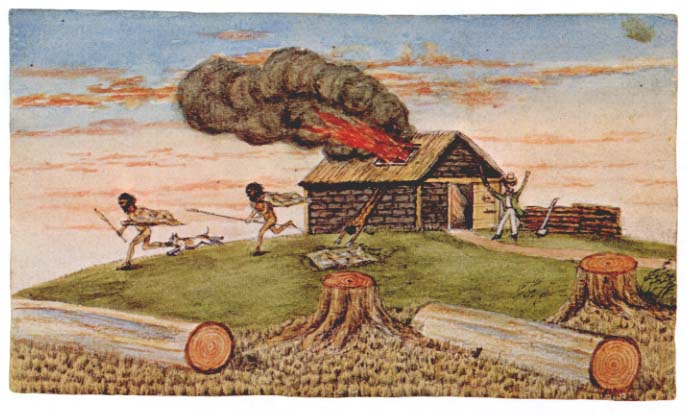 SEE IMAGE painted two years later:Tullamareena escaping from first Melbourne gaol; watercolor by W. Liardet (1840) On 25 April 1838, Tullamareena was arrested for stealing potatoes from John Gardiner’s property in Hawthorn.[1] During his imprisonment he escaped and as a consequence burnt down the first Melbourne gaol along with his friends Moonee Moonee and Jin Jin. William Lonsdale, the first Police magistrate of Melbourne wrote in a letter to the colonial secretary on 26 April 1838: …I was at first apprehensive that some of the blacks had set the gaol on fire…for the purpose of liberating the three who were confined, but to ascertain what I could on this point, I went as soon as I was satisfied that the stores and prisoners were temporarily disposed of after their being taken from the buildings, into the different camps of blacks, of which there were three in the neighbourhood… Describing how the gaol was set fire to, he says that the other black who was confined with him got a long piece of reed which he thrust through an opening in the partition between the place where he was confined in and the guard room, and after lighting the reed by the guard’s candle he drew it back and set fire to the thatch roof. The two blacks got off but one was afterwards retaken, viz. Jin Jin. This affair is much to be regretted, keeping up as it undoubtedly will the public alarm and agitation regarding the blacks. Tullamareena was later recaptured and sent for trial in Sydney by ship. His trial was terminated when it was established he was unable to understand English. He was set free more than 700 km from his home and no records indicate further colonial contact. It is told in Sunbury that upon release he walked back all the way home – to the region around Tullamarine and placed a spell on the land near Tullamarine Airport. He has a Melbourne suburb, its airport and the freeway named after him. -SOURCE https://en.wikipedia.org/wiki/Tullamareena |
| Rented stone building gets used as prison 1838 – April 25th onwards after the hut burns down La Trobe rents stone building [where, within cbd?] to serve as prison while waiting for a temporary (but presumably still custom built and more secure) jail to be built which is started in this year 1838 and [completed in 1840]. (was it imagined to be temporary or did it turn out to not be big enough once built and so is being referred to as temporary once it was decided something bigger was needed again?-where is this new building, I think it was on government block future bourke st west police station) ‘But despite best intentions, its standard of accommodation was terrible: I was yesterday doomed to this miserable hole, closely confined during the whole night with two others in a room scarcely 10 feet square with disgusting atmosphere and the heat about 120 (Fahrenheit) … I have been seriously ill lately and now under Doctor’s hands, who will certify that he believes a few days confinement in this place might cause my death. – anonymous prisoner, circa 1838 -Melbourne’s first gaols https://ergo.slv.vic.gov.au /explore-history/rebels-outlaws/law-enforcement /melbournes-first-gaols#:~:text=Port%20Phillip’s %20first%20gaol %20was,building%20to% 20house%20its%20criminals. |
| 1838 First permanent gaol starts getting built – while rented stone building is being used as gaol An allotment of scrubland to the north-east of Melbourne was selected as Port Phillips first permanent gaol. –https://en.wikipedia.org/wiki/ Old_Melbourne_Gaol#:~:text=An%20allotment %20of%20scrubland%20to,colloquially %20known%20as%20Wintle’s%20Hotel. I’m guessing they mean Russell St hill which is finally opened and now current site of Old Melb Gaol 1 Jan 1845 SOURCE -Melbourne’s first gaols https://ergo. slv.vic.gov.au/explore-history/rebels-outlaws /law-enforcement/melbournes-first-gaols#:~:text=Port%20Phillip’s%20first% 20gaol%20was,building%20to%20 house%20its%20criminals. |
| A VDL bank branch opens in Melbourne 1838 Perhaps the first banking institution in Victoria was The Derwent Banking Company. Founded in Hobart Town, it specified that it conducted general banking business. Opening a Melbourne agency on the 8th February 1838 on the corner of Collins and Queen Streets, where exactly after experimenting with branch banking, it closed in 1849 after bad debts started accumulating on mortgage loans. -SOURCE ‘Melbourne Banks’ https://www.egold.net.au/biogs/EG00066b.htm |
| ad for gunpowder 1838 DEC 29 find out location of shop and if in the grid get reproduction of the ad Gunpowder was commercially sold in gun shops, as seen in an advertisement for J. Blanch’s store in the Port Phillip Gazette on December 29, 1838. Unfortunately, Blanch and his wife would be killed in a tragic accident in December 1839 when a gun went off and ignited his supply. At the time, the government was blamed for a lack of urgency on a safe storage space. SOURCE: A view to a hill (with an explosive secret) 29th July, 2020 By Ashley Smith https://www.docklandsnews.com.au/ history_16633/ |
| 1839 as a year |
| Batman dies from Syphilis, buried in unmarked grave 1839 ‘When Batman died in 1839, he was in debt, and his hilltop house was acquired for Government use. Batman was buried in an unmarked grave and he was largely forgotten’. -SOURCE Unveiling the Layers of Batman’s Hill and Melbourne’s Urban History by Luci Nicholson https://farragomagazine.com/article/farrago/ Unveiling-the-Layers-of-Batmans-Hill-and-Melbournes-Urban-History/ |
| Superintendent La Trobe arrives for job BYO house GOVERNMENT PADDOCK (outside grid) 1839 In 1839 C.J. La Trobe was appointed superintendent of the Port Phillip District. He and his family took up residence in a prefabricated cottage that they had erected near Lonsdale’s house in the government paddock and named ‘Jolimont’. SOURCE Context Pty Ltd 2012, Thematic History: A History of the City of Melbourne’s Urban Environment, prepared for the City of Melbourne. |
| pushing science 1839 …adult education as existed was carried on in the Mechanics’ Institute. The Melbourne Institute had been founded in 1839, and men like Barry and Westgarth had earnestly tried to carry out the vital duty of diffusing knowledge, especially of science, as widely as possible. An excellent up-to-date library had been formed, and regular series of winter lectures on miscellaneous subjects had been given. But though there was hundreds of members and the reading room was used by many more, few mechanics were among them. p352 The Golden Age: A History of the Colony of Victoria 1851-1861 by Geoffrey Serle, 1977 Melbourne University Press. |
Soon after arriving in Melbourne in 1839, Superintendent La Trobe began a program of setting aside public reserves in the township. A block of land on the Western Hill, bounded by
Lonsdale, La Trobe, Queen and William Streets, was reserved as a ‘town square’, and an area east of present-day Princes Bridge and north of the Yarra (present-day Federation Square and Birrarung Marr) was set aside as a proposed reserve for public purposes. The town square was never developed as such, but was used for other public purposes. La Trobe also set aside large areas of parkland ‘for the health and general
enjoyment of the population’. Flagstaff Hill was a popular meeting place.
SOURCE Context Pty Ltd 2012, Thematic History: A History of the City of Melbourne’s Urban Environment, prepared for the City of Melbourne.
- ‘Archives and Collections: George III cartwheel penny’ by Historic Environment Scotland, online here: https://www.historicenvironment.scot/archives-and-research/archives-and-collections/properties-in-care-collections/object/george-iii-cartwheel-penny-1797-18th-century-48188 ↩︎
- Full Steam Ahead! Britain’s Cartwheel Coins by Justin Robinson, The Coins and History Foundation published 11 April 2022 https://coinsandhistoryfoundation.org/2022/04/11/full-steam-ahead-britains-cartwheel-coins/ ↩︎
- Full Steam Ahead! Britain’s Cartwheel Coins by Justin Robinson, The Coins and History Foundation published 11 April 2022 https://coinsandhistoryfoundation.org/2022/04/11/full-steam-ahead-britains-cartwheel-coins/ ↩︎
- ‘1797 Australia’s first coin’ by? note the typo in 1880 date first para should be 1800. https://australianfoodtimeline.com.au/1797-australias-first-coin/ ↩︎
- ‘Penny’ The Royal Mint Museum https://www.royalmintmuseum.org.uk/journal/curators-corner/penny/ ↩︎
- Archives and Collections: George III cartwheel penny’ by Historic Environment Scotland, online here: https://www.historicenvironment.scot/archives-and-research/archives-and-collections/properties-in-care-collections/object/george-iii-cartwheel-penny-1797-18th-century-48188 ↩︎
- Convict Sydney: Cartwheel Penny’ https://mhnsw.au/stories/convict-sydney/cartwheel-penny/ ↩︎
- Convict Sydney: Cartwheel Penny’ https://mhnsw.au/stories/convict-sydney/cartwheel-penny/ ↩︎
 burrows & co